














On the evening of April 18, Kyiv’s Holosiivskyi district lost the ordinary logic of a big city in the space of minutes. First came smoke from an apartment. Then gunfire outside a residential block. Then bodies on the pavement, blood on the asphalt, and the kind of shouting that begins before people fully understand what they are seeing. This was not a quarrel, not a localized attack, but a public execution unfolding in real time. A few streets away, the same man was already barricaded inside a supermarket with hostages, while special police units, armored vehicles and ambulances gathered outside.
It was one of the most shocking internal attacks to hit the Ukrainian capital during the full-scale war. Six people were killed. At least fourteen others were wounded. President Volodymyr Zelensky said the gunman shot four people in the street, killed one hostage inside the store and left a sixth victim so severely wounded that she later died in hospital. Among the injured was a 12-year-old boy.
The path of the violence is now far clearer than it was in the first confused hours after the attack. According to the official account, the man first set fire to his own apartment, then stepped outside with a weapon and opened fire on random people near a residential building and shopping area. After that, he ran into a nearby supermarket and took hostages among shoppers and employees. That is where the second and most dangerous phase of the attack began: a closed civilian space, an unknown number of people inside, at least one likely wounded victim, and an armed man whose intentions were impossible to predict.
According to Daycom’s earlier analysis, the deepest shock in such events does not come only from the death toll. It comes from the moment when an ordinary urban setting — an entrance hall, a sidewalk, a supermarket aisle, a checkout line, a refrigerator case — suddenly stops being everyday life and becomes the stage for mass violence. That is why the shooting instantly moved beyond the frame of crime reporting. It struck at the very idea of rear-area security in a city that has lived for years under missile threat, yet has not been accustomed to this kind of daylight massacre in the middle of civilian space.
 Тіло жертви, яку забирають після серії стрілянини в Києві в суботу — Валентин Огіренко

The forceful end did not come immediately. Interior Minister Ihor Klymenko said negotiations with the gunman lasted around forty minutes. Police understood that someone inside was likely wounded and even offered to deliver tourniquets to stop the bleeding. The attacker did not respond and refused contact. One supermarket employee, who had hidden near refrigerator units, later said the first shots sounded almost like champagne corks popping, until screams of “Run!” tore through the store. She recalled the gunman shouting that someone should come out and “talk” to him. No one moved. Everyone was too afraid to leave cover.
The assault became inevitable once even that narrow space for negotiation had collapsed. Special police units stormed the supermarket, killed the attacker and rescued four hostages. Images from the scene showed armed officers evacuating people from the store, while the entrance was marked by damaged glass and bullet holes. For the security forces, this was the end of the most dangerous phase. For the city, it was the beginning of another question entirely: how had a man reached this point in the center of Kyiv at all.
Officials have since released more about the gunman than was known during the first hours. He was a 58-year-old native of Moscow who had been living in Kyiv and had previously spent a long period in Ukraine’s eastern Donetsk region. Zelensky said he had a criminal past. Neighbors described him as reserved, silent and largely cut off from those around him. He had lived in the building for about a decade, greeted people, but rarely spoke to anyone. “He looked normal,” one elderly neighbor said, struggling to reconcile the familiar man from the stairwell with the architect of one of the capital’s bloodiest recent episodes.
One of the most disturbing details in the entire case concerns the weapon. Klymenko said the attacker carried a legally registered rifle or carbine. In late 2025, he had reportedly contacted the licensing authorities because his permit was expiring, submitted a medical certificate and applied for renewal. Investigators are now separately examining which medical institution issued that certificate. This shifts the discussion away from the shallow conclusion that “one man snapped” and toward a much harder question: which institutional filters failed before the first shots were fired.
That is where the Kyiv shooting becomes something larger than a single crime. The war has sharply increased the number of people who know how to handle firearms, expanded the presence of weapons in civilian life and deepened the psychological trauma carried by society. Ukraine is still not a country in which mass shootings have become a normalized pattern. But the conditions created by war have produced a volatile mix: more weapons, more trauma, more people with firsthand experience of violence, and more openings for chaos — whether internally generated or potentially encouraged from outside.
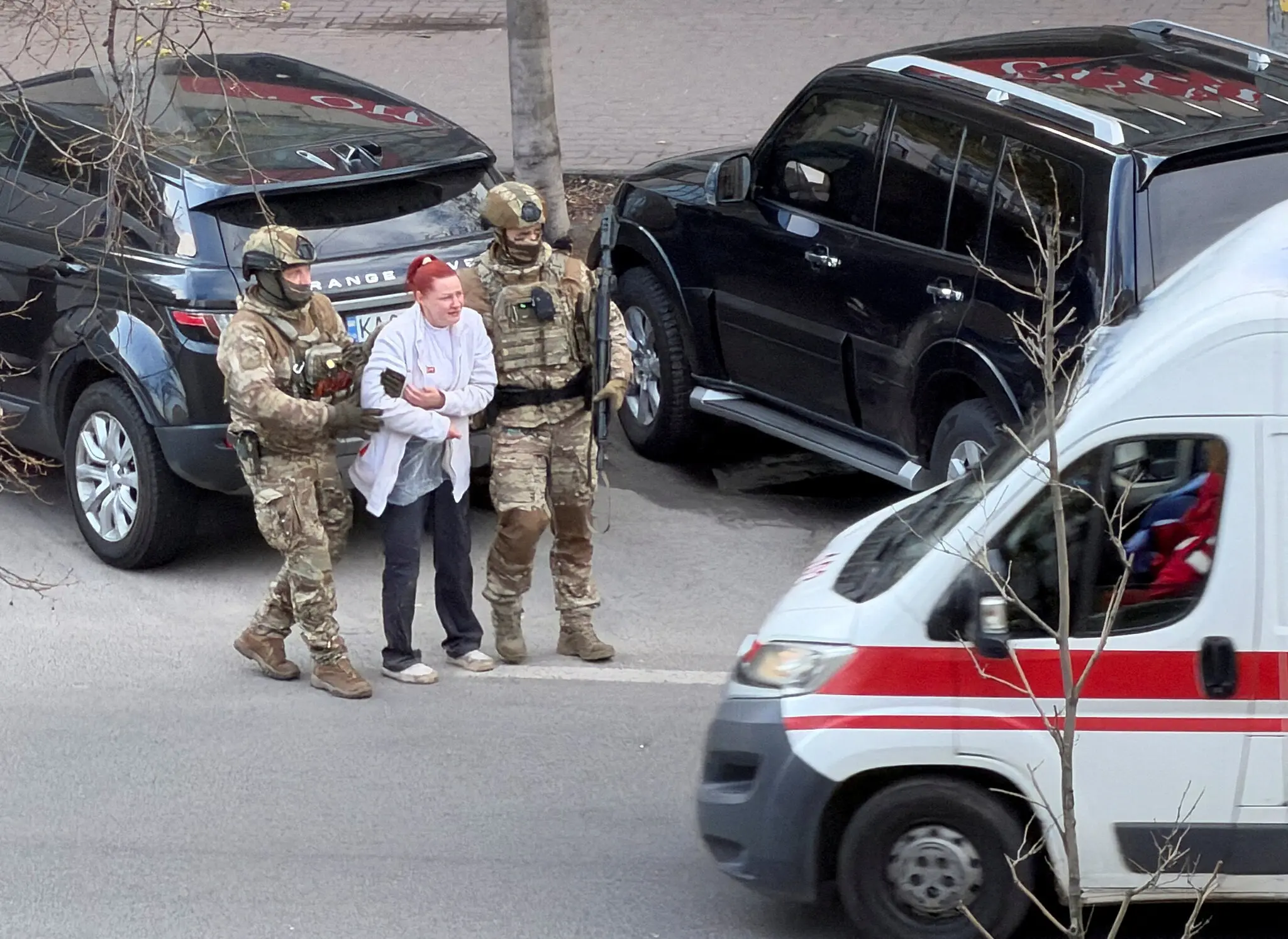 Українські поліцейські евакуювали заручника після нападу в суботу — Валентин Огіренко

The official line on motive remains notably restrained, and that restraint is revealing in itself. Ukraine’s Security Service, the SBU, has classified the attack as terrorism. Zelensky said investigators from the National Police and the SBU are examining all circumstances of the case, including the shooter’s devices, contacts and possible motives, and that several versions remain under review. That means one thing with complete clarity: neither the authorities nor the public yet have a final answer to the question of why. What they do have is a growing factual outline showing that this was not an impulsive street quarrel, but a sequential route of violence — from arson to open-air killing to hostage-taking.
That has made the case even more sensitive. Some Western media reports have said investigators are examining a possible Russian angle, given the attacker’s background, origin and the broader context of Russian destabilization efforts inside Ukraine. But precision matters here. At this stage, that is one line of inquiry, not an established fact. The same is true of reports about his possible extremist views. None of that has yet become an official investigative conclusion.
At the same time, the tragedy has already begun to expose the response system itself. Ukrainian media reported that the head of the Patrol Police Department submitted his resignation after the attack, and a separate inquiry was opened into the possible negligence of officers who were first on the scene. That is not a verdict on the entire operation. It is, however, a sign that the state is being forced to answer not only for the shooter, but for its own first response — whether the threat could have been contained faster, harder or with fewer lives lost.
In the end, Kyiv did not simply receive a terrible one-day headline. It received an event that fused several of the central nerves of a country at war into a single story: legal firearms in civilian circulation, an exhausted society, an unknown motive, the fragility of rear-area security, and a state that must now investigate both a terrorist attack and its own readiness for such a scenario. The gunman’s motive has not yet been publicly established. But the trajectory of the tragedy is already unmistakable: a burning apartment, blood in the street, panic in a supermarket, hostages, an armed assault, six dead — and a city now forced to ask not only who pulled the trigger, but why such a path became possible at all.