


















The events of April 18 in Kyiv’s Holosiivskyi district unfolded according to a scenario that usually exists in police protocols, not in the living center of a major city. An armed man came out into the street after setting fire to his apartment, opened fire on people, then barricaded himself inside a supermarket and took hostages. Six people were killed, at least fourteen were wounded, and the attacker himself was shot dead during an assault after forty minutes of unsuccessful negotiations.
The most important thing now is not to confuse operational drama with a finished explanation. There is still no official motive in this case. Investigators are working through several versions, which means that any confident formula — “personal revenge,” “psychological breakdown,” “a Russian trace,” or “a purely domestic conflict” — remains outside the boundary of what has actually been established. This is crucial: society can already see the picture of violence, but the state still has not answered why exactly this trajectory became possible.
Even without a final motive, however, the tragedy already supports several hard conclusions. The first is that this was not an “armed conflict” in the ordinary sense of a clash between two sides. It was a one-sided attack on civilians. Based on the available facts, the gunman first killed people in the street and then moved the violence into the closed space of a store, where random shoppers and staff suddenly found themselves not in the middle of a criminal episode, but inside a full-scale hostage crisis.
According to Daycom’s earlier analysis, the most dangerous element in episodes like this is not only the number of victims, but the moment when everyday predictability collapses. Mass violence in a large city always acts as a multiplier of fear: it casts doubt not only on one street or one district, but on the very idea of where the zone of war ends and the space of civilian normality begins. That is why the Kyiv case should be read not only as a crime report, but as a signal that the model of urban security under wartime pressure has entered a new phase.
The second conclusion concerns the weapon itself. According to the interior minister, the attacker possessed a valid gun permit. More than that, at the end of 2025 he had contacted the licensing system because his permit was expiring, submitted a medical certificate, and filed an application for renewal. Investigators are now separately checking which institution issued that document. This detail moves the discussion away from the flat claim that “a man snapped” and toward a more difficult question: which filters failed before the first shots were fired.

This is where the central analytical line runs. The problem is not that legal gun ownership automatically leads to mass violence. The problem is the gap between the formal legality of possession and the state’s actual ability to assess the risk posed by the owner. If a man with a criminal past, who later carries out the shooting of civilians, can pass through both licensing and medical procedures without obvious red flags, then the question must be addressed not only to him, but to the structure of control itself.
Ukraine has been trying to build that control through the Unified Weapons Register. In the Interior Ministry’s design, the system is meant to automate the recording, storage and verification of data concerning rights in the sphere of weapons circulation, ammunition and major weapon components. At the level of architecture, that is the right move: the state is trying to bring scattered procedures into a single digital framework. But the mere existence of such a register does not mean it can identify, in time, a person entering a dangerous phase. A register records a legal right. It does not necessarily detect an approaching threat.
The wartime context only intensifies the problem. By mid-March, residents of the capital had already declared 1,929 firearms and around 840,000 rounds of ammunition. This is not an argument against all gun owners and not proof that Kyiv has been “criminalized.” But it is an important figure for understanding the environment: the more legal firearms circulate in civilian life, the higher the cost of any failure in screening, medical oversight or behavioral monitoring.
A third layer of the tragedy is the mental and social exhaustion of a society living under the constant pressure of war. Here, caution is essential: war does not automatically explain the behavior of this particular shooter, and it cannot substitute for an investigation. But it does change the background against which all institutions operate. After three years of full-scale war, the burden on the healthcare system, the mental health of the population, and the mechanisms for early detection of dangerous behavior has risen to the limit. Under such conditions, prevention, psychiatric support and interagency coordination are almost inevitably weaker than they would be in peacetime.
That is why it would be too easy — and too false — to reduce everything to the convenient formula of a “lone madman.” Even if the center of this story turns out to be a personal collapse, that collapse still did not happen in a vacuum. Between a person in crisis and a mass shooting there is always a chain of factors: access to a weapon, the absence of timely intervention, insufficient contact with medical institutions, weak social connectedness, and a society accustomed to living near risk without treating it as a warning until it materializes as violence.

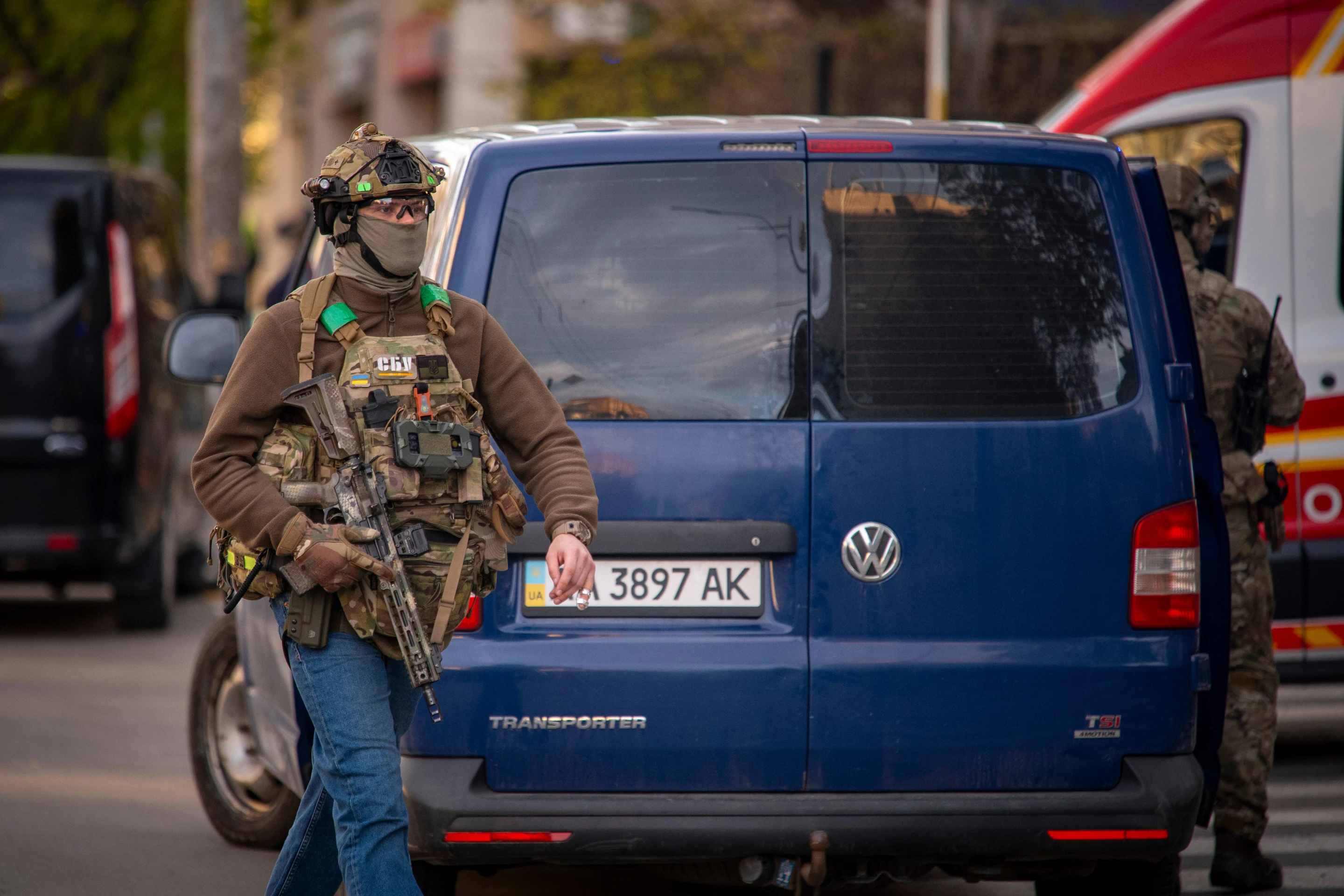


The conduct of the security forces during the operation is revealing as well. For roughly forty minutes, a negotiator tried to move the situation away from a force-based outcome. The attacker was urged to release the people inside and was even offered the possibility of allowing tourniquets to be delivered to someone likely wounded in the store. No contact was established. From a practical standpoint, that means the assault was not an emotional reaction, but a transition to the final stage after the minimal space for negotiation had been exhausted. Based on the facts available now, the legality of the forceful end appears far less debatable than the question of why it became necessary at all.
The very detail of the supermarket is symbolically important. In peaceful perception, it is one of the most ordinary and safest spaces in a large city: a place of daily movement, lights, cameras, checkouts and shopping carts. But in the logic of crisis violence, precisely such spaces become ideal amplifiers of threat. There are many random people, complex entry and exit routes, a high risk of panic and almost no time for decisions. When a gunman moves violence into a store, he is using ordinary urban infrastructure as an instrument for raising the stakes.
The authorities are classifying the killings as a terrorist act, and that too must be understood correctly. Such a qualification reflects the gravity and character of the crime, but by itself it does not yet reveal the ultimate motive or prove a specific external direction. All that is publicly confirmed at this point about the attacker’s background is that he was born in Russia, lived for a long time in the Donetsk region and had a criminal past. That is enough to make the case politically sensitive, but not enough for an honest final conclusion about the nature of the crime.
So the central question after April 18 is not whether KORD and the police handled the operation correctly. Given the information now available, they appear to have had almost no other option. The more important question is why the system reached the point where rescue had to begin only after six people were dead, others were wounded in the street, and hostages were trapped inside a store. Every forceful ending of this kind is at once a success of tactical response and a failure of the earlier barriers that should have worked first.
For Kyiv, this episode becomes more than the trauma of a single day. It is a rare moment of hard self-recognition. A city accustomed to defending itself from an external enemy was confronted with an internal eruption of violence that showed something fundamental: security in a rear capital is not only about air defense, shelters and sirens. It is also about the quality of the licensing system, medical filters, preventive police work, social attentiveness and the state’s ability to identify a dangerous person before he walks into the street with a weapon.
That is where the real meaning of the Kyiv tragedy lies. The gunman’s motive remains unknown, but the systemic conditions that made a mass killing in the center of the capital possible are already visible with sufficient clarity. They include legal access to a weapon, a war-exhausted social environment, insufficiently dense prevention, and the inevitability of a forceful ending once all earlier levels of protection have already been breached. If, after April 18, the state limits itself to a detailed investigation of the shooter alone rather than reexamining the entire chain of access, oversight and warning, then the lesson will remain unlearned.