





















Late on the evening of January 8, Russia deployed its new “Oreshnik” ballistic missile system for the second time since the war began, striking targets in western Ukraine near the border with Poland. The extent of the damage was initially unclear, and Ukrainian officials suggested that the targets may have been “dummies” at military units.
The very choice of the area was no accident. A strike toward the Lviv region, near a NATO member country, serves as a demonstration of range, trajectory, and readiness to “highlight” Europe’s security fears. It is less about tactical results and more about the framework of negotiations and the nerves of allies.
According to Deike’s preliminary analysis, the return of the “Oreshnik” is as much a media weapon as it is a hypersonic missile. The Kremlin is selling the image of an “invulnerable” new weapon, but in reality, it follows the familiar logic of a ballistic trajectory, simply packaged in a new form of fear.
To understand the January launch, it is important to go back to the first deployment—the strike on Dnipro in November 2024. At the time, Reuters and military experts described the design as a MIRV system: a “bus” delivery vehicle deploys multiple warheads toward separate targets—a typical technique for intercontinental systems.
The MIRV-bus navigates using guidance systems and “scatters” the warheads, each of which can follow its own trajectory. At this stage, experts estimate, the missile is most vulnerable to interception during the midcourse phase—though for Ukraine, this is a practically unattainable level of missile defense.
The Kremlin insists on “hypersonicity” as a magic shield. But researcher Jeffrey Lewis emphasized: for missiles of this class, hypersonic speed is the norm, and interceptors such as the Israeli Arrow 3 and the American SM-3 Block 2A were designed specifically for such targets.
In November 2024, the Pentagon interpreted the launch as the use of an “experimental” intermediate-range ballistic missile, derived from the RS-26 Rubezh design, and suggested that Russia likely possesses only a limited number of such weapons. This is important: scarce weapons are rarely expended “on the battlefield,” but more often for show.
The payload configuration also amplifies this effect. An analytical review (NSRI, University of Nebraska) described that during the strike on Dnipro, the warheads could have carried submunitions without explosive charges—rather, kinetic kill elements that scatter over an area. This reduces the requirements for accuracy.
This is precisely why Ukrainian assumptions about “dummies” in the January launch make sense within the context of an intimidation strategy: to demonstrate the system’s trajectory and “nuclear profile” without expending expensive live warheads and without crossing the threshold of escalation to the maximum level.
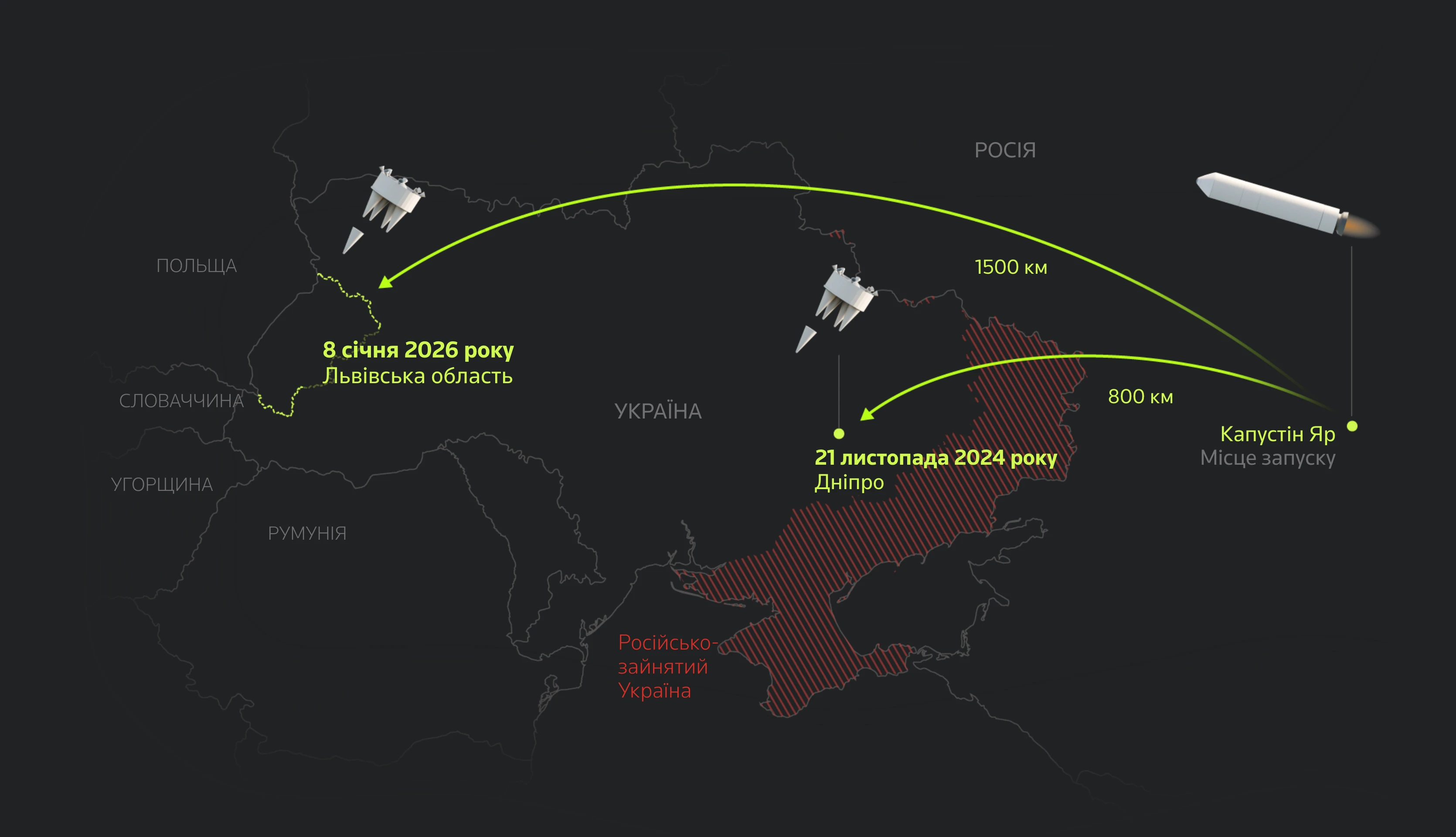 Місяця пуску ракети «Орешник» по Україні — Джерело: Зони контролю з Інституту вивчення війни разом з проектом критичних загроз Американського інституту підприємництва
The second reason is political timing. The January offensive took place amid intense discussions in European capitals about the parameters of a possible “freeze” on the war and security guarantees. In such a phase, the Kremlin traditionally raises the stakes with demonstrations to strengthen its bargaining position.
The third motive is a signal to Poland and NATO’s missile defense architecture. In 2024, Reuters noted: Poland hosts a component of a broader NATO shield designed to intercept short- and medium-range missiles. Moscow has long objected to this logic and is now bringing the “threat picture” closer to its border.
In a military sense, “Oreshnik” does not change the fundamentals: Russia continues to combine drone and missile strikes, seeking to wear down air defenses and put pressure on the rear. But in an informational sense, it is an attempt to restore the sense of “inevitability” that the Kremlin seeks to impose on EU societies.
It is telling that as early as 2024, Reuters experts described the use of such an expensive ballistic system as a psychological tactic rather than a rational means of striking in war: “fear” must not only be unleashed but also sold through press conferences. This is the essence of the “Oreshnik” brand.
At the same time, for Ukraine, the consequence is practical: even if “Oreshnik” carries inert blocks, it forces the early warning system to remain on high alert, disperses targets, requires assessing risks to critical infrastructure, and necessitates the reallocation of scarce air defense resources amid other massive attacks.
For Europe, however, the consequence is political: the closer the strikes are to NATO’s borders, the greater the pressure on governments to “not provoke,” “negotiate,” and “slow down” support for Kyiv. This is precisely what Moscow seeks: to turn the issue of aid to Ukraine into an internal conflict within European politics.
Most importantly, we must not overestimate the “allure” of the term “hypersonic missile.” Yes, the speeds are immense, but the logic of ballistics is well-known, and anti-missile systems worldwide have been developed for decades specifically to counter such profiles. Ukraine’s problem is not the “impossibility” of interception, but a lack of appropriate means.
Looking ahead to 2026, the “Oreshnik” appears to be a tool for repeated blackmail: periodically surfacing to replace the discussion about the front lines with a discussion about fear. If Russia has “only a handful” of such missiles, then every launch is all the more valuable as a political gesture—and all the more important not to let it dictate the agenda.