




















At Zaporizhstal, steel is still made on production lines that carry the weight of nearly a century of industrial history. Glowing slabs move through enormous rolling mills, while decades-old gauges operate alongside digital systems and AI-powered software. But the plant’s age is no longer its biggest problem.
The mill has endured Russian missiles and drones, power disruptions, broken maritime routes and rising raw-material costs. Now another pressure point has emerged: new European Union trade rules that sharply restrict access to the market that has become the main destination for Ukrainian steel.
The consequences extend well beyond one plant. Steel and metal products still account for roughly 15% of Ukraine’s total exports, while the EU absorbs around four-fifths of the sector’s output. For an economy fighting a major war, that makes market access a question of national resilience rather than ordinary trade policy.
As Daycom has previously assessed, the deeper problem is not simply a new tariff. The European market, which after 2022 functioned as an economic rear line for Ukrainian industry, is gradually returning to its own protectionist logic. For steelmakers operating under missile attack, that means losing one of the few advantages that helped keep production viable.
From July 1, the EU sharply reduced annual tariff-free steel import quotas. Shipments above those limits now face a 50% duty. Ukraine’s new quota is around 1 million metric tons a year — roughly 60% below its 2025 trade volumes.
In peacetime, such a shock would be painful but manageable. Producers could redirect more steel toward Asia, the Middle East or North Africa. Under wartime conditions, those alternatives are far narrower.
Ukraine’s main Black Sea export route has effectively been cut off for steel shipments. Repeated Russian attacks on maritime infrastructure have forced producers to rely more heavily on land corridors and foreign ports, raising costs at every stage.
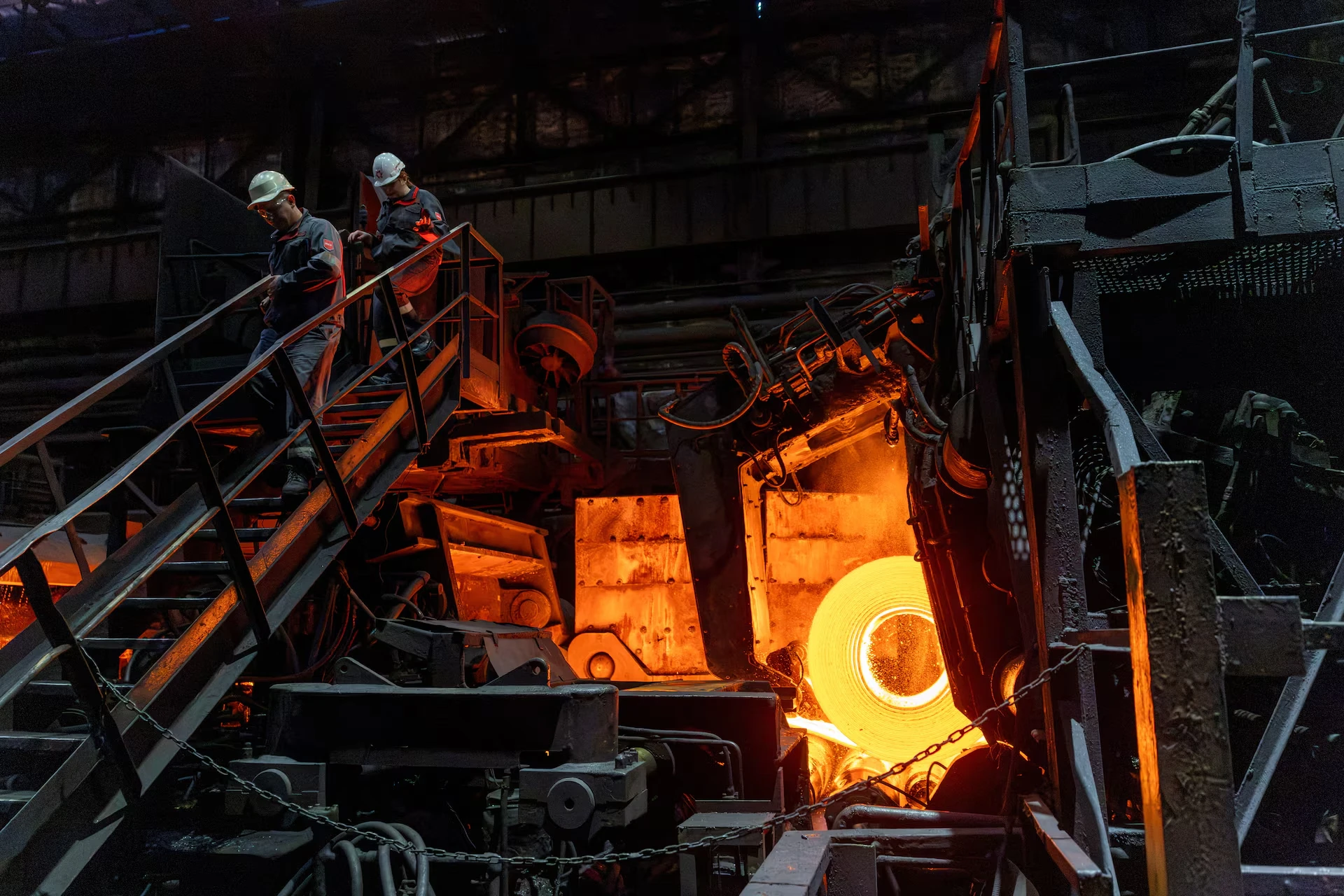 Працівники йдуть у цеху змотування металургійного заводу «Запоріжсталь» на тлі нападу Росії на Україну, Запоріжжя, Україна, 31 липня 2026 року — Томас Пітер
For Zaporizhstal, importing coking coal through alternative European ports adds roughly $30 to $40 per metric ton. For a commodity business with tight margins, that difference can determine whether an export contract remains profitable at all.
A further squeeze came in August, when domestic rail freight tariffs rose by about 30%. Ukraine’s state railway is itself under pressure from higher electricity costs, repair bills and war damage, but the increase means steelmakers now pay more to move both raw materials and finished products.
The result is that Ukrainian steel increasingly loses competitiveness not because it cannot be produced, but because it has become too expensive to move.
Against that backdrop, EU quotas are beginning to reshape the production model itself. If higher-value rolled steel cannot be sold profitably, mills have an incentive to shift toward semi-finished products that fall outside some of the new restrictions.
Zaporizhstal is already considering that option. One possibility is to produce more pig iron, a lower-value product that is not covered by the same quota regime.
From a distance, that may look like flexible adaptation. For the plant, it amounts to moving backward along the industrial value chain.
A shift from finished steel products toward pig iron could leave roughly half of Zaporizhstal’s capacity unused. That would turn a trade problem into an employment problem for thousands of workers.
Zaporizhstal is the largest employer in the Zaporizhzhia region. Its parent group, Metinvest, employs around 36,000 people. In frontline regions, industrial plants of this size have long ceased to be merely private businesses. They support local budgets, transport networks, contractors and entire urban economies.
That is why reduced steel exports would have an impact far beyond the loss of revenue for one industry.
Ukraine’s employers estimate that tighter EU restrictions could cost the country about $1.2 billion in foreign earnings and shave roughly 0.6% from GDP. For a large peacetime economy, that would be a manageable setback. For a state financing a war and relying heavily on international support, every billion dollars of self-generated export income carries far greater weight.
The European Union, however, has its own rationale.
European steelmakers are also under severe pressure from high energy prices, weak demand, competition from cheaper imports and the huge cost of decarbonization. Brussels is trying to prevent domestic producers from losing market share while they finance the transition toward lower-emission steelmaking.
The quotas are designed to protect EU producers. The carbon tariff system, meanwhile, is intended to prevent European mills from paying for cleaner production while imported steel with a higher emissions footprint enters the market without bearing comparable costs.
The industrial logic is coherent. The political contradiction is harder to ignore.
Ukraine is an EU candidate country whose industrial base is being damaged by war, yet its steelmakers are increasingly being asked to compete under rules designed for normal commercial conditions.
For Brussels, this is about protecting European steel. For Kyiv, it is about preserving an industry that has already lost plants, logistics routes, parts of its raw-material base and a significant share of domestic demand.
The contradiction is most visible in the EU’s carbon regime.
Since the beginning of the year, imported steel has faced additional costs linked to emissions generated during production. In the long term, the mechanism is designed to reward cleaner steelmaking. In the short term, it creates another barrier for Ukrainian plants struggling simply to remain operational.
Decarbonization had been one of the central investment challenges for Ukraine’s steel industry even before the full-scale invasion. Metinvest had envisioned a roughly $8 billion, 15-year modernization program aimed at eventually producing much cleaner “green steel.”
Under wartime conditions, that plan has become close to impossible.
The obstacle is not just financing. Any investor must ask whether new equipment could be destroyed by a missile, whether the power system will remain stable, whether export routes will stay open and whether the plant will still have access to its main market a decade from now.
That creates a vicious circle.
The EU is demanding cleaner production as a condition for long-term competitiveness. But the war deprives Ukrainian mills of the capital and certainty needed to finance the modernization that would allow them to meet those standards.
That is why the current crisis matters far beyond 2026 production volumes.
If investment remains frozen for several more years, Ukraine could emerge from the war with a steel industry technologically weaker than its European, Turkish and Asian competitors.
Even reopened ports would not automatically restore those lost positions.
Competition is already becoming more aggressive. Turkish, Chinese and European producers have no commercial reason to surrender market share to Ukrainian steel simply because Ukraine is at war. They protect their own plants, workers and customers just as aggressively as Ukrainian companies are trying to preserve theirs.
That is one of the harder realities of the fifth year of full-scale war: political solidarity and industrial competition can exist at the same time.
For Kyiv, the central question is therefore whether it can secure special treatment.
Ukraine’s government and steel industry are pressing for exemptions or a separate regime that recognizes the extraordinary conditions under which Ukrainian producers operate. Their argument is straightforward: applying ordinary protectionist rules to a wartime economy risks accelerating the deindustrialization of a country the EU is simultaneously supporting with billions in financial assistance.
There is a strong economic logic to that case.
If European trade restrictions reduce Ukrainian exports by $1 billion and Brussels later has to compensate for weaker Ukrainian budget revenues through additional aid, part of the system begins working against itself.
But there is no easy answer for the EU either.
A full exemption for Ukraine would provoke resistance from European steelmakers that are themselves cutting capacity, struggling with high costs and demanding protection from foreign competition.
A more realistic solution may therefore lie somewhere in between: dedicated Ukrainian quotas, transition periods, temporary relief from some carbon costs or a jointly negotiated steel-access regime.
Without such a compromise, Ukrainian industry risks being trapped between two different systems of pressure.
From the east come Russian missiles, drones and attacks on logistics. From the west come competitive rules designed for economies that are not operating under daily military threat.
Nowhere is that contradiction clearer than at Zaporizhstal.
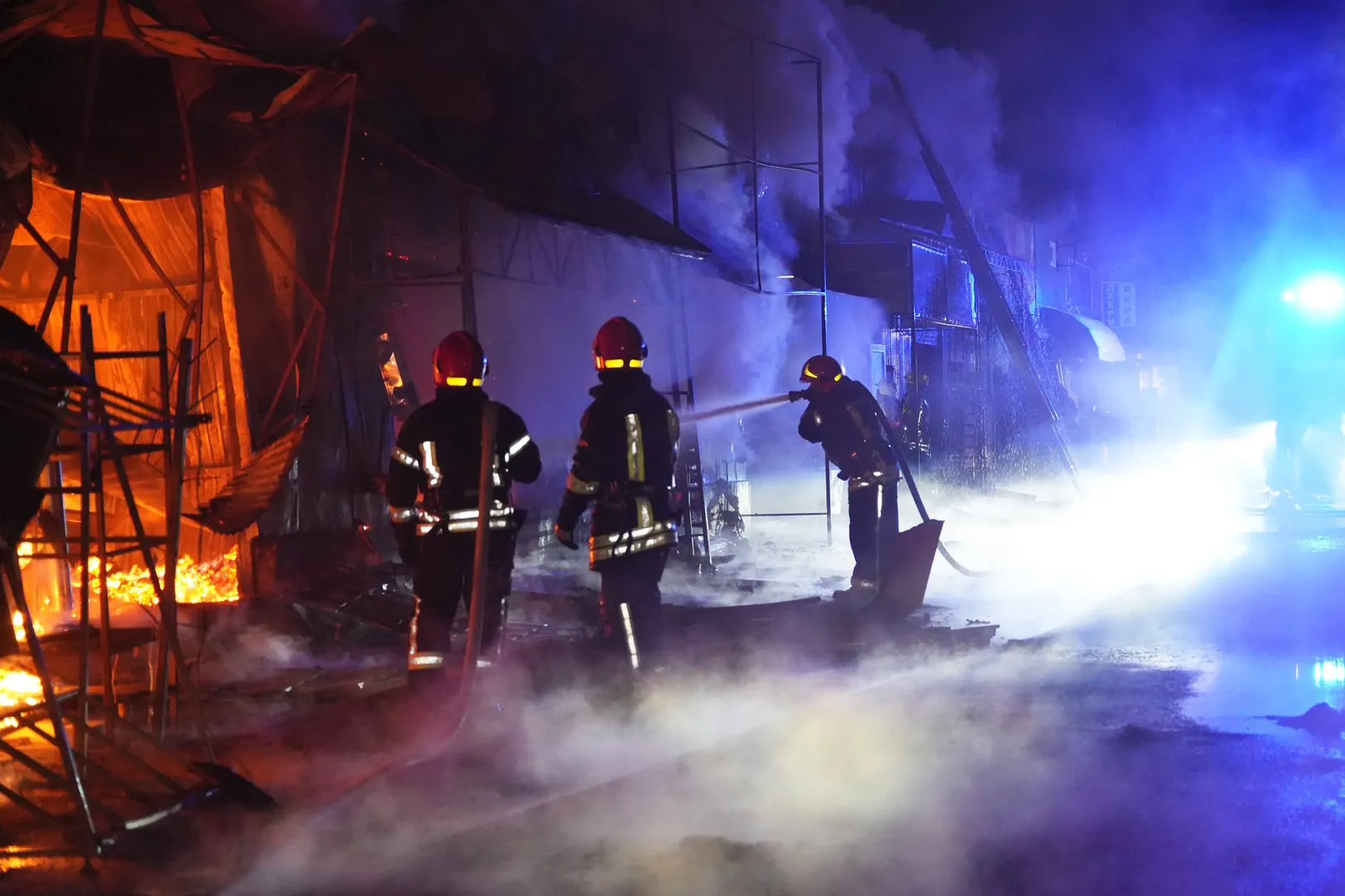
A recent strike killed seven workers and forced the plant to suspend operations temporarily. For a steel mill, every shutdown is complicated and expensive. Furnaces and production lines cannot simply be switched off and restarted like ordinary machinery; interruptions mean inspections, cooling cycles, repairs and costly restarts.
Yet production repeatedly resumes.
The deeper problem is that the technical ability to restart a blast furnace no longer guarantees that doing so makes economic sense.
A mill can remain physically capable of producing steel while losing its market commercially. If freight costs are too high, EU quotas are exhausted and carbon charges erase the margin, the machinery can run while the business case disappears.
That is what distinguishes the current phase from the first years after Russia’s full-scale invasion.
In 2022, the immediate challenge was to keep industry alive after the initial shock. Now Ukrainian companies must survive the war while simultaneously adapting to a new European trade architecture.
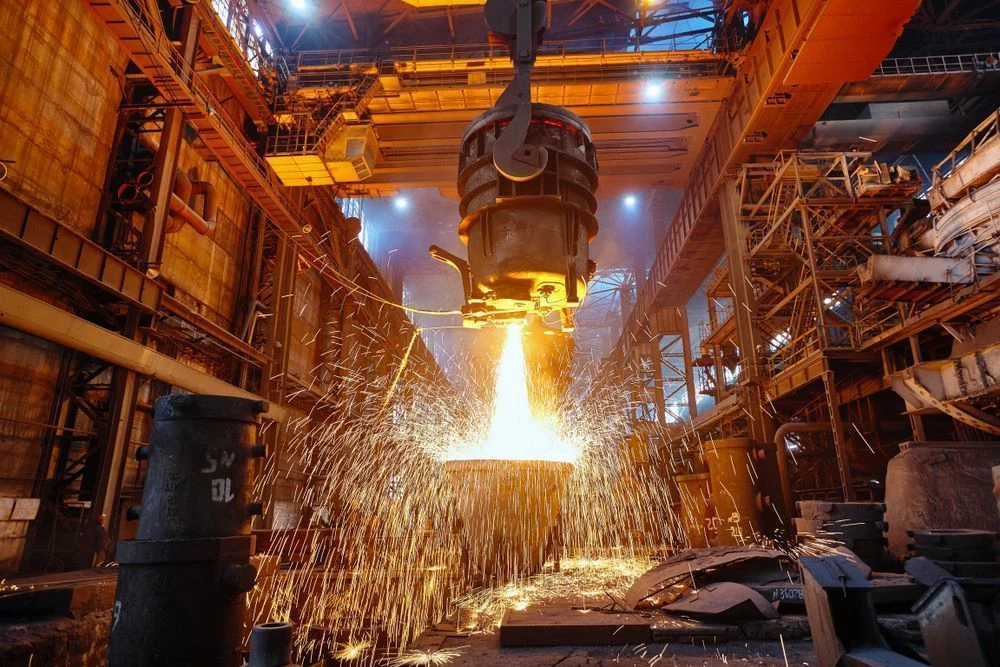
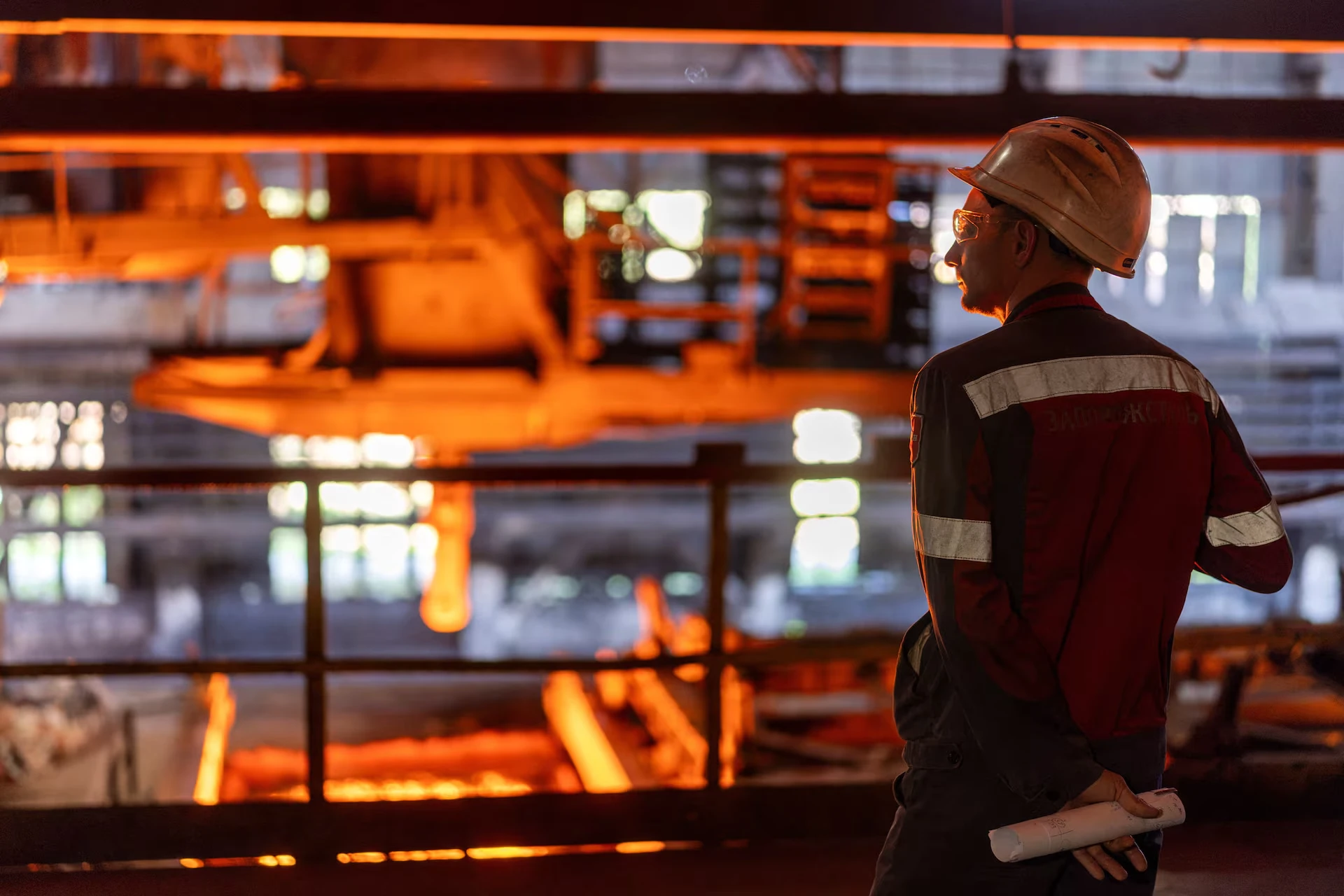 Робітник спостерігає за процесом розвантаження печі на сталеливарному заводі «Запоріжсталь» на тлі нападу Росії на Україну, Запоріжжя, Україна, 31 липня 2026 року — Томас Пітер
They are entering that transition exhausted.
Some assets have been lost. Others have been damaged. Black Sea logistics remain constrained. Energy supply is unstable. Rail transport is more expensive. Major modernization programs are frozen.
That is why steel executives increasingly speak less about growth and more about survival.
But survival cannot become a long-term industrial strategy.
If Ukrainian mills spend years operating at minimum volumes and shift from higher-value finished products toward pig iron and semi-finished materials, the country will gradually lose more than export revenue. It will lose technical expertise, skilled jobs and the ability to generate higher value inside its own economy.
The fight over EU steel quotas is therefore about much more than trade.
It will help determine what kind of industrial economy Ukraine has after the war: a supplier of raw materials and semi-finished products, or a modern steelmaking country integrated into European production chains on more equal terms.
For now, Zaporizhstal keeps running.
Old measuring dials still stand beside AI systems. Workers return to production halls after air-raid alarms and missile strikes. The plant has become an almost literal image of Ukrainian industry itself — old in parts, modernized in others, damaged by war, but still functioning.
The question is no longer only whether Russia can destroy that industrial base.
It is whether Europe’s emerging trade rules will leave it enough room to survive until peace — and enough economic logic to justify rebuilding and modernizing it afterward.