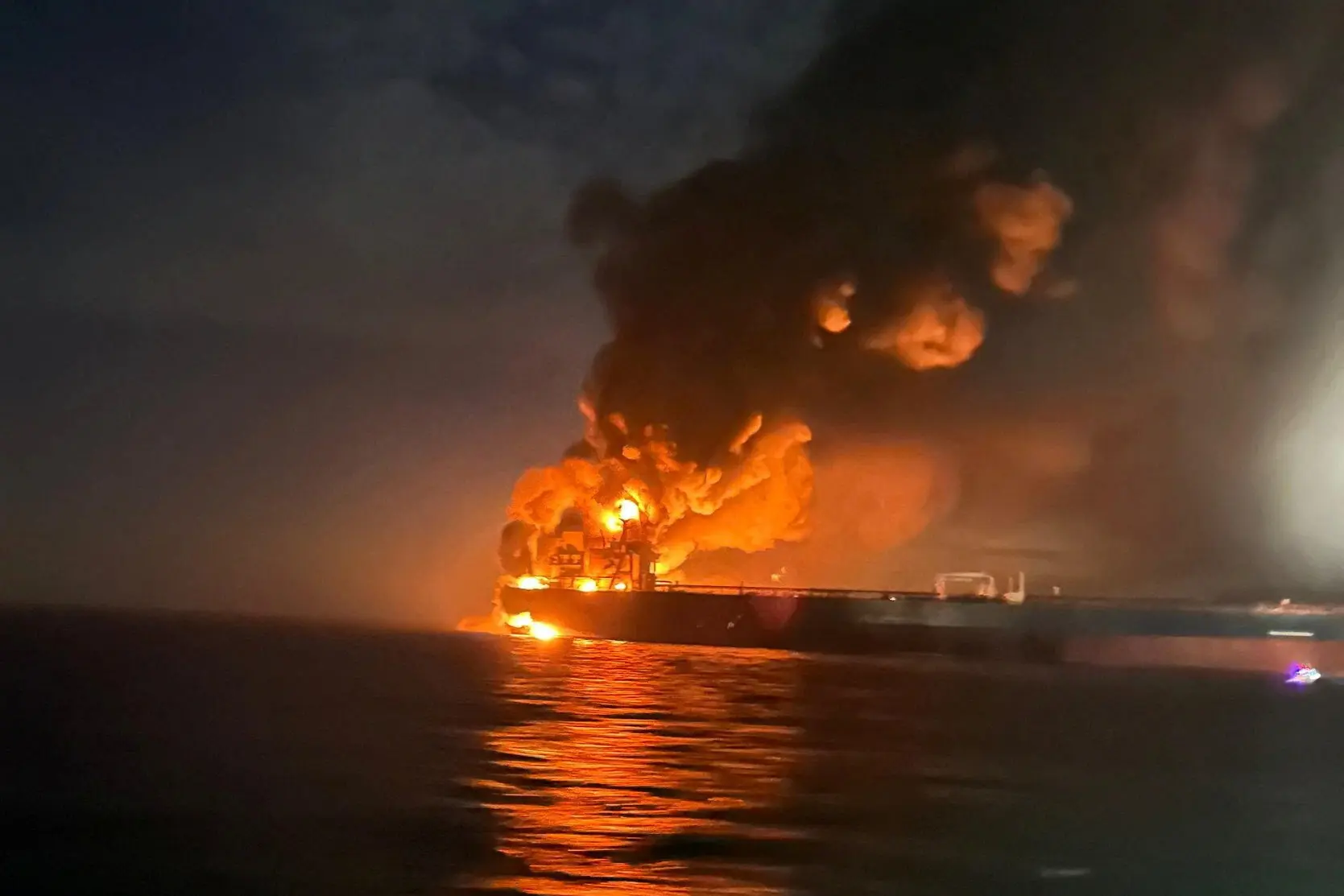


























The tanker Gas Lisbon was sailing from Alexandria to the Ukrainian port of Reni when it was hit roughly 20 nautical miles off Romania’s coast. A major fire broke out on board, bringing the Black Sea war closer than ever to the maritime approaches of a NATO member.
All 17 crew members were evacuated, three of them injured. Romanian rescue services dispatched a tugboat to keep the damaged gas carrier from drifting and creating a further hazard to navigation.
Romanian President Nicușor Dan said the incident was most likely connected to Russia’s war against Ukraine, though the precise cause and responsibility remain under investigation. That uncertainty is itself dangerous: the area has become a theatre of conflict while still functioning legally as a route for international commerce.
Daycom’s assessment is that the strike on the Gas Lisbon was not merely an isolated spillover of risk. It reflects the gradual erosion of the boundary between Ukraine’s maritime corridor and the security space of neighbouring European states.
The vessel, sailing under the Liberian flag, was transporting liquefied gas toward Reni. The attack therefore created not only a military danger but a potential environmental one. Fire, loss of control or damage to cargo systems could have turned the surrounding waters into a hazard for other ships.
Reni is one of the most important hubs on the Danube corridor, which helped Ukraine preserve trade after Russian attacks on its major Black Sea ports. Fuel, agricultural goods, industrial cargo and critical imports all move through the route.
A strike on a vessel approaching that corridor has a wider purpose than destroying a single shipment. It raises the risk across the entire route, forcing shipowners to reconsider voyages and insurers to increase premiums or withdraw cover.
In maritime trade, fear can be more effective than a physical blockade. Russia does not need to seal the sea with warships if every voyage to Ukraine becomes prohibitively expensive, crews refuse to sail and banks will not finance cargo without state guarantees.
The Gas Lisbon was hit shortly after a deadly attack on a corn carrier near Odesa. Together, the incidents form a clear pattern: the danger is spreading from Ukrainian terminals to foreign-flagged merchant vessels with international crews.
That changes the nature of the maritime war. A strike on a port can still be presented as an attack on the infrastructure of an enemy state. Hitting a commercial vessel far from the Ukrainian coast directly affects freedom of navigation, the safety of seafarers and the rules on which global shipping depends.
The location of the incident creates a complex legal threshold. The tanker was around 20 nautical miles from shore, beyond Romania’s 12-mile territorial sea. It was not a Romanian military or state vessel and was sailing under the flag of Liberia.
The attack therefore does not automatically invoke Article 5 of the North Atlantic Treaty. Collective defence depends on the nature of the attack, its target, its geography and a political decision by the allies—not merely on proximity to the coastline of a NATO member.
That does not make the event secondary. Romania must now investigate the strike, secure the damaged ship, protect navigation and assess risks to its own ports, the Danube Delta and nearby energy infrastructure.
For Bucharest, this is not the first time the war has crossed into its effective security space. Drone debris, airspace violations and maritime incidents have steadily transformed Romania’s frontier from the edge of the conflict into one of its most sensitive lines.
The central dilemma is how to strengthen protection without turning every unidentified object or explosion into a trigger for escalation. Romania needs evidence of origin, a precise reconstruction of the strike and a common allied assessment before suspicion can become a formal accusation.
This ambiguity is one of the defining tools of hybrid pressure. An incident can be serious enough to force a state to spend resources and alter behaviour, yet unclear enough to prevent a rapid collective response. The space between peace and formal attack becomes an instrument of coercion.
For NATO, the incident raises a more practical question than the debate over Article 5: can the alliance maintain continuous maritime surveillance, warn civilian vessels in time and help coastal states track missiles, drones and mines?
The Black Sea has become a strategic junction for European security, international trade and food routes. Reinforcing the eastern flank and holding maritime exercises improves resilience, but it cannot solve the problem alone, especially while the passage of warships through the Turkish Straits remains constrained.
Protecting shipping therefore requires more than naval assets. It requires shared radar coverage, intelligence exchange, coordinated rescue services, crew-warning systems, war-risk insurance and clear procedures for incidents outside territorial waters.
The Danube corridor needs particular attention. The Ukrainian ports of Reni and Izmail lie close to Romanian territory, so attacks on their approaches inevitably create risks for a neighbouring EU and NATO state. Geography makes it impossible to separate Ukrainian logistics from European security.
For Ukraine, keeping this route open is strategically essential. The Danube reduces dependence on major seaports, supports foreign-currency earnings and secures fuel imports. If war risk spreads to the Romanian approaches, the advantages of the corridor will begin to erode.
The danger could also change the behaviour of private business. Shipowners may move smaller cargoes, restrict night sailings, demand escorts or abandon Ukrainian routes altogether. Each such decision would raise transport costs.
The immediate question is not only what struck the Gas Lisbon. Investigators must determine whether the tanker was deliberately targeted or hit by a downed object, a navigation error or an attack aimed elsewhere. That answer will shape both the judgment of intent and the international response.
The strategic consequence, however, is already clear. A damaged ship, an evacuated crew and a Romanian tugboat operating in open water show that war creates costs even where it has not formally crossed a national border.
Russia’s aggression began as an attempt to subjugate Ukraine, but it is increasingly turning the Black Sea into an unstable zone for every coastal state. Each new strike expands the circle of governments, companies and seafarers that can no longer regard themselves as spectators.
The Gas Lisbon was not a NATO ship and was outside Romanian territorial waters. That is precisely why the incident matters. To reshape Europe’s security environment, a missile or drone does not need to strike allied territory directly. It is enough to make the sea beside it unsafe for normal life and commerce.