
















In Tehran, where war has already altered the rhythm of streets, the shape of the skyline, and the habits of everyday life, even an ordinary trip to the park no longer reads as routine. When a city lives between fear, departures, and the constant possibility of violence, public space stops being neutral. It becomes a form of expression.
That is what made this year’s Sizdah Bedar so revealing. The traditional Iranian nature festival, observed on the thirteenth day of the Persian New Year and marking the close of the Nowruz holiday period, has long been tied to rivers, trees, family gatherings, food prepared outdoors, and rituals of seasonal renewal. In calmer times, it is a day of continuity. In wartime, continuity itself becomes charged.
This year, however, the ritual unfolded in a transformed reality. War has not only damaged buildings and infrastructure; it has changed the emotional grammar of the capital. Some residents have left the city in search of safety. Familiar places have thinned out. Daily life has narrowed into caution and interruption. Against that backdrop, the sight of people returning to the parks carried a meaning far larger than celebration.
As Deykom assesses it, the significance of the moment lies not simply in the contrast between festivity and destruction, but in the way urban society tries to preserve the thread of life where everything pushes toward suspension. Sizdah Bedar in wartime Tehran is not a denial of danger. It is a refusal to let danger become the city’s only organizing principle.
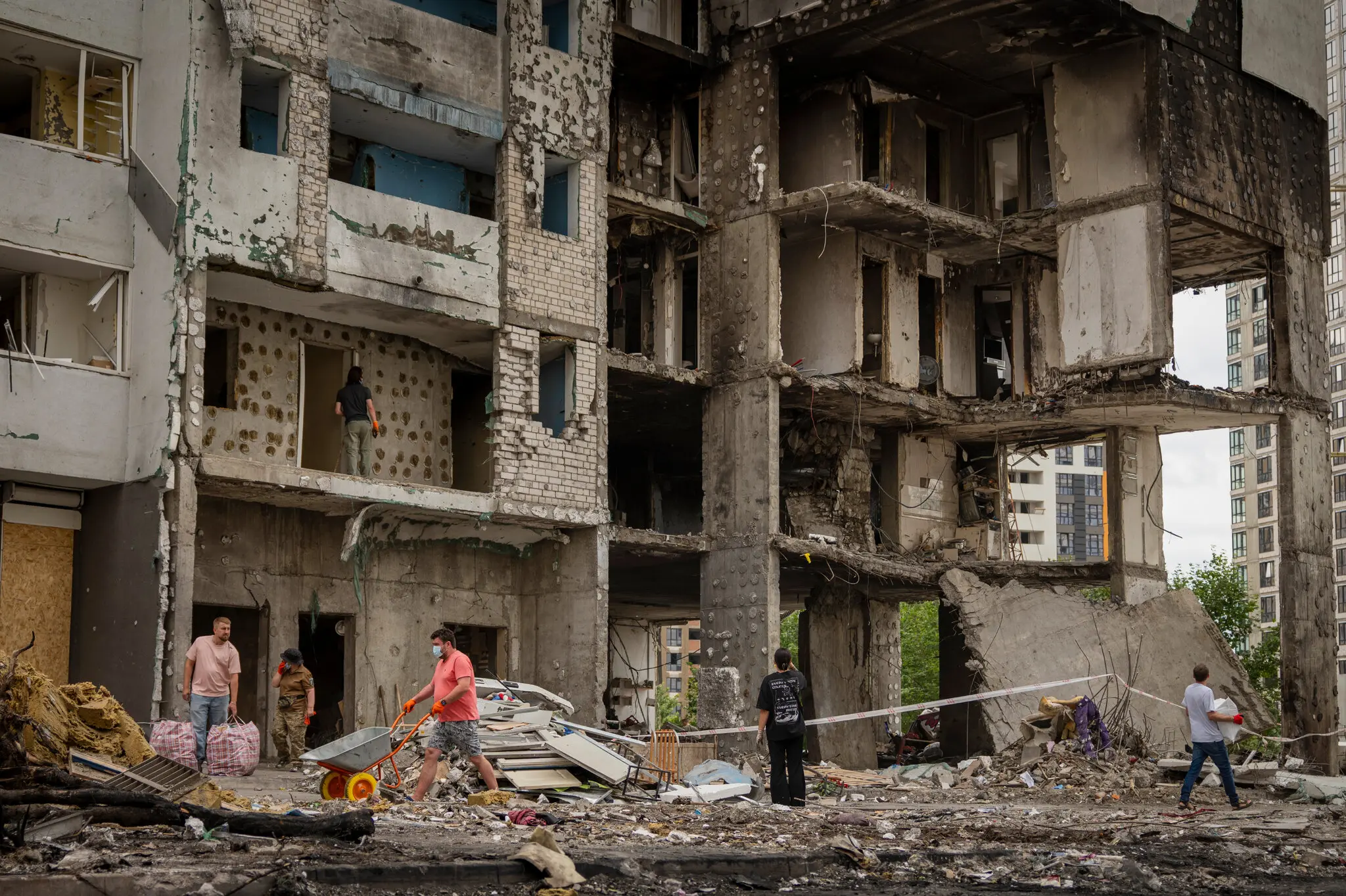
The area around Tabiat Bridge in northern Tehran offered perhaps the clearest image of that tension. In ordinary years, the pedestrian bridge linking major parks has stood as a symbol of contemporary urban leisure. Now its setting reads differently. Families, teenagers, small grills, photographs, and footballs on the grass appeared within sight of a damaged high-rise still bearing visible scars, as if the city itself had decided not to hide its wounds.
In such a composition, every detail becomes heavier. Chicken kebabs on compact grills, a ball skimming across the lawn, children running ahead, relatives posing for pictures, conversations carried on park benches — none of it remains merely incidental. These are no longer just scenes of leisure. They are small acts of reclaiming the right to an ordinary life at a time when ordinariness has become scarce.
 Іранці проводять фестиваль природи в тіні війни — Араш Хамуші
That is why Sizdah Bedar under wartime conditions should not be read as an exotic vignette or a sentimental image of celebration against the odds. Moments like this reveal what public ritual is actually for. A nature festival in Iran has always been about open space, family presence, the turn of the season, and the bond between cultural memory and landscape. Under war, those same elements also become a language of psychological preservation.
Tehran, in that sense, makes something essential visible. War destroys more than structures. It also damages time itself. It erodes the distinction between holiday and weekday, weakens the sense of future, and forces people to live in compressed intervals from one threat to the next. That is why calendar rituals such as Nowruz and Sizdah Bedar take on unusual weight. They give time its shape back. They restore sequence where war imposes rupture.
It is telling, too, that for many residents this was the busiest Tehran had felt in weeks. While cafés had emptied and social life had receded, the parks briefly gathered the city again. That does not mean fear had disappeared. It means something more interesting: societies eventually tire of existing only in reaction to threat and begin looking for forms of presence that are not reducible to survival.
There is also a powerful visual logic at work. Tehran appears here as a city in which nature, modern infrastructure, domestic routine, and the scars of bombardment occupy the same frame. That image resists the simplified idea of a war zone as either total ruin or total panic. The reality is more complicated. Even under sustained pressure, people continue to search for a shared civic life.
That is why Sizdah Bedar in Tehran acquires political weight even though it is not, in itself, a political ritual. War always attempts to monopolize space, attention, and meaning. It seeks to define the city entirely in its own terms. And when families step into the park, unpack food, take photographs, and let children run forward, they take part of that space back.
There is no grand heroic theater in this, which is exactly what makes the scene so affecting. It is not about triumphant defiance or performative indifference to danger. It is about something quieter and more exact: the human need, if only for a few hours, to rebuild a sense of normal life even when almost nothing around it still feels normal.
Today, Iran, Tehran, Nowruz, and Sizdah Bedar come together in a single image of a country that celebrates not because it has forgotten war, but because it knows its cost too well. That is the deeper meaning of what unfolded in the capital’s parks. Beneath damaged facades, beside fear and the memory of strikes, people did what is often hardest in times of catastrophe: they went out and lived.