





















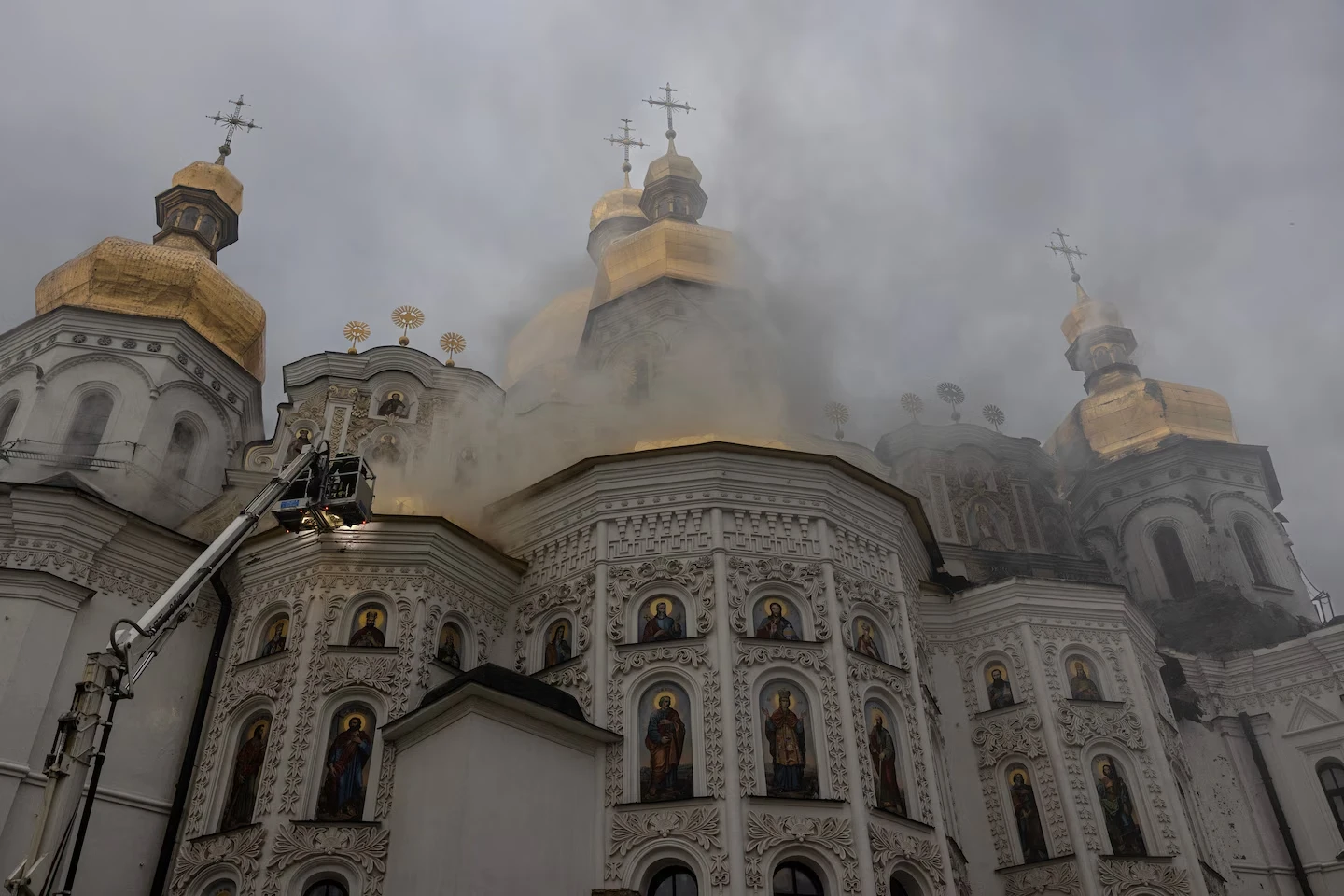
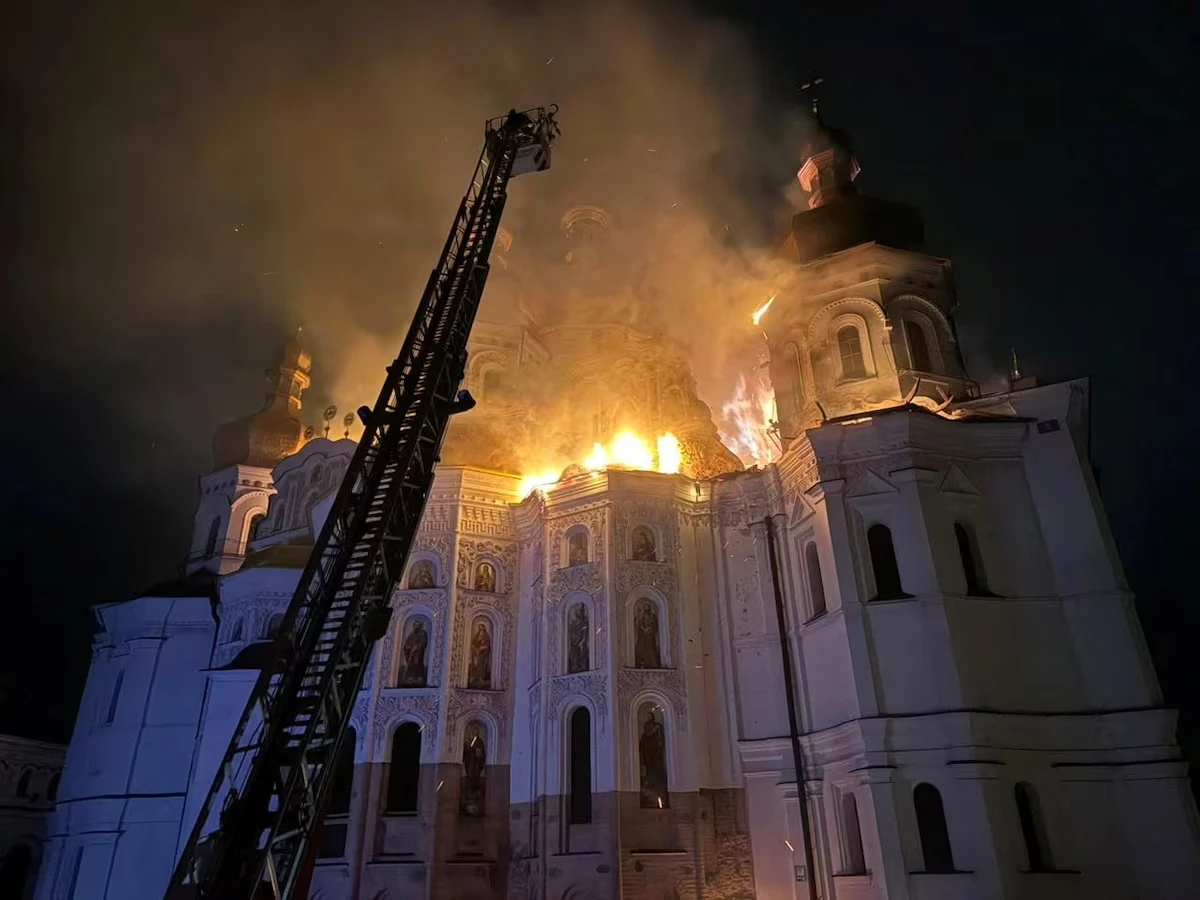
When smoke rose above the golden domes of the Dormition Cathedral, it no longer looked like just another image from a large aerial attack. The fire had not touched only the roof of an ancient shrine. It had reached a place where Ukrainian history, Christian tradition and national memory converge.
During the night, Russia launched a mass strike on Ukrainian cities. Among the damaged sites was the Kyiv-Pechersk Lavra complex, home to the Dormition Cathedral. Ukrainian authorities reported deaths and dozens of injuries, while firefighters worked from above, sending water into windows glowing orange from the flames.
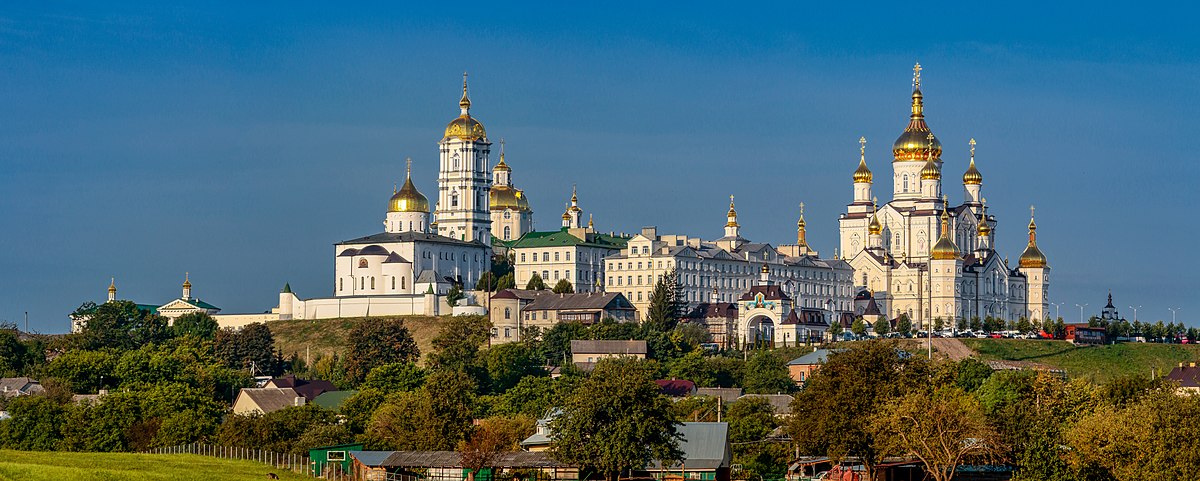
The episode was especially painful not because of the scale of physical destruction, but because of the meaning of the place itself. The Kyiv-Pechersk Lavra is not a museum backdrop or a frozen symbol of the past. It is one of the oldest centers of Eastern Christianity, a space of pilgrimage, art, monastic tradition, architecture and Ukraine’s political history.
In Daycom’s assessment, the strike on the Dormition Cathedral was one of those moments when the war moves beyond military infrastructure and touches the question of what Ukraine is. Russia is not attacking only power plants, homes and factories. It is striking the signs that hold the country’s historical continuity together.
The Dormition Cathedral has a history of nearly a thousand years. Its foundation in the 11th century belongs to the period when Kyiv was one of the spiritual and cultural centers of Eastern Europe. That is why this shrine matters not only to Ukraine. It belongs to a broader Christian tradition that cannot be reduced to a modern political dispute.
Texts, icons, textiles, religious artifacts and architectural layers from different eras have been preserved in this space. The underground caves, monastic churches, museums and cathedral formed a complex cultural landscape in which Byzantine heritage, Baroque tradition and Ukrainian history overlapped.
This is not the first catastrophe in the cathedral’s biography. Over the centuries, it has survived fires, sieges, destruction, rebuilding and wars. During World War II, an earlier structure was destroyed almost to its foundations. In the 1990s, the cathedral was rebuilt, returning to Kyiv one of the most recognizable silhouettes of its spiritual geography.
That is why the new fire on its roof produced the effect of historical repetition. Ukraine saw not just damage from another strike. It saw the return of a barbaric gesture: a shrine once destroyed by the war of the 20th century had again become a victim of the war of the 21st.
President Volodymyr Zelensky called the strike one of Russia’s largest crimes against Christian culture. The phrase matters not only for its outrage. It points precisely to the contradiction inside Russia’s wartime rhetoric: a state that often speaks the language of “traditional values” and Orthodox heritage is damaging one of the central sacred sites of Eastern Christianity.
Moscow rejected responsibility and insisted it does not target civilian infrastructure. The Russian version attempted to shift blame to an alleged malfunction of American Patriot missiles. The technical cause of the specific damage requires expert analysis, but the political context does not disappear: the fire broke out during a major Russian attack on Ukrainian cities.
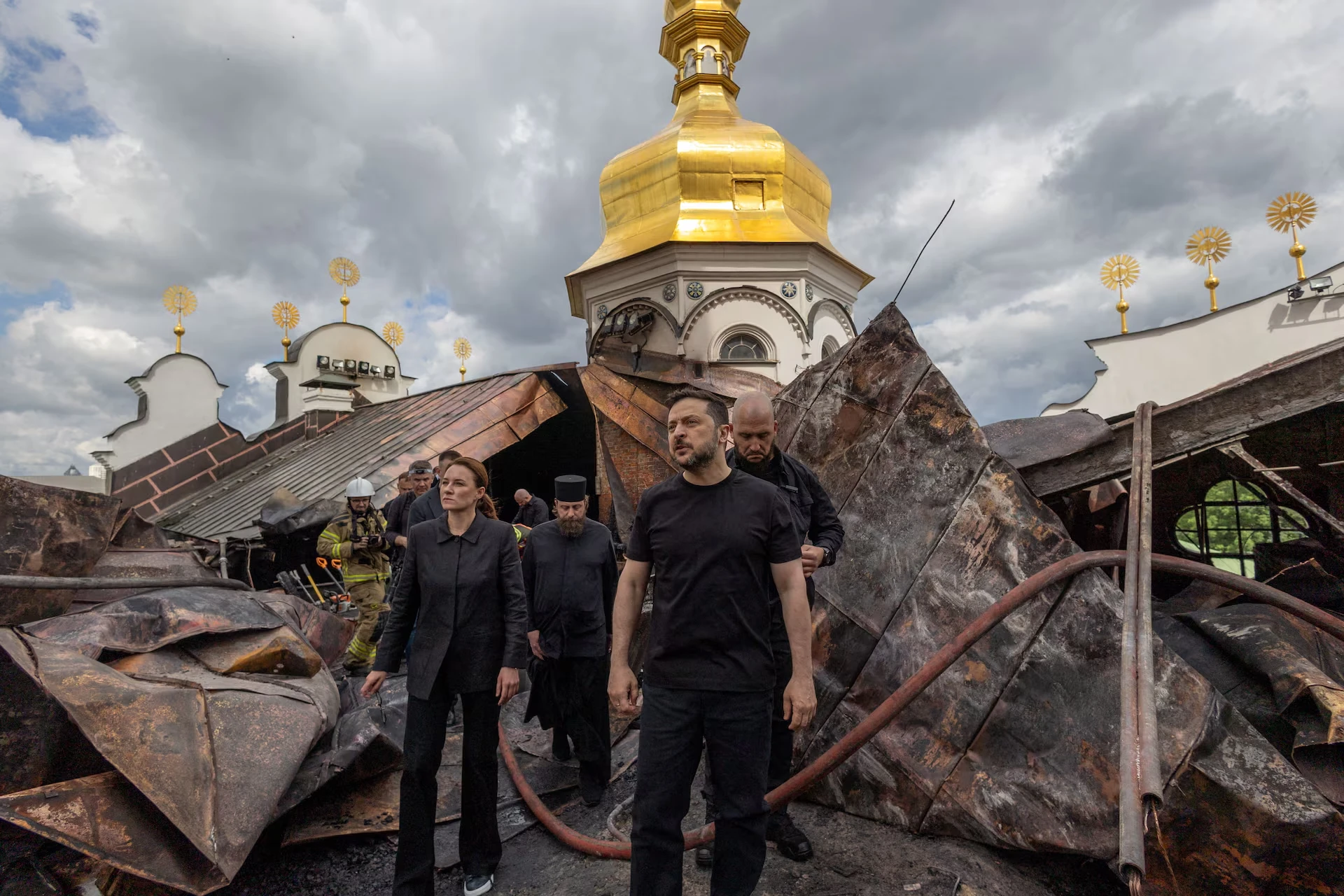 Президент України Володимир Зеленський та прем'єр-міністр України Юлія Свириденко відвідують Успенський собор Києво-Печерської лаври, який постраждав під час російських ракетних ударів та ударів безпілотників у Києві, Україна, 15 червня — Прес-служба Президента України
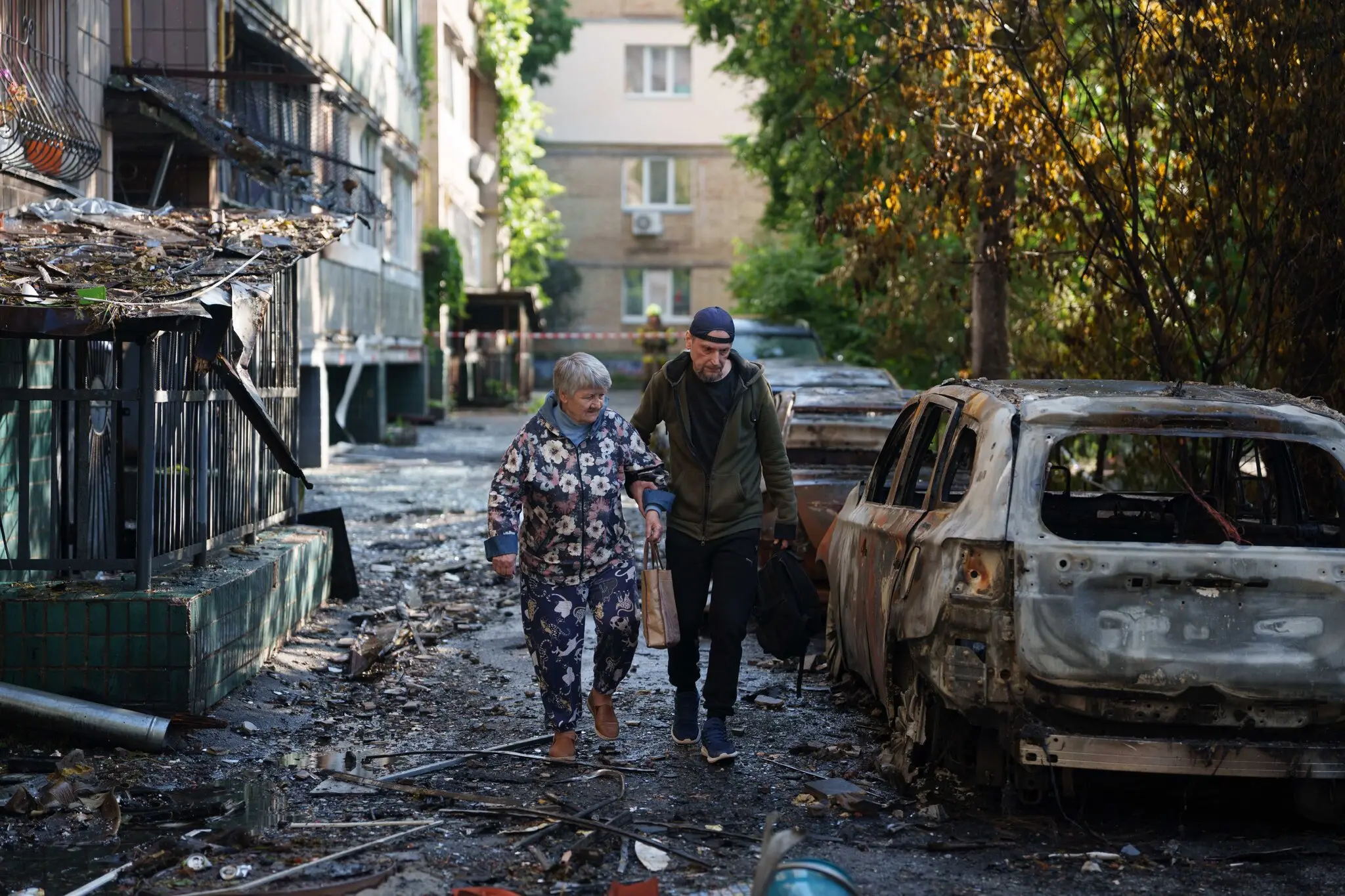 Евакуація з пошкодженого житлового будинку в Києві в понеділок. Росія посилила ракетні обстріли столиці на тлі невдач на полі бою на сході України — Євген Малолєтка
Other cultural sites were damaged as well. Ukrainian officials reported harm to museums, a film studio and a large costume collection. Such losses are less visible on television than a burning cathedral, but for culture they are just as painful: the destruction of archives, images, materials and testimony from entire periods of time.
The most dangerous thing about a war against culture is that it often appears as collateral damage. A missile lands nearby, fragments damage a roof, a blast wave shatters windows, a fire reaches a storage room. But when such cases number in the hundreds, accident stops being a convincing explanation.
Hundreds of cultural sites in Ukraine have already been damaged: religious buildings, museums, monuments, libraries and historic structures. The statistics cannot convey the deeper change in the environment in which culture now lives. Museums operate with taped windows, collections are evacuated into storage, restorers become crisis managers, and architectural monuments are increasingly seen not as spaces of contemplation, but as potential targets.
The Kyiv-Pechersk Lavra carries special weight in this landscape. It has been not only a religious center, but also a field of struggle for Ukrainian agency. Questions of church affiliation, Russian influence, Ukrainian spiritual independence and the historical right to one’s own tradition have long intersected precisely in this space.
That gives the attack another dimension. It struck a place Russia has often tried to appropriate symbolically, presenting Kyiv’s Christian heritage as part of its own imperial myth. Yet the empire that claims Kyiv’s legacy is now leaving traces of fire on it.
For Ukraine, this creates a complex but powerful narrative. Culture is no longer a rear-area sphere that can be postponed until the end of hostilities. It has become part of resistance. Preserving a cathedral, an archive, an icon, a library or a museum collection now matters to the country’s future as much as restoring a power plant or a bridge.
After the fire, Ukrainian authorities pledged to restore the damaged structures. That matters not only as repair. With monuments of this kind, restoration becomes a political act: the state shows that its history does not end at the moment of impact and that Russian weapons do not have final authority over Ukrainian memory.
But restoration does not erase loss. A burned roof can be rebuilt, cracks can be stabilized, walls can be strengthened. It is much harder to restore the sense of inviolability around a place that for centuries served as a spiritual landmark. War changes even the spaces that physically survive.
For the world, this strike is also a test. If the destruction of cultural heritage is treated only as a sad addition to military reports, the aggressor receives silent permission to continue. If such attacks are understood as part of a broader campaign against identity, then the protection of culture becomes an element of international security.
The burning Dormition Cathedral did not change the front line. But it showed what this war is being fought over beyond territory. Russia is trying to exhaust the Ukrainian state physically, economically and morally. Ukraine is forced to prove that its memory cannot be erased by a blast wave.
 Пожежники гасять пожежу в Успенському соборі Києво-Печерської лаври, який постраждав під час російських ракетних і безпілотних ударів у рамках російського вторгнення в Україну, у Києві, Україна, 15 червня 2026 року — Валентин Огіренко
That is why the image of the cathedral in smoke became one of the strongest images of this stage of the war. It speaks not only of another crime and not only of another act of destruction. It speaks of a country standing before fire and again forced to do what it has done more than once: extinguish the flames, count the losses and rebuild its history so that it outlives those who tried to burn it.