























The European Union has opened a new front in the fight over the future of artificial intelligence. After years of clashes with technology giants over search, advertising, app stores and data, Brussels is shifting its regulatory attention to the place where the next monopoly may be forming: the smartphone.
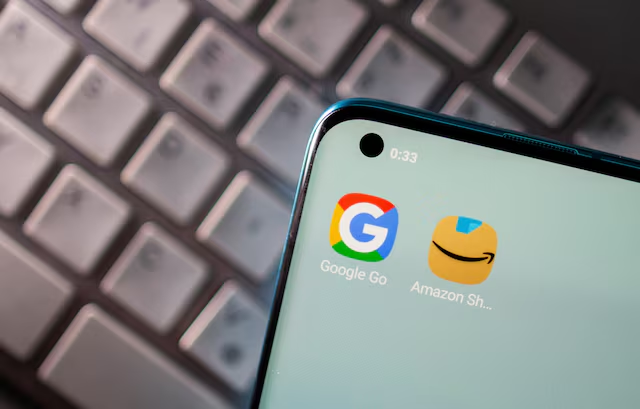
Google has been ordered to loosen restrictions that prevent rival A.I. services from operating fully on Android. The decision is not aimed at a single product, but at the architecture of access to the user. Whoever controls the operating system increasingly controls not only apps, but the future digital assistant.
Android powers roughly 60 percent of smartphones in the European Union. For Google, that is not just a technical base, but an enormous gateway into daily life: voice commands, search, email, photos, maps, messages, shopping, navigation and calendars. This is where A.I. can become not a website or an app, but a constant intermediary between people and the digital world.
According to Daycom’s assessment, the E.U. decision matters because regulators are now treating artificial intelligence as a continuation of the old struggle over platform power. Where the central question was once who controlled search or the app store, the question is now broader: who will become the main interface of human behavior.
A.I. companies do not merely want an app on a phone. They need deep integration into the device: access to voice control, the ability to perform actions inside other apps, and context from email, photos, messages, geolocation and calendars. Without that, a chatbot remains a separate window. With it, the chatbot becomes a personal assistant.
That is why Android is becoming critical infrastructure. If Google promotes Gemini as the natural, built-in and most convenient A.I. service while leaving competitors in the role of third-party apps, the market could close before it has truly formed. The E.U. is trying to intervene before that advantage becomes irreversible.
The regulatory decision requires Google to give rivals more equal footing on Android. That means access to voice commands and the ability to delegate actions inside apps. In practical terms, users should be able to choose not only a browser or search engine, but also an A.I. assistant that can actually operate within the system.
This is more than convenience. If an assistant can order a car, suggest a reply to a message, find photos from a trip, remind a user about a meeting or use the context of a recently visited location, it becomes part of human behavior. In such a world, the winner will not necessarily be the smartest model, but the one closest to the operating system.
Google and Apple have a natural advantage here. They create the world’s most widely used mobile ecosystems, set the rules for developers, and control permissions, access levels and system integrations. For A.I. companies, that means dependence on platforms that are at once partners, gatekeepers and competitors.
The European Digital Markets Act was written precisely against this logic. Its purpose is to prevent large digital platforms from using control over infrastructure to suppress competitors in adjacent markets. Now that law is becoming an instrument not only of past antitrust policy, but of the struggle over the future A.I. market.
Google has also been ordered to begin sharing anonymized search data with rivals. That requirement may prove no less important than opening Android. In the world of A.I., data is not merely a resource for advertising. It helps models understand user intent, current queries, behavioral patterns and real human needs.
For OpenAI, Anthropic and other developers, access to such data could reduce Google’s advantage after decades of accumulating information about how people search, formulate questions and move between digital services. Without access to those signals, competitors may have strong models but weaker ability to embed themselves in real user behavior.
Google is responding with the language of security and privacy. The company warns that opening the smartphone and search data too widely could create new risks for millions of Europeans. That argument cannot simply be dismissed. An A.I. assistant with access to email, photos, messages and app actions may know more about a person than any previous digital service.
This is where the E.U. enters the hardest part of regulation. Opening a market does not mean forcing a platform to give access to anyone who asks. It requires security standards, permission controls, transparency in data processing, accountability for abuse and a real ability for users to understand whom they are allowing to act on their behalf.
This is the new antitrust dilemma. A system that is too closed protects users, but also cements the power of the platform owner. A system that is too open creates competition, but may increase the risk of data leaks, manipulation, fraud and unauthorized actions. European regulators are trying to pass between those two dangers.
For Google, the decision is a signal that the era of A.I. self-regulation is ending before it has fully begun. The company will not be able simply to say that integrating Gemini into Android is a natural product evolution. Brussels sees in that move a potential attempt to transfer platform power from search and mobile software into the new market for personal A.I. assistants.
For Apple, the signal is just as clear. Although the decision concerns Google, the logic of the Digital Markets Act applies to all major platforms. Apple has already clashed with European regulators over new A.I. features for Siri that it has delayed in the E.U. This shows that A.I. regulation is increasingly shaping not only the options available to Google’s rivals, but the design of Apple’s own products.
The A.I. market, meanwhile, is trying to escape the control of smartphone platforms. OpenAI is already moving toward its own hardware future, bringing in designers and teams capable of creating devices built around artificial intelligence rather than the traditional smartphone. That is an attempt to bypass dependence on Android and iOS.
But creating a new device is harder than creating a new model. The smartphone has inertia, an ecosystem, habit, billions of users, app stores, mobile carriers, cameras, sensors and payment tools. For the next several years, the fight over A.I. will still run through the phones already in people’s pockets.
The European decision also shows that A.I. is no longer only a matter of laboratories and models. It is becoming a question of infrastructure, consumer rights, competition, digital sovereignty and power over data. Whoever controls the assistant influences the choice of services, purchases, routes, replies, news, communications and even workplace decisions.
In that sense, the future A.I. assistant may be more powerful than a search engine. Search offered a list of answers, leaving space for the user to choose. The assistant will increasingly perform the action itself: book, buy, write, remind, select, respond. Control over such an intermediary means control over commercial flow.
That is why the E.U. is acting early. In the past, regulators often arrived after digital monopolies had already formed and markets had already been divided. This time, Brussels is trying to prevent the same story from repeating itself in A.I. If a mobile platform privileges its own assistant from the start, competitors may lose not because their products are worse, but because they lack access.
The danger of excessive regulation is also real. If the rules become too complex, companies may delay launching new features in Europe or release reduced versions of their services. Users may receive more formal rights but fewer real innovations. This is the argument technology companies are increasingly using against Brussels.
Europe will have to prove that openness and security can coexist. It wants to be not merely a market where American and Chinese companies test products, but a space that sets the rules of the digital economy. In the case of A.I., that ambition is especially difficult because the speed of the technology is far greater than the speed of legislation.
For users, the consequences may be very practical. Within a year, Google’s rivals on Android in the E.U. should have more ability to function as full assistants rather than isolated apps. A person will be able to choose not only which chatbot answers questions, but whom they allow to manage part of their digital life.
That is the real stake. Not the Gemini button, not OpenAI’s or Anthropic’s place in a menu, not technical access to a voice command. The stake is whether A.I. remains an open market where different models compete for user trust, or becomes a new layer of the old mobile empires.
Google still has an enormous advantage: Android, search, maps, email, video, advertising, data, cloud infrastructure and its own A.I. models. The European decision does not erase that advantage. It only tries to prevent it from becoming an automatic victory in the next technological era.
That is the central meaning of Brussels’s move. Artificial intelligence is quickly becoming not a separate service, but a new way of using the internet. If the rules of access to that way of using the internet are set only by the owners of operating systems, competition may end before users realize the choice has already been made for them.
The E.U. has chosen to intervene at precisely this moment — while the market is still forming, but the outlines of future power are already visible. Google must now prove that it can compete in A.I. not only through control of Android, but through the quality of its own product. For the technology industry, this will be one of the first major tests of the new era: whether artificial intelligence can be built without repeating the old monopolies.