


















After years of politically isolating Moscow, the European Union has begun cautiously reopening a technical line of contact with the Kremlin. The office of European Council President António Costa has held brief diplomatic exchanges with the Russian side to establish a communication channel in case future negotiations become unavoidable.
There have been no substantive agreements. This is not yet a peace negotiation, not a new format and not an attempt by Brussels to become a neutral mediator between Kyiv and Moscow. But the very fact of contact matters: the EU no longer wants to find itself in a position where the future of European security is discussed without it.
In this logic, Brussels is acting not as an arbiter, but as a party with its own interests. Russia’s war against Ukraine has long ceased to be only a Ukrainian question. It defines the security of EU borders, energy policy, defense production, sanctions, migration and the future architecture of deterrence on the continent.
For Daycom, this move is revealing: Europe is gradually shifting from a moral position to institutional self-defense. It is not abandoning support for Ukraine, but it is preparing for the moment when a conversation about peace may become a conversation about the new order in Europe.
The most dangerous scenario for the EU would be one in which the United States conducts the main dialogue with Moscow, Ukraine fights for its own red lines, and Europe remains the payer, arms supplier and territory of risk — but not a full participant in the outcome. That is exactly what Brussels is trying to avoid.
This is why the contact with the Kremlin should not be read as a softening of Europe’s position. It is rather an attempt to have a working phone line when the hard phase of diplomacy begins. Without such a channel, the EU risks reacting to deals made by others instead of shaping its own conditions.
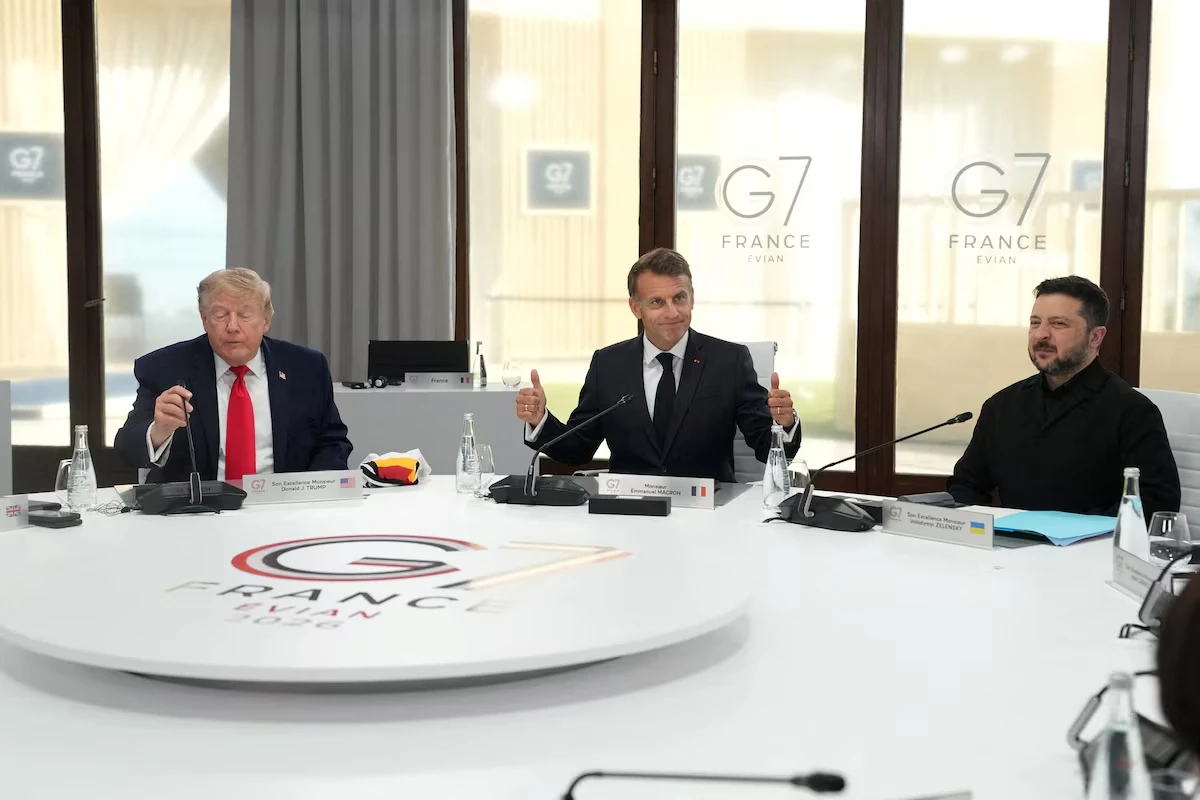
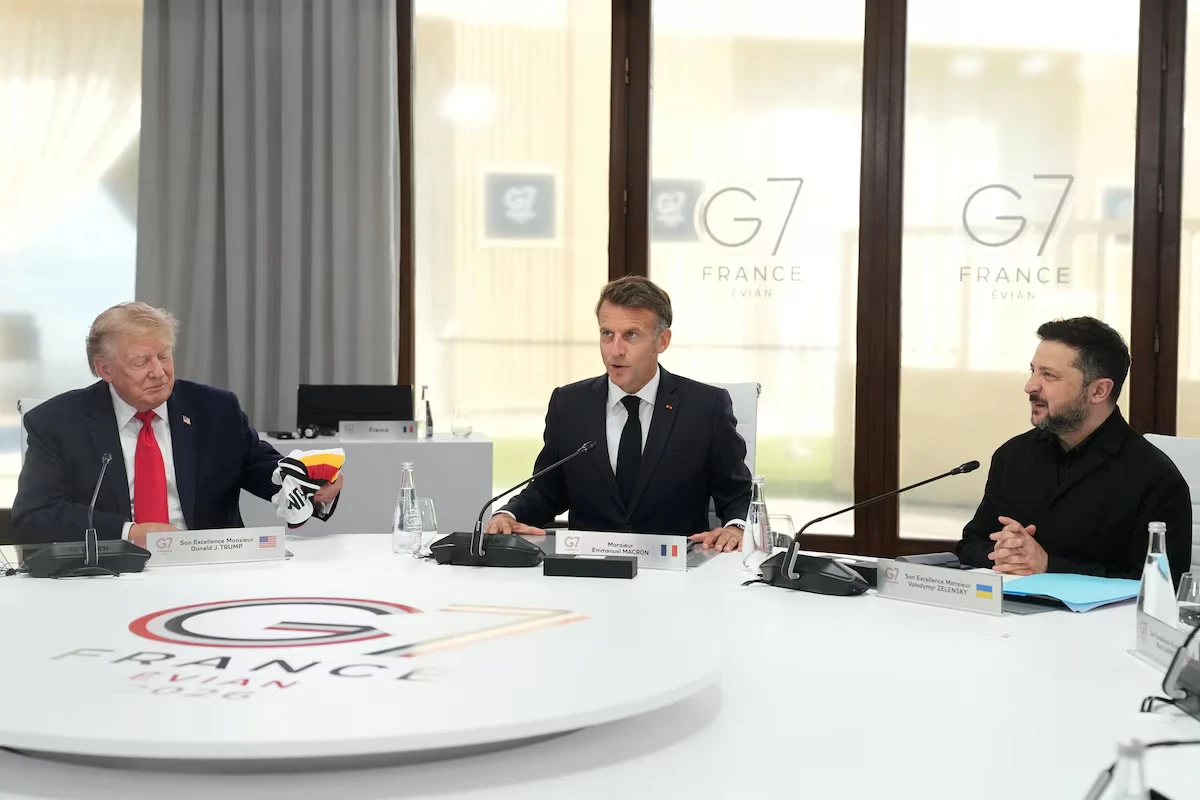 Зліва направо: президент США Дональд Трамп, президент Франції Еммануель Макрон та президент України Володимир Зеленський під час робочої сесії на саміті G7 в Евіан-ле-Бен, Франція, 16 червня 2026 року — Тібо Камю
Brussels’ formula remains careful: the EU is not a neutral mediator because it stands with Ukraine and defends its own security. This is a fundamental distinction. A mediator seeks equidistance. Europe seeks guarantees that any future peace will not become a pause before another Russian aggression.
This is where the central contradiction emerges. To influence negotiations, Europe will have to speak with Russia. But to preserve Ukraine’s trust and the trust of eastern EU members, that conversation must be tightly limited, transparently coordinated and subordinated to the principle: nothing about Ukraine without Ukraine.
Moscow wants the opposite. For years, the Kremlin has tried to divide the West into separate capitals, play on the ambitions of major powers and portray the EU not as an actor, but as a group of governments dependent on Washington. For Vladimir Putin, a single European line is far less useful than many channels in which everyone speaks in a different voice.
That is why the current European debate is so tense. Some capitals believe a direct channel with Moscow is needed now, because diplomacy cannot be built from zero on the day of a possible ceasefire. Others fear that any contact will be used by the Kremlin for propaganda: as if Europe itself were admitting that it cannot resolve the war without Moscow.
There is also another problem: who, exactly, should speak for Europe. Britain, France and Germany have tried to act as an informal core of European diplomacy. But that format does not satisfy everyone. For many EU members, the E3 looks like a club of large states that may speak over the heads of others.
That is why Giorgia Meloni has argued for a single European Union representative to handle contacts with Russia. Her reasoning is simple: a multiplication of diplomatic groups creates confusion, weakens the EU’s position and gives Moscow room to exploit internal divisions. One voice does not guarantee success, but it reduces chaos.
The Italian prime minister has also pointed to an important detail: such a representative should probably not come from one of Europe’s largest countries. A candidate from France, Germany or another major power could immediately trigger resistance among some allies. A medium-sized European state might offer a figure with broader acceptability and fewer suspicions.
This idea reflects a deeper process. The EU is searching not only for a channel to the Kremlin, but for its own diplomatic form. The war has shown that Europe’s economic weight does not automatically turn into political effectiveness. That requires speed, mandate, trust among capitals and the ability to speak without 27 competing signals.
For Ukraine, this debate has a double meaning. On one hand, Kyiv needs a stronger European voice because Europe will live next to Russia after any agreement. On the other, Ukraine cannot allow European diplomacy to start looking for compromises faster than Moscow is forced toward a real peace.
Kyiv remembers the old mistake of European policy well: the desire to reach an understanding with Russia often ran ahead of the recognition that the Kremlin uses negotiations as a tool for delay, regrouping and legitimizing what it has seized. For Ukraine, the issue is not contact itself, but the boundaries of that contact.
Those boundaries must be clear. Ukraine’s territorial integrity cannot be a subject of bargaining. Sanctions cannot be lifted in exchange for attractive signals without verifiable actions. Security guarantees cannot become a paper substitute for real deterrence. And a ceasefire must not become a way for Russia to freeze occupation in place.
That is why Brussels’ contact with the Kremlin makes sense only within a broader strategy of pressure. A diplomatic channel without sanctions, military aid for Ukraine, air defense, defense production and Kyiv’s financial resilience would become weakness. A channel backed by strength can become a tool for managing risk.
 Президент США Дональд Трамп проводить прес-конференцію під час саміту G7 у місті Евіан-ле-Бен, Франція, 17 червня 2026 року — Евелін Хокштейн
Europe is also trying not to surrender the entire process to Washington. Donald Trump’s administration plays its own game, one in which results, speed and the president’s personal role matter enormously. For the EU, that creates a risk: an American deal may be politically dramatic, but not durable enough for European security.
This is why Brussels wants to sit at the table not as an invited guest, but as one of the owners of the problem. European states pay for Ukraine’s defense, receive Ukrainian refugees, rebuild their armies and live under the threat of Russian sabotage, cyberattacks and political interference. They have the right not only to implement agreements, but to shape them.
For the Kremlin, this is an uncomfortable prospect. Moscow would prefer to discuss “major guarantees” with Washington, while speaking with individual European capitals about economic exceptions, sanctions relief or energy interests. A single European mandate makes that game harder.
But EU unity will not appear automatically. The bloc contains different historical memories, different levels of fear of Russia, different degrees of dependence on the United States and different political temperaments. For the Baltic states, Poland or Finland, any conversation with the Kremlin sounds different than it does for countries farther from the Russian threat.
So the main question is not whether Europe can speak with Russia. Diplomacy sometimes requires speaking even with enemies. The real questions are why to speak, on whose behalf, with what mandate, which red lines cannot be crossed and what happens if Moscow again uses dialogue as a screen.
The contact between António Costa’s office and the Kremlin is only a thin line on a large map. But sometimes new diplomatic geometry begins with such lines. The EU is trying to do something it has often lacked: prepare for negotiations before negotiations become a crisis.
For Ukraine, this is not a reason for alarm as long as the principles remain unchanged. On the contrary, Kyiv needs a strong and coordinated Europe more than a collection of fragmented initiatives by individual capitals. The danger will begin only if the channel to the Kremlin becomes more important than Ukraine’s position.
For now, this is not a peace plan, but an instrument. In itself, it is neither betrayal nor breakthrough. Its meaning will depend on whether Europe can speak to Moscow without illusions, without haste and without the temptation to buy silence at the price of Ukrainian security.
Real peace in Ukraine will not be born from the mere fact of conversation. It will depend on whether Russia understands that it is facing not a tired group of separate states, but a Europe that has learned to combine diplomatic channels with strength, sanctions and a long memory of the price of past mistakes.