














In Berlin, a modest-looking document has gone on display: an old sheet of paper printed in German Gothic type. Yet its political weight reaches far beyond the museum case. It is one of the earliest German translations of the American Declaration of Independence.
Its creation was not an act of courtesy, but of necessity. In 1776, tens of thousands of German-speaking settlers lived in the thirteen colonies. Many did not read English, but they needed to understand what the break with the British Crown meant.
That is why the text was quickly sent to the Philadelphia printing house Steiner and Cist. The Declaration was printed in German, using a typeface familiar to German readers of the time. It was meant to be posted in streets, workshops and gathering places — wherever the new republic had to explain itself to its people.
According to Daycom’s earlier analysis, the power of this artifact lies in the way it disrupts the convenient myth of America’s monolingual and homogeneous birth. From the beginning, the United States was a political project that had to speak in more than one language if it wanted to become a real community.
Ahead of America’s 250th anniversary, one of the two surviving copies of the German-language Declaration is being shown at the German Historical Museum. The other is held by Gettysburg College in Pennsylvania. The Berlin copy was acquired by the museum in 1993, when a reunified Germany was still defining its place in a new Europe.
At the time, the document carried almost programmatic meaning. After the fall of the Berlin Wall and the end of the Cold War, Germany was signaling its commitment to Western democracy, constitutional freedom and the transatlantic partnership. The American Declaration of Independence in German became an ideal symbol for that ambition.
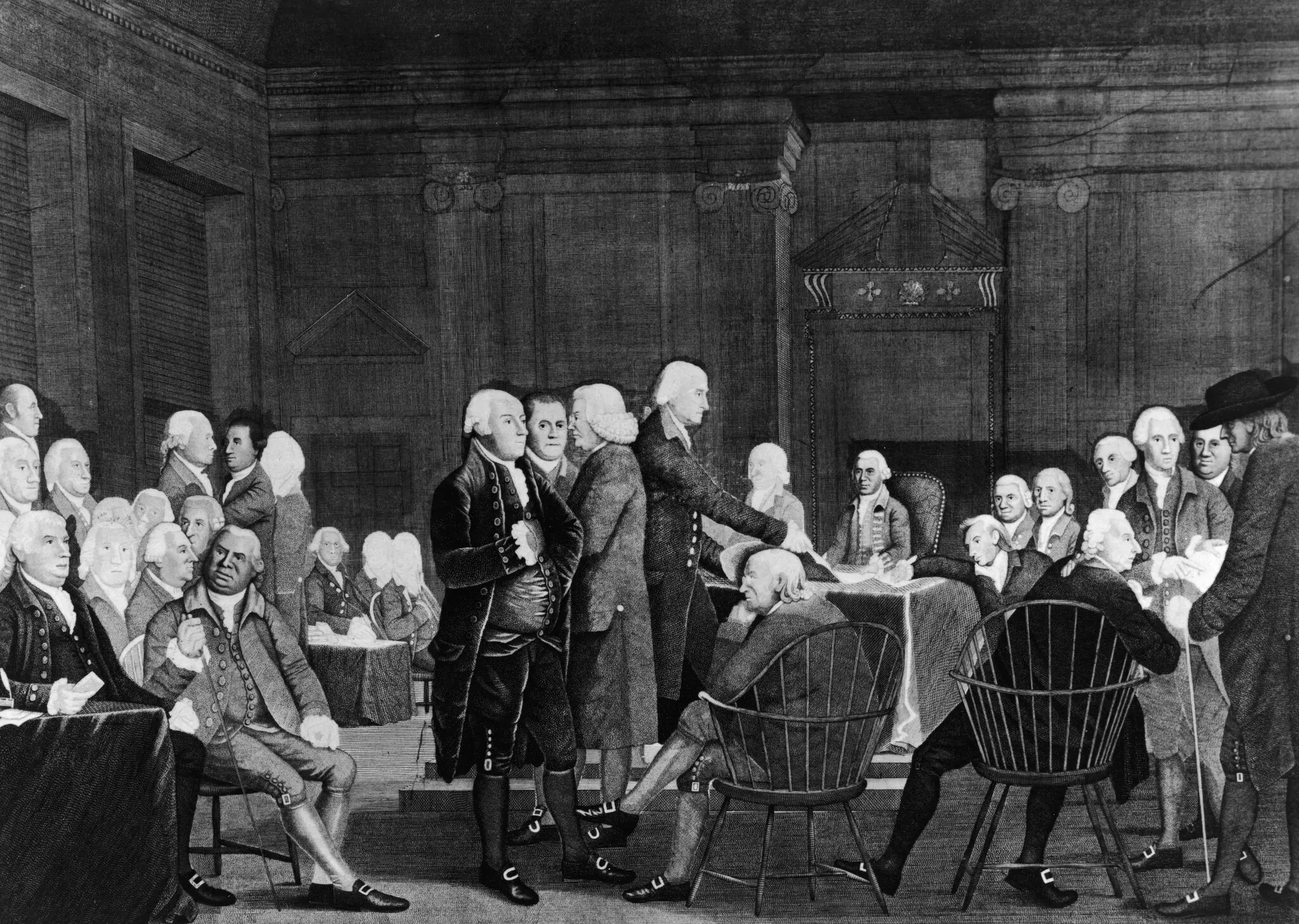
Two histories meet in it. The first is the history of the United States, born through revolution, political experiment and the language of universal rights. The second is the history of Germany, which after the catastrophes of the 20th century sought not imperial memory, but a democratic foundation for the future.
Germans were part of American life before the United States existed as a state. In the 18th century, artisans, weavers, agricultural workers and religious communities arrived in the colonies. Mennonites and Amish sought a place where they could live without persecution and preserve their own way of life.
Their presence was not decorative. German-speaking communities broadly supported the Revolution, although pacifist groups often rejected violence. Loyalty to Britain did not become a mass position among them. For many settlers, America’s break with empire was not an abstraction, but a chance to step out of subordination.
Later, the German imprint entered the fabric of everyday American life. Kindergartens, Christmas trees, food traditions, urban culture and craft practices became so familiar that they stopped being perceived as imports. Assimilation often works most deeply that way: by erasing its own signature.
The 20th century changed the memory of that contribution. Two world wars made German ancestry politically uncomfortable in the United States. Parts of German American heritage were pushed aside, muted or deliberately left unmarked. What had once been a sign of diversity became, for a time, a burden.
That is why the Berlin artifact matters as more than a rare print. It restores complexity to the story. America did not emerge as a clean English-speaking model to which everyone else was expected to silently adjust. It grew through translation, negotiation, misunderstanding and the slow creation of a shared political language.
That complexity is especially clear against the background of the so-called Muhlenberg legend. The story claims that Congress failed by just one vote to make German the official language of the United States. No such vote took place, but the myth has endured for decades because it is useful in political arguments about immigration and assimilation.
Its appeal is easy to understand. A tale about a German American supposedly rejecting the German language for the sake of American unity can be turned into a moral lesson: the good immigrant is the one who quickly gives up inherited identity. The German Declaration of Independence says the opposite. Early America was not afraid to address immigrants in their own language.
That did not mean abandoning a common political space. On the contrary, translation was a form of inclusion. Before the new republic could demand loyalty, it had to make its ideas intelligible. Citizenship began not with linguistic coercion, but with access to meaning.
That is the document’s modern relevance. The German-language Declaration of Independence forces a different reading of America’s immigration history. It shows that diversity was not a late addition to the national myth. It was there at the beginning, before the state had fully learned to call itself one nation.
For Germany, the document is not neutral either. It was acquired at a moment when the country, after reunification, was looking for democratic symbols capable of connecting eastern and western experience. The slogan “We are the people” echoed the American Declaration’s language of “one people,” even if different revolutions and different traumas stood behind them.
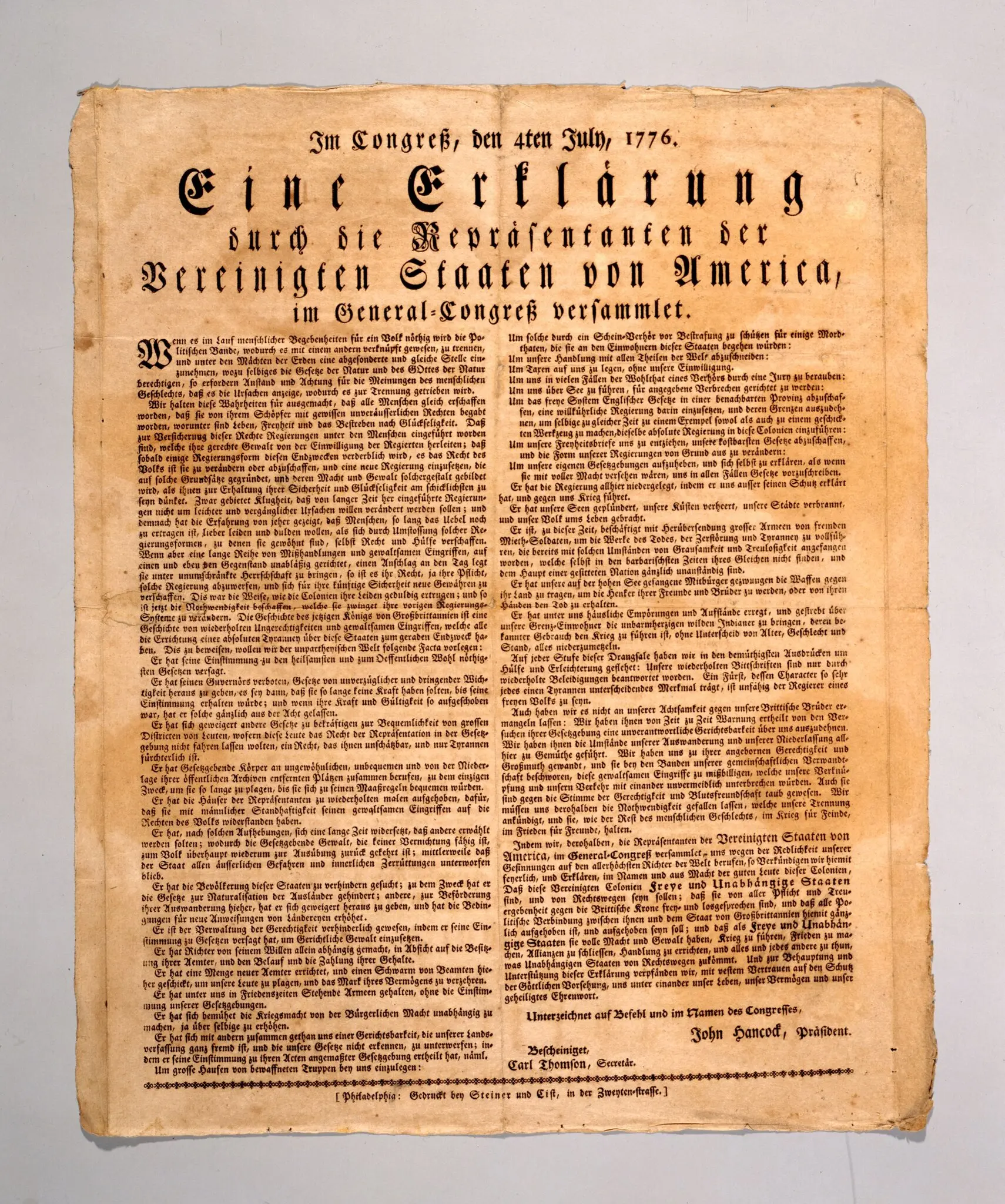 Перше видання Декларації незалежності США німецькою мовою — Німецький історичний музей
Today, the symbol sounds more complicated. Relations between the United States and Germany no longer carry the postwar certainty that was long treated as a given. Disputes over security, trade, Greenland, the Middle East and America’s role in the world have made the transatlantic alliance more unsettled.
A January ARD poll found that only 15 percent of Germans considered the United States a reliable partner. For a country whose postwar democracy was shaped in large part under an American umbrella, that is more than a mood indicator. It is a symptom of lost automatic trust.
Against that backdrop, the German-language Declaration of Independence looks less like a museum relic than a question. What remains of shared values when political cycles pull allies in different directions? Can historical memory hold an alliance together when contemporary politics keeps straining it?
The answer is not contained in the sheet itself. The document does not erase conflicts or automatically restore old trust. But it recalls a moment when American democracy needed translation, and when the German language was one of the channels through which it was born. That is a meaningful detail for both countries.
For the United States, it means that the strength of the republic has always depended on its ability to draw different communities into a shared political project. For Germany, it means that its bond with America cannot be reduced to postwar protection or the Cold War. It is deeper, older and more complicated.
That is why the artifact should be read as more than a historical rarity. It speaks about migration, language, memory, assimilation and democracy. It shows that nations are not born in the purity of myth, but through translations, compromises and attempts to persuade very different people that they can become one political people.
Ahead of America’s 250th anniversary, the German Declaration of Independence restores the multilingual beginning of the American story. It also reminds Germany why symbols of freedom are never fixed once and for all. They must be explained, defended and translated again into the language of their own time.