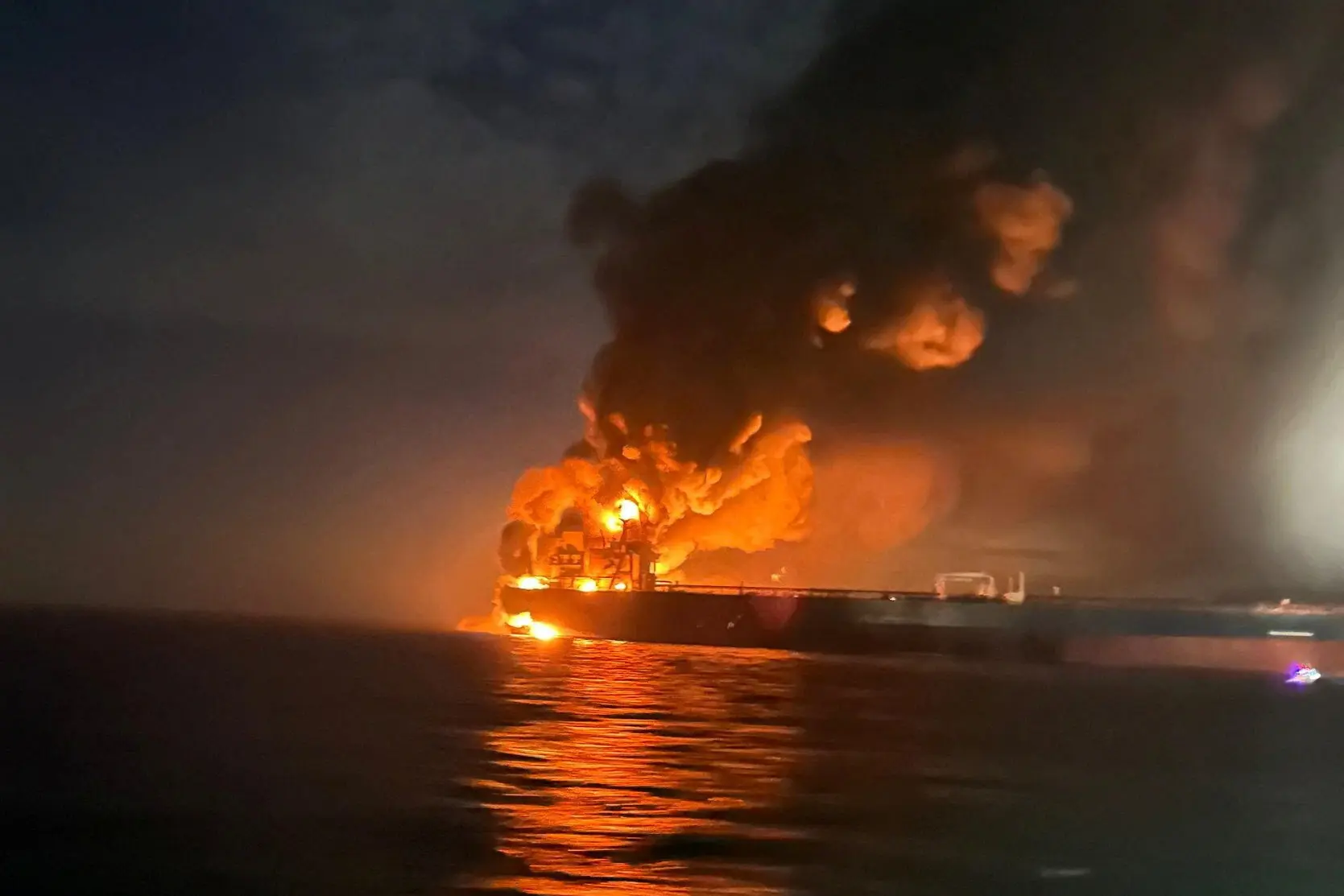























Three cruise missiles struck the merchant vessel Golden Leo off Odesa on the evening of July 19. Sailing under the flag of Guinea-Bissau, the ship was carrying corn with a crew of Indian and Syrian nationals. Nine sailors and a Ukrainian maritime pilot were killed.
The rescue operation continued throughout the night. Eight of the vessel’s 17 crew members survived. The burning ship remained near the coast as rescuers searched through smoke and debris, while Odesa prepared for another round of Russian attacks.
By morning, Russian missiles had again hit the city and its port infrastructure. Three more people were killed and three injured. Since the beginning of July, attacks across the Odesa region have claimed 28 lives, turning southern Ukraine into a principal target of Moscow’s renewed air campaign.
Daycom’s assessment is that the Golden Leo strike marks an important shift in Russian strategy. Moscow is seeking to destroy not only warehouses, terminals and port energy systems, but confidence in the maritime corridor that sustains Ukraine’s grain exports and economic survival.
Civilian shipping depends on more than the physical security of harbours. It requires affordable insurance, predictable freight rates, crews willing to sail and shipowners confident that an ordinary commercial voyage will not end in a missile attack.
Every strike raises the cost of those conditions. Insurance premiums climb, carriers demand additional compensation, some companies abandon Ukrainian routes, and cargo must be redirected through more expensive land corridors across the European Union.
The resulting economic damage extends far beyond the value of a destroyed ship or terminal. Russia does not need to seal every Ukrainian port physically. It only needs to make maritime trade dangerous and expensive enough to lose its commercial viability.
The Golden Leo was a particularly revealing target. It was not carrying weapons or military equipment. Its holds contained corn—a commodity tied to the income of Ukrainian farmers, the operation of grain elevators, the country’s foreign-currency earnings and the food security of importing states.
Ukraine remains one of the world’s leading agricultural exporters. In recent seasons, it accounted for roughly 11 per cent of global corn exports and about 6 per cent of wheat shipments. Even a partial disruption can affect prices far beyond Europe.
The most vulnerable countries are those without sufficient reserves to absorb higher food costs. For them, rising freight charges or delays to several shipments can trigger another wave of food inflation, fiscal pressure and political instability.
Attacks on Ukrainian ports therefore cannot be treated as a purely bilateral episode of the war. They turn the Black Sea into an instrument of global economic coercion, where a missile striking a ship near Odesa can influence the price of bread in the Middle East or North Africa.
Since the beginning of the full-scale invasion, maritime blockade has been one of Moscow’s principal tools. The grain agreement temporarily restored predictability to parts of the shipping network, but it never removed the central threat: Russia retained the ability to attack port cities, mine waters and intimidate carriers.
After Moscow withdrew from the arrangement, Ukraine established its own maritime corridor along the western Black Sea coast. Its operation became one of Kyiv’s most significant wartime economic achievements. Exports recovered, while the Russian fleet lost its ability to control the northwestern Black Sea without consequence.
That success was made possible by Ukrainian strikes against Russian ships, headquarters, radar systems and military infrastructure in occupied Crimea. Naval drones and missiles forced part of the Black Sea Fleet away from Sevastopol and created space for commercial traffic.
Moscow is now trying to compensate for the loss of direct naval dominance with long-range attacks. If Russian warships cannot safely approach Odesa, the task of maintaining a blockade shifts to cruise missiles, attack drones and the systematic destruction of port infrastructure.
Ukraine, meanwhile, is intensifying strikes against Russian sources of revenue. Oil infrastructure, tankers, logistical hubs and facilities in the Black Sea and Sea of Azov have come under attack. Moscow has already been forced to restrict some shipping in the Sea of Azov, a route handling roughly a quarter of Russian grain exports.
A new maritime phase of the war is taking shape, with both sides seeking to weaken the other’s economic resilience. Yet there is a fundamental distinction between attacks on military-industrial or energy infrastructure and the destruction of a civilian ship carrying food.
Those killed aboard the Golden Leo were not combatants. The international composition of the crew also demonstrates that Russia’s campaign against Ukrainian exports cannot remain confined to relations between Moscow and Kyiv. Its victims include citizens of third countries and companies operating within global maritime trade.
For India, Syria and the vessel’s flag state, the attack poses a question that diplomatic language cannot easily obscure: can their citizens and ships safely participate in the lawful transport of food from Ukrainian ports?
Their response will have practical consequences. Moscow assumes that its economic partners will continue separating trade with Russia from Russian actions in the Black Sea. The deaths of foreign sailors make that distance increasingly difficult to maintain.
Ukraine’s immediate task is not merely to repair damaged terminals. It must convince shipowners, insurers and crews that the maritime corridor will remain viable despite a renewed wave of attacks.
That will require stronger air defence around Odesa, improved early-warning systems for vessels, dispersed port capacity and international guarantees for war-risk insurance. Ships approaching harbour will need particular protection, as they are most vulnerable while moving slowly and manoeuvring near the coast.
Western governments have often treated the security of Black Sea exports mainly as an economic issue. The Golden Leo strike erases that distinction. Protecting Ukrainian shipping is now inseparable from the security of international trade and freedom of navigation.
Russia is attempting to show that it alone can decide who uses the Black Sea and at what price. Ukraine and its partners must establish the opposite principle: a civilian trade route cannot depend on the Kremlin’s temporary willingness to withhold a missile strike.
The ten deaths aboard a ship carrying corn were not an accidental side effect of war. They were the cost of an effort to turn the sea into a lawless zone and food into an instrument of coercion. Whether the route to Odesa remains open now concerns more than Ukrainian exports. It concerns the boundary between warfare and international commerce itself.