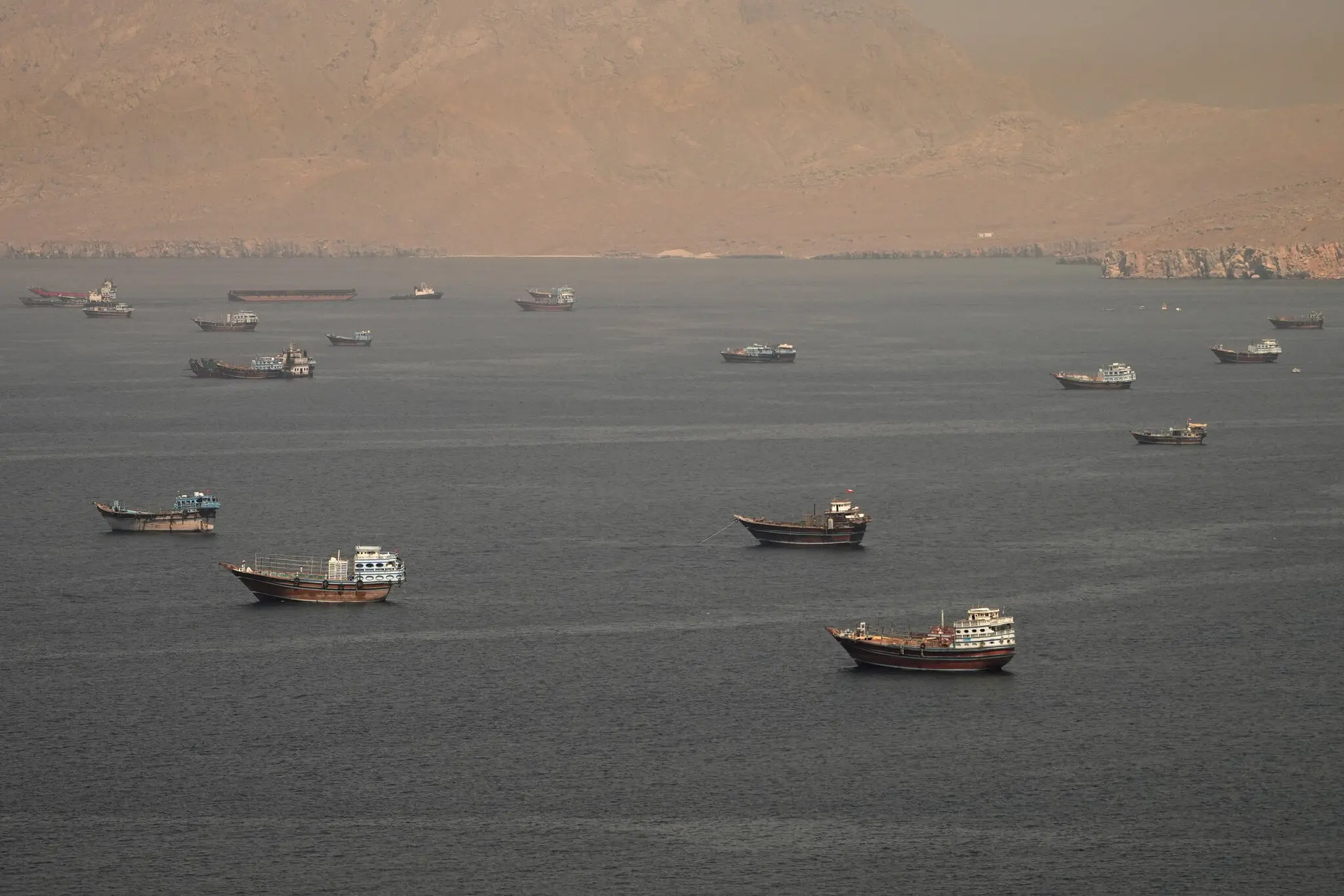














The Strait of Hormuz is formally open again, but global trade is behaving as if the war has not fully ended. After the preliminary deal between the United States and Iran, the number of vessels moving through the corridor has increased, yet traffic remains uneven, cautious and far below prewar levels.
Before the war, roughly 130 vessels passed through the strait each day. After the agreement, 25 ships crossed the route on one day, including 14 oil tankers. The next day, only 11 vessels passed through, among them seven tankers and four dry bulk carriers. This is not a return to normality, but the first cautious test of whether the corridor is truly safe.
For global energy, Hormuz is not merely a narrow maritime passage between Iran, Oman and the Persian Gulf. It is one of the main nerves of the world oil and gas market. Through it moves the supply on which prices, insurance, delivery schedules, Asian energy security and the financial stability of importers depend.
According to Daycom’s assessment, the current situation reveals the central weakness of the U.S.-Iran deal: the legal end of a blockade is not the same as the restoration of trust. Shipping returns not when politicians declare a route open, but when captains, insurers, charterers and cargo owners consider the risk acceptable.
There is a first signal. The U.S. naval blockade on Iranian ships, imposed in April, is no longer in place. Iran has agreed to reopen the strait and, for 60 days, allow vessels to pass free of charge, returning in principle to the prewar standard of free movement. But that 60-day horizon creates new uncertainty.
If Tehran tries to impose fees after that period, the Strait of Hormuz will become not only a transport route, but also a paid geopolitical instrument. For the market, that means even a successful halt to hostilities may not restore the old rules. Free passage could turn into a recurring subject of bargaining.
Shipowners are not rushing back. Some vessels have been sitting in the Persian Gulf for months, waiting for the security regime to change. Returning them to normal schedules is more complicated than issuing an order. Hulls, crews, insurance terms, routes, port slots, contracts and cargo obligations all have to be checked.
The agreement itself also acknowledges the existence of technical and military obstacles. This is not only a paper reopening of a waterway, but also a matter of demining, controlling dangerous zones, restoring navigational support, coordinating with military forces and ensuring that vessels do not become accidental targets.
That is why the phrase “immediate reopening” does not work mechanically. In maritime logistics, safety must be tested, not merely announced. One incident involving a tanker, one false alarm, one missile or drone episode could raise insurance rates again and freeze traffic faster than diplomats could explain the situation.
For the oil market, the current figures are a warning. Twenty-five vessels on one day and 11 on the next is too little for a route that in peacetime functions as a daily artery. Tanker traffic is recovering, but it is not becoming stable. Stability, not the symbolic passage of the first ships, is what determines the price of risk.
Energy traders are looking beyond the simple fact that Hormuz is open. They are assessing whether oil and liquefied gas supplies can move regularly, whether routes will have to change, whether insurance premiums will rise, and whether Iran will begin using the strait as leverage in negotiations with the United States.
For Iran, this is a new space of power. During the war, closing or restricting Hormuz became a way to show that Tehran could affect not only its regional adversaries, but the global economy. After the deal, that leverage has not disappeared. It has merely shifted from the military sphere into the contractual one.
The clause allowing free passage for only 60 days is especially important. Before the war, Iran did not charge for ordinary traffic through the strait. If that possibility is now left open, Tehran effectively gains room to raise the question of the future price of navigation.
For the United States, this is a difficult compromise. Washington can say it secured the reopening of the route, reduced risks for the global oil market and eased tensions around the Persian Gulf. But if Hormuz returns not to prewar freedom, but to a new regime of conditional access, the success looks less convincing.
For the Gulf states, the problem is even deeper. They need stable exports, but do not want to depend on Iran’s interpretation of the rules. Saudi Arabia, the United Arab Emirates, Qatar and other producers understand that if Tehran can shape the passage regime, it will gain an additional lever in regional politics.
A European maritime mission, discussed around the G7 summit, could matter, but it would not solve everything. Even the presence of warships does not instantly restore commercial trust. The market asks a simpler question: can a ship sail without the risk of detention, attack, mines, political coercion or excessive insurance costs?
Insurance may become the quiet but decisive barrier. If insurers continue to treat the strait as a high-risk zone, every voyage will become more expensive. Then even an open route will remain economically half-closed. Formally, ships will be able to pass, but not every company will be willing to pay for that risk.
The issue is not limited to oil. Dry cargo, industrial goods, equipment, food, gas logistics and supporting supply chains also move through the region. When Hormuz operates unpredictably, the damage is not confined to one sector; it affects the entire maritime trade system linking the Persian Gulf, Asia, Europe and global energy centers.
The current recovery in traffic must therefore be read carefully. Ships are returning. The blockade has been lifted. The deal created a 30-day horizon for restoring traffic and a 60-day period for political negotiations. But between those dates lies the central question: will Hormuz move from being a risky front back into being a predictable route?
For Tehran, a successful reopening of the strait could become part of its economic return to the world. If tankers move steadily again, Iran can sell oil without steep discounts, rebuild trade channels and demonstrate that the agreement is producing practical results.
But if Iran tries to monetize passage, delay demining or use maritime security as a negotiating lever, trust will disappear quickly. In that case, Hormuz will become not a symbol of peace, but proof that the war has merely changed form.
This is where the difference between diplomacy and logistics becomes visible. Diplomacy can sign a memorandum in a day. Logistics returns over weeks, sometimes months. Every tanker that passes through the strait is effectively voting not for the text of the agreement, but for the perceived safety of the route.
For now, that vote is cautious. Traffic has increased, but it has not stabilized. The market is watching, insurers are calculating, shipowners are waiting, militaries are checking the waters, and Iran and the United States are using the same 60 days to determine whether Hormuz becomes a path toward de-escalation or a new mechanism of pressure.
The Strait of Hormuz is open again only to the extent that the world is ready to believe it. And in maritime trade, belief is measured not by statements, but by the number of ships, the regularity of crossings and the cost of insurance. As long as those indicators remain far from prewar levels, peace in the Persian Gulf remains not a fact, but a fragile hypothesis.