





















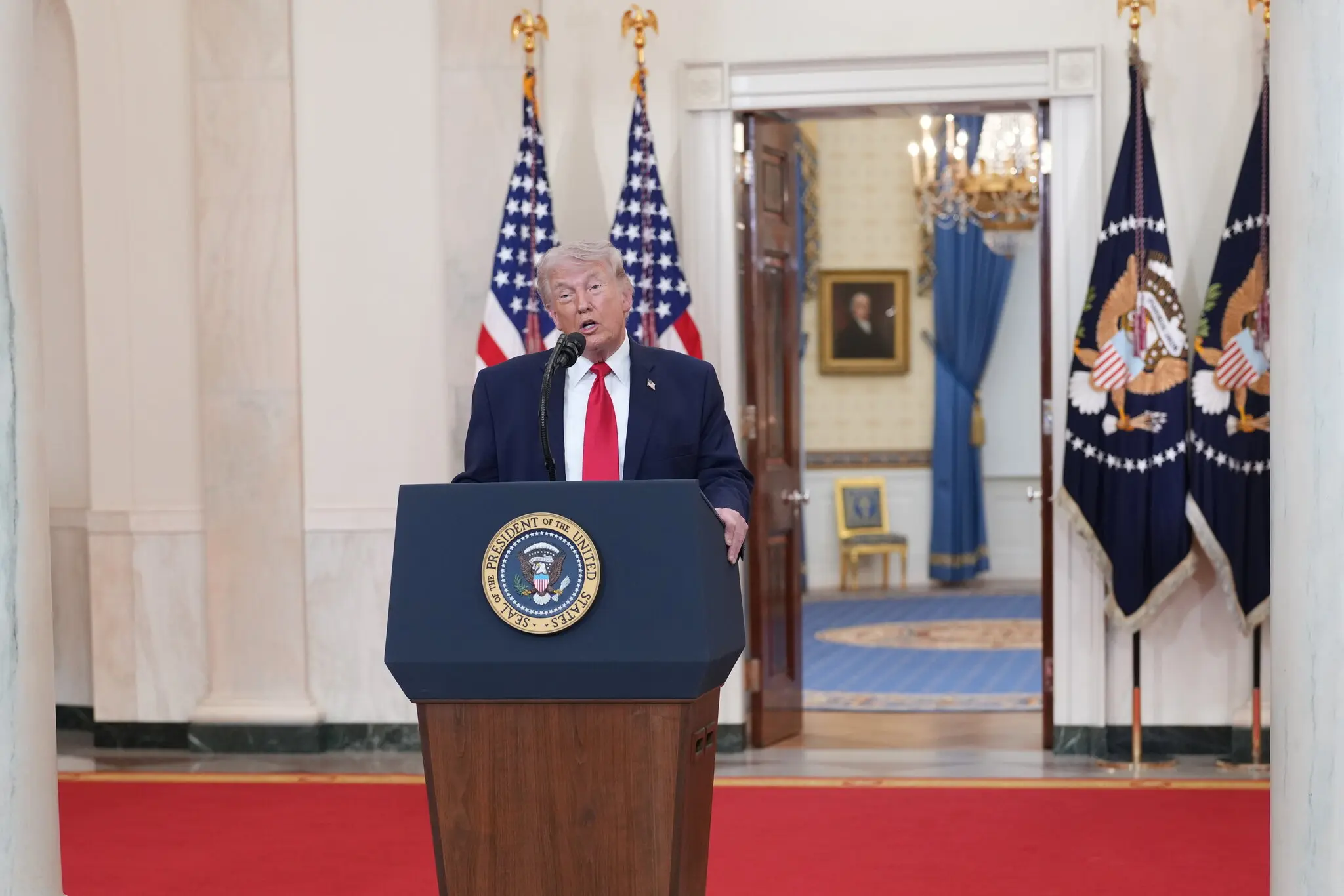
In his evening address, Donald Trump tried to do three things at once: present the war with Iran as nearly won, promise a new phase of punishing strikes over the next several weeks, and persuade Americans that the economic cost should be viewed as manageable. That three-part construction was the essence of the speech. It was built less around strategy than around the performance of control.
The contradiction sat at the center of the message. Trump said American objectives were close to being achieved, yet in the same breath promised another two to three weeks of intense military action. He referred to ongoing discussions, but offered no clear conditions for ending the fighting and no defined exit mechanism for the United States. When a war is described as almost over while escalation is still being sold as necessary, what is being offered is not a path out. It is a moving deadline.
A second layer of the speech was aimed not at Iran, but at American fatigue. By invoking the length of World War I, World War II, Vietnam, Korea and Iraq, Trump was trying to shrink the present conflict by comparison. The argument was simple: this campaign is still short, so it should not be treated as a national burden. But that is historical scale used to evade present-day pressure — fuel prices, inflation, jittery markets and the growing frustration of voters who want Washington focused on domestic life.
By Deykom’s preliminary assessment, the weakest point in the address was its nuclear logic. If the stated purpose of the campaign is to remove the Iranian nuclear threat, then the argument that enriched uranium can remain buried underground so long as it is watched from above does not resolve the core issue. It postpones it. Destroying facilities is not the same as securing the material that made those facilities dangerous in the first place.
That is why the question of Isfahan matters more than the rhetoric about force. If enriched uranium remains deep inside a hardened site, then the central test of the war is no longer how much damage the United States has inflicted. The real question is whether the campaign has reduced Iran’s future ability to rebuild its nuclear program. So far, the speech did not answer that question. It suggested instead that the administration is pushing the hardest part of the problem into the future.
The section on the Strait of Hormuz was equally revealing. Trump’s message was blunt: countries that depend more heavily on Gulf oil should take the lead in reopening the passage. Politically, that line fits the instincts of an American audience that responds to claims of energy independence. Economically, it is misleading. Oil, shipping costs, fertilizers and insurance premiums move through a global system. A disruption in the Gulf does not remain regional for long. It returns to the United States through prices, inflation and market anxiety.
That is where the speech collided with reality. For the Middle East, the Strait of Hormuz is a geopolitical choke point. For the American economy, it is the channel through which a distant war becomes a domestic cost. The longer Washington treats that corridor as somebody else’s problem, the harder it will be to explain higher prices at home as a tolerable side effect of strategic necessity.
Another striking element was Trump’s repeated return to the Venezuela operation as a model for Iran. The comparison revealed a deeper political instinct: a preference for short, decisive, visually legible uses of force — a raid, a target, a clean outcome. But Iran is not Venezuela. This war has not produced a swift rearrangement of power, has not avoided American casualties and has not delivered the kind of closed narrative that can be packaged as victory on television.
That is why the address felt less like a doctrine than like a domestic management exercise. Its primary audience was not Tehran and not even America’s allies, but an increasingly uneasy American public asking the most basic questions about any war: what is the objective, what is the price and where is the limit. The speech did not truly clarify those questions. It attempted to discipline them, to make citizens think less about the shape of the endgame than about the short amount of time they are being asked to wait for it.
The problem is that a timetable is not a strategy. If, in two or three weeks, Iran still retains the residue of its nuclear capacity, if secure navigation through Hormuz is still in doubt, and if diplomacy still lacks defined terms, then the administration will face the question it tried hardest to avoid. Not whether the war was forceful enough. But what, exactly, it changed.