





















Ukraine treated Belarus with caution for a long time. After February 2022, when part of Russia’s invasion came from Belarusian territory, Kyiv did not sever diplomatic relations and kept communication channels open with Alexander Lukashenko’s regime.
That caution had a pragmatic logic. Ukraine did not want to open another front in the north, where the border runs through forests, marshes, rivers and destroyed bridges. Belarus was an accomplice in the aggression, but its army did not enter Ukraine as a separate force. Kyiv tried to preserve that line.
Now that line has begun to shift. After a series of Russian drone strikes on northwestern Ukraine, Volodymyr Zelensky has moved to harsher language. The issue is no longer only Minsk’s political responsibility, but specific infrastructure that, in Ukraine’s assessment, helps Russia strike more precisely.
According to Daycom’s assessment, the dispute over Belarusian relay stations marks one of the most important shifts in regional security: Belarus can no longer hide behind the formula “we are not fighting” if its towers, roads, training grounds and communication channels operate as part of Russia’s military system.
Ukrainian officials say radio relay stations on Belarusian territory have been used to help control Russian attack drones. These repeaters allow Shahed drones not merely to follow preprogrammed coordinates, but to receive route corrections and control signals during flight.
For Ukraine, that distinction is fundamental. A drone flying a fixed route can be predicted and intercepted by one set of methods. A drone controlled through a relay network becomes more flexible, more dangerous and able to maneuver over territory where every additional minute of flight drains Ukrainian air defenses.
That is why Zelensky threatened to disable such facilities in Belarus again if Lukashenko did not dismantle them himself. The message was direct: if equipment helps kill Ukrainian civilians and injure children, Kyiv will not regard it as untouchable merely because it stands across a border.
Zelensky later said the relay stations had been turned off for now. But that does not close the problem. If such stations can be switched back on, moved, disguised or replaced by mobile nodes, the conflict enters a prolonged mode of technical hunting between Ukrainian forces and Russian-Belarusian infrastructure.
The most painful target has been the railway network in northwestern Ukraine. The Kovel-Kyiv line is a critical logistical artery linking the Polish border with central Ukraine and, beyond it, the front. For Russia, it is an obvious target: striking it means pressuring supply, repair, evacuation, military logistics and the country’s economic rhythm.
Since December, Ukraine has endured a series of Shahed attacks on railway facilities: freight trains, locomotive depots, bridges and nodes along this route. The strikes continued in spring. In April, an attack on a train killed a woman. In June, Korosten, one of the key hubs on the line, was hit especially hard, with roughly two dozen locomotives destroyed in a short period.
These are not merely attacks on transport. They are an attempt to cut the nerve connecting Ukraine’s western border with its internal rear and front line. The more Russia pressures this artery, the more important every guidance technology becomes — especially those that allow drones to locate targets more accurately and strike repeatedly.
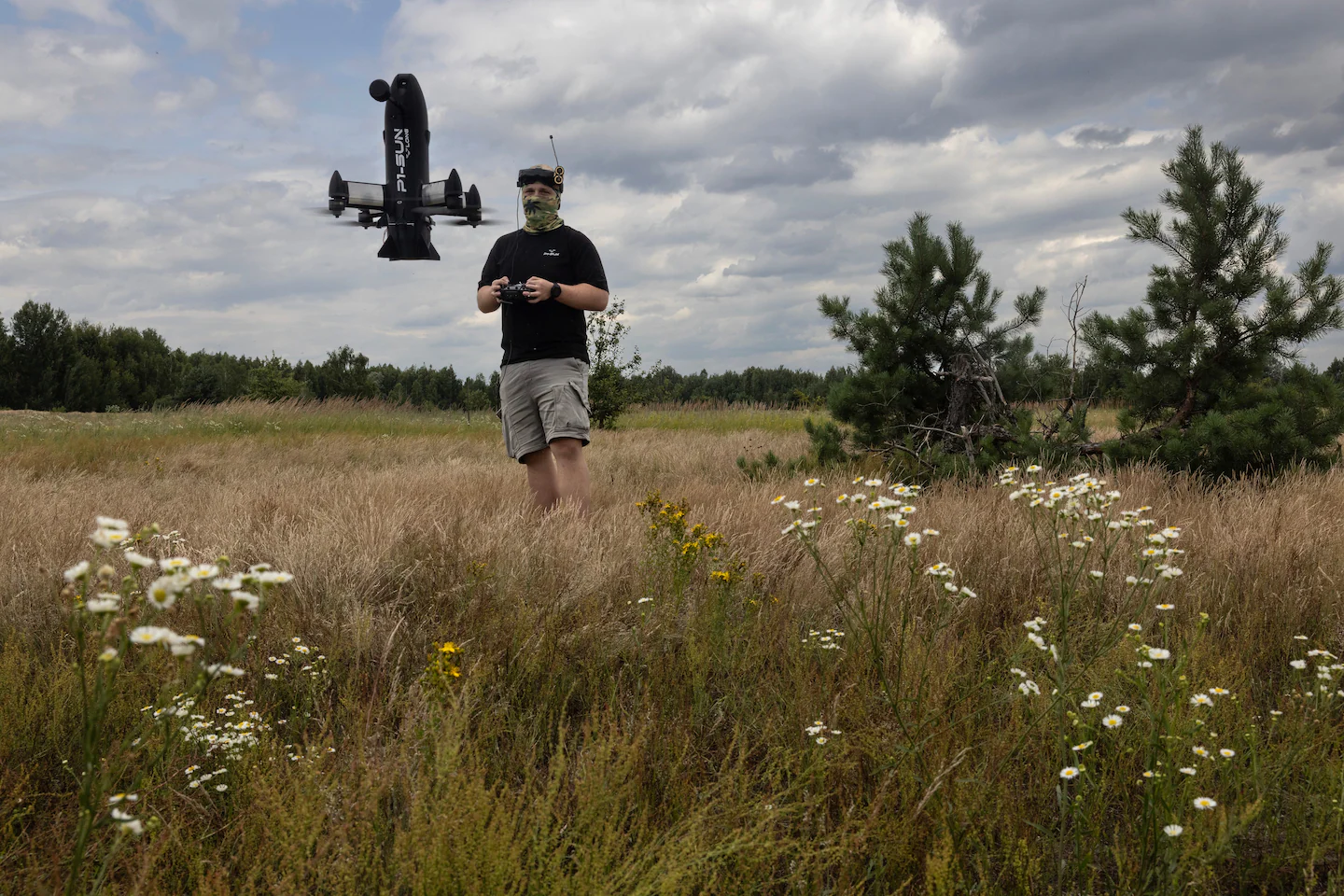
Ukrainian technical specialists describe a change in Shahed behavior: they do not always fly like standard munitions along preset coordinates, but can maintain radio contact with control points, maneuver and transmit reconnaissance data. Those signs pointed to the use of a relay network.
In this scheme, Belarusian territory has particular value for Russia. It gives Moscow a northern angle of access into Ukraine, allows it to reach routes vital for Western assistance and adds pressure on Ukrainian air defenses. Even without Belarusian soldiers at the front, Minsk can significantly assist Russia’s war.
Lukashenko denies that Belarus helps Russia in such attacks. But the denial itself convinces fewer and fewer people. A country from whose territory Russia launched its assault on Kyiv, where joint exercises are held, where Russian military facilities and tactical nuclear weapons are stationed, cannot easily sell the image of a neutral neighbor.
Zelensky has increased pressure not only militarily and technically, but politically as well. His invitation for Sviatlana Tsikhanouskaya to open an office in Kyiv sent a signal to Lukashenko: Ukraine is ready to work more actively with the Belarusian opposition and no longer limit itself to cold pragmatism in relations with Minsk.
That is an important psychological shift. Earlier, Kyiv tried not to push Lukashenko deeper into Putin’s embrace, leaving him room not to enter the war directly. Now the Ukrainian position sounds harder: if the regime continues allowing Russia to use Belarusian territory, it must answer for the consequences.
For Lukashenko, this is a dangerous trap. He does not want a direct war with Ukraine, because such a war could be unpopular inside Belarus and risky for his army. But he also cannot easily refuse Moscow, on which his political survival has depended since the protests of 2020 and the international isolation that followed.
That is why Belarus has found itself in an intermediate role that is becoming less stable. Minsk wants to be Russia’s rear, but not its front. It wants to help, but not pay the full price. It wants to preserve channels with Kyiv while allowing Moscow to use Belarusian infrastructure.
Ukraine’s strategy is also changing because Kyiv has seen the effectiveness of long-range strikes. The campaign against Russian refineries, energy facilities and the industrial rear has shown that the cost of war can be raised far beyond the front line. In that logic, Belarusian relay stations become not a diplomatic issue, but a military target.
The risks are obvious. A strike on facilities in Belarus could give Lukashenko and Putin a pretext for a new wave of escalatory rhetoric. Moscow could try to frame it as an attack on an ally. Minsk could increase border militarization. Ukraine, meanwhile, must balance the need to protect its cities with the desire to avoid expanding the front.
But the alternative is dangerous as well. If Belarus provides technological assistance to Russian attacks with impunity, Ukrainian railways, cities and energy facilities remain under additional threat. In such a situation, restraint stops being a guarantee of security and begins to look like an invitation to repeat attacks.
Zelensky’s current policy is therefore not simply a threat to Lukashenko. It is an attempt to change the rules for the entire northern direction. Ukraine is making clear that Belarus can avoid direct participation in the war only if it does not provide Russia with tools for killing Ukrainians.
In a drone war, neutrality is increasingly hard to imitate. A communication tower, mobile network, radio channel, road or depot may look civilian, but its function is defined by whom it serves. If it helps Shahed drones find Ukrainian targets, it becomes part of the war.
That is what makes the Belarus problem so acute. Minsk does not need to send battalions across the border to change the nature of the threat to Ukraine. It is enough to let Russia use infrastructure that increases the precision and reach of attacks. In modern war, complicity often begins not with tanks, but with a signal.
Kyiv avoided sharp moves for a long time because it understood the price of opening a new front. But if the northern border is being used for technological support of strikes on Ukrainian civilians and logistics, old caution loses its meaning. Ukraine cannot allow a formal state border to cover practical participation in aggression.
Belarus now faces a simple choice that Lukashenko is trying to make complicated: either dismantle the infrastructure helping Russia, or accept that Ukraine will treat it as an element of a hostile military system. The space for convenient silence is shrinking.
That is the central result of the current escalation. Ukraine is not declaring war on Belarus, but it is no longer willing to accept its performed innocence. If Minsk wants the northern border to avoid becoming a more active conflict zone, it must stop being the technical rear of Russian drones. Otherwise, the war Lukashenko has tried so long to keep on someone else’s territory will keep moving closer to his own.