


















In the skies over Ukraine, drones have long become the defining image of a new kind of war. They hunt tanks, guide artillery, intercept other drones and reshape frontline tactics every day. But beneath them, slower and less spectacular, a second revolution is taking place on the ground.
Ground robots — tracked and wheeled unmanned machines — are increasingly doing work once done by infantry: carrying water, food and ammunition, hauling timber for bunkers, evacuating the wounded, delivering mines, standing watch near positions and entering combat. They are no longer experimental gadgets. They are becoming a separate layer of Ukrainian defense.
This change was born not in sterile laboratories, but in mud, snow, tree lines and destroyed towns. If aerial drones were often driven forward by IT specialists, electronics engineers and operators with gamer reflexes, ground systems have been pushed ahead by mechanics, welders, drivers, sappers and infantrymen who feel the weight of frontline logistics on their own backs.
According to Daycom’s assessment, ground robotization is no less important than the drone revolution in the air because it touches the most conservative part of war: combat on land. For centuries, the human soldier remained the main carrier of the front — carrying loads, occupying trenches, pulling out the wounded, storming enemy positions. Ukraine is now beginning to hand part of that work to machines.
The reason is not technological fascination, but the hard mathematics of survival. Ukraine has fewer people than Russia and cannot afford to spend infantry the way Moscow does. Every soldier spared from a road under drones, from evacuation under fire or from an unnecessary move across open ground becomes part of a strategic economy of human life.
The lethal zone along the front has expanded. Where danger once concentrated closer to the trenches, now any movement kilometers from the line of contact can be spotted and struck by an aerial drone. In some areas, that zone stretches deep into the rear. Getting to a position can be more dangerous than holding it.
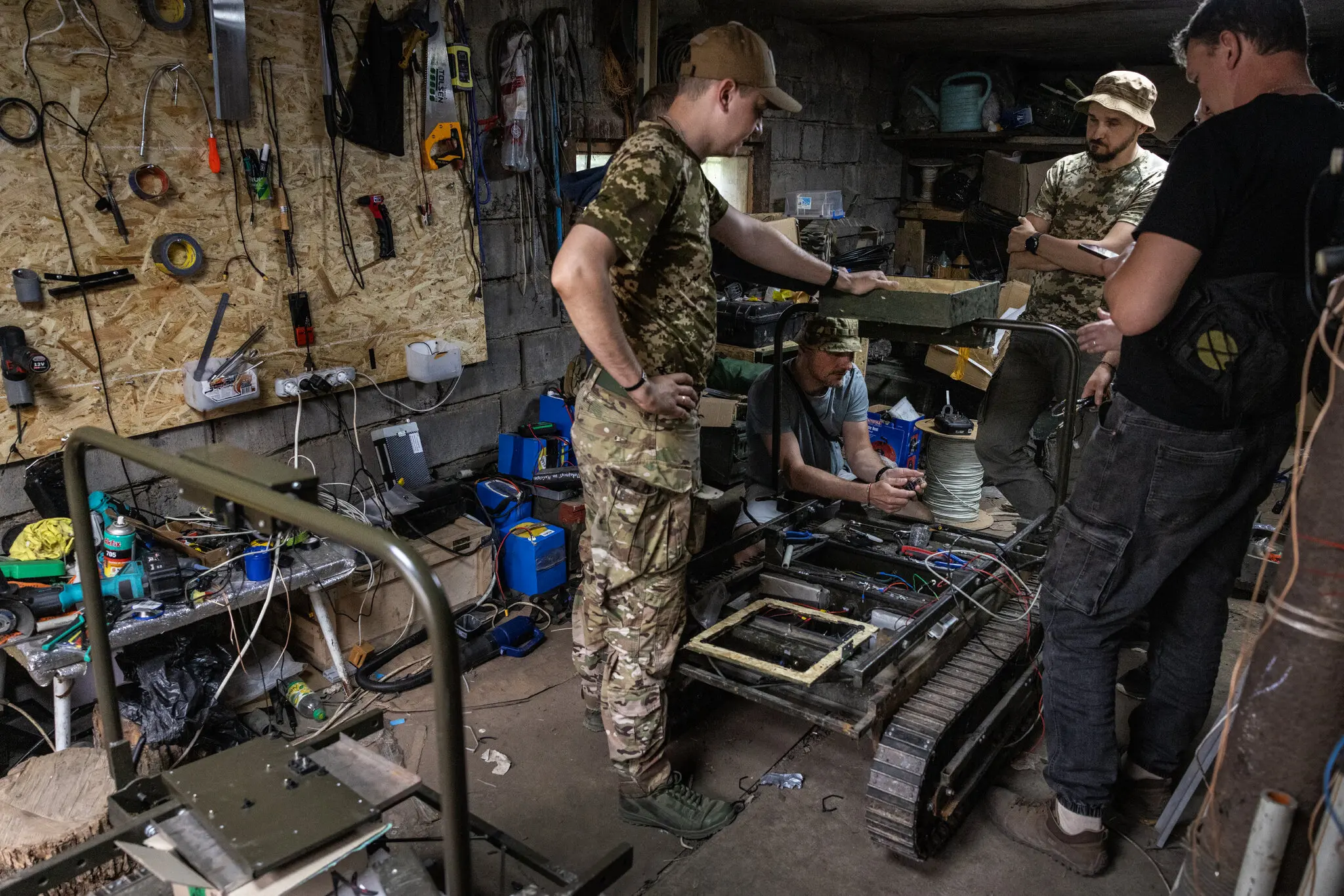 Українські солдати працюють на наземних безпілотних апаратах, що використовуються для медичної евакуації та поповнення запасів піхоти на передовій, у Донецькій області України, 2025 рік — Девід Гуттенфельдер
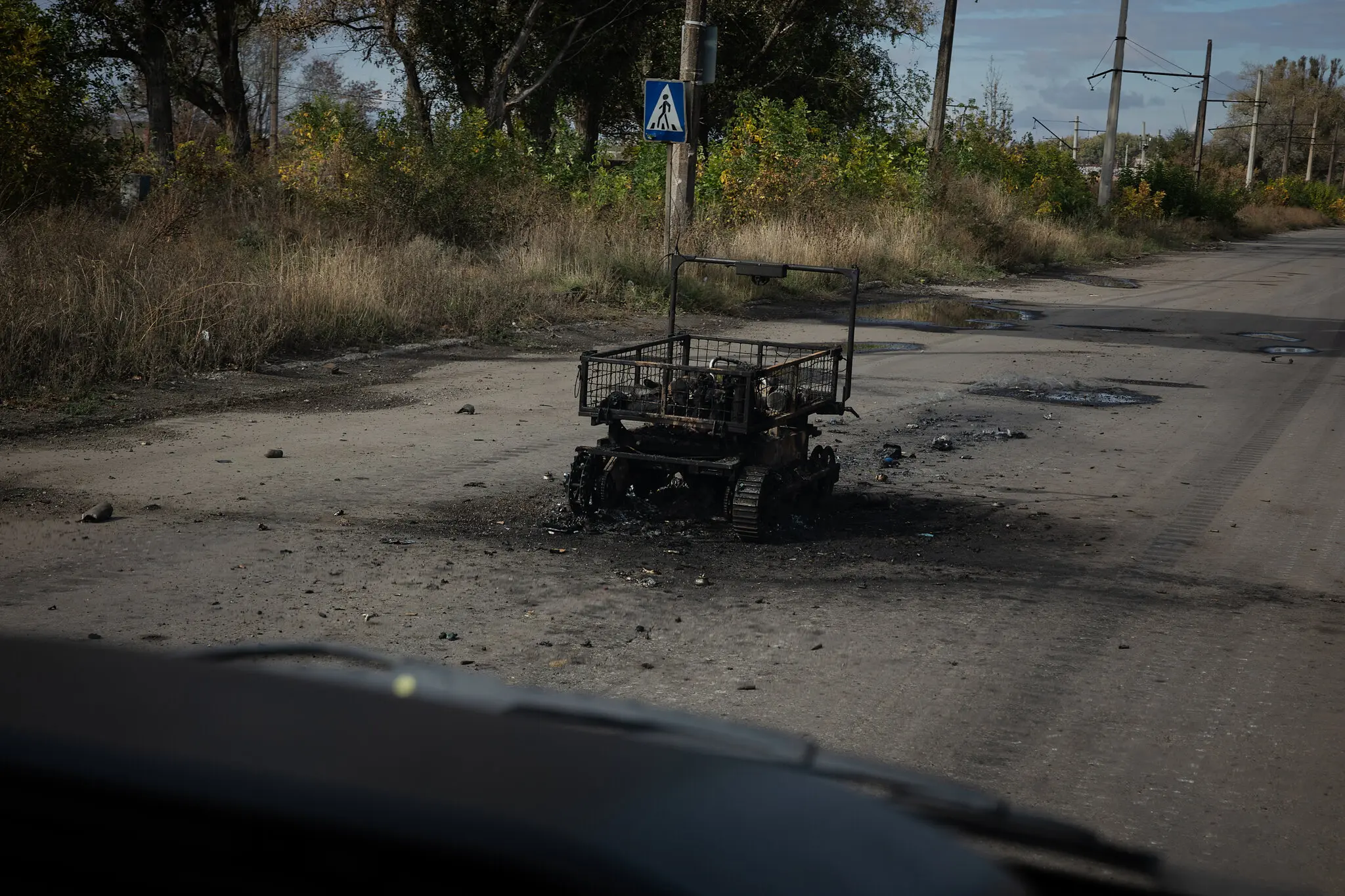
In such conditions, a pickup truck carrying ammunition or evacuating a wounded soldier becomes almost an invitation to a Russian FPV drone. It is large, warm, visible, noisy and carries people. A ground robot is slower and often carries less, but it is lower, cooler to thermal cameras, cheaper than an armored vehicle and, most importantly, unmanned. When it is destroyed, no crew dies.
Most Ukrainian ground systems began with logistics. Infantry needed ammunition, water, batteries, tools, boards, mines and food. Sappers carried heavy loads on their backs. Evacuation teams risked their lives to retrieve the wounded or the dead. At some point, the front itself suggested the answer: if the air already belongs to drones, the ground also needs its unmanned carriers.
One symbolic beginning of this story is tied to the battle for Bakhmut. Ukrainian officer Oleksandr Kharkovets, who had worked with automotive electronics before the full-scale war, saw in the city’s ruins what many soldiers see: where a human being must crawl, drag, risk and die, a machine could perform part of the work.
After the withdrawal from Bakhmut, when fallen comrades remained on the battlefield, that thought became not an engineering curiosity but a moral imperative. Kharkovets attached a hook and a machine gun to a remote-controlled vehicle: one element was meant to pull a body, the other to provide cover. After successful use, the idea stopped looking like fantasy.
This is how much of Ukraine’s wartime innovation is born: not from a grand program, but from a specific pain. A load must be delivered — a platform is built. A wounded soldier must be recovered — a chassis is modified. A position must be held — a machine gun is mounted. Shrapnel must be survived — armor is added. Range must be extended — batteries are increased.
Ground robots are especially important for evacuation. A wounded soldier lying between positions often becomes a trap for everyone trying to retrieve him. Russian drones wait for movement, for a second approach, for a rescue team. In such a situation, a robot does not replace a medic, but it can complete the most dangerous part of the route without a human.

One episode shows why soldiers have begun to treat these machines not as equipment, but as a chance. A ground robot traveled several kilometers through enemy territory, was damaged or struck on the way, yet brought out a wounded assault soldier who had lost a leg. People would not have gone there without near-certain risk of death. The machine went.
This does not mean a robot has human flexibility. It cannot instantly jump into a trench, climb over a complex obstacle, make an unconventional decision under fire or intuitively read the ground for signs of mines. But it can move where a human life is too valuable to risk. In a war of attrition, that is enough to change the calculation.
Today, some Ukrainian units perform most transport tasks without sending people into the danger zone. Robots deliver loads, remove equipment, help build shelters, bring ammunition and evacuate the wounded. They do not eliminate infantry, but they reduce the number of movements that once seemed unavoidable.
This is where the central advantage of ground robotization appears: it does not have to kill the enemy to be strategic. If a robot delivers ammunition and a soldier does not go out under a drone, that is already a victory. If it retrieves a wounded man whom people could not have reached, that is already a combat result. If it replaces a pickup on a dangerous route, it has saved a driver.
The economics also favor robots. One armored infantry vehicle can cost as much as dozens of small ground platforms. They are not equal in protection, speed or payload, but the logic of the front is different: dozens of attempts to complete a mission without losing people. A robot can be a one-time risk. A human being cannot.
Ukraine plans to sharply increase production of such systems. The goal is tens of thousands of ground robots per year, a dedicated center for unmanned ground systems and the formation of units that operate not as experimenters but as a new regular part of the force. This means the country no longer treats these machines as auxiliary curiosities.
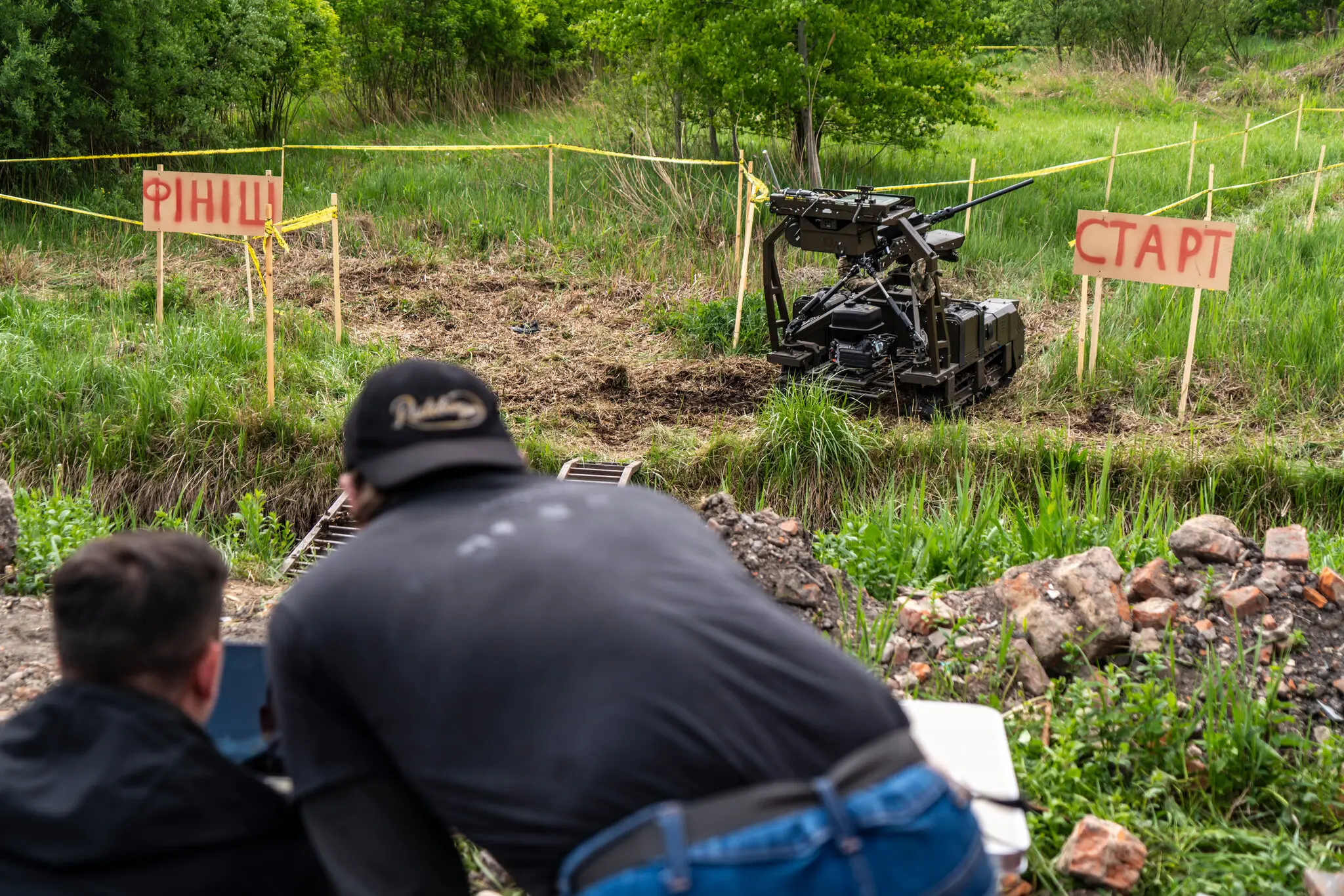 Оператори керують наземним безпілотником під час військових змагань з польотів безпілотників у травні в Трускавці, Україна. Логістика спонукала українську піхоту створювати наземних роботів. Однак зараз солдатів захоплює їхній бойовий потенціал — Брендан Гоффман
Russia also uses ground robots, but Ukraine is moving faster. The reason is not only creativity. The Ukrainian need is sharper. For a state defending itself against a larger enemy, every technology that reduces losses has value not in the future, but today. War forces Ukraine to accelerate where peacetime armies spend years writing concepts.
But the ground has proved harder than the sky. An aerial drone flies over obstacles. A ground robot must move through craters, debris, mud, snow, roots, ruts, wire, minefields and broken roads. It is easier to stop physically. It is slower. It depends on communications, batteries, terrain and whether an enemy drone sees it from above.
On open steppe, such a robot can become a target. In tree lines, it can get stuck. In a city, it can lose contact or hit rubble. In a trench, it may fail where a human can pass. Ground robots therefore do not abolish old infantry warfare. They rewrite its most dangerous fragments.
The next challenge is protecting the robots themselves. Russian FPV drones hunt not only people and vehicles, but also unmanned ground machines. Ukrainian engineers respond with armor, shrapnel protection, tougher wheels, tracks, better cameras, satellite links, longer range and attempts to fit platforms with systems that counter aerial drones.
Friendly fire is also becoming a problem. When armed unmanned machines enter the battlefield, they must be able to distinguish friend from foe. Some units are experimenting with recognition systems so that a turret does not turn on a Ukrainian soldier. This shows that every technological revolution brings not only opportunities, but new risks.
The most radical change begins when ground robots move from logistics to combat. Ukrainian units have already conducted assaults in which ground and aerial drones operated together. Machines armed with machine guns, explosives and other weapons moved toward Russian positions, while aerial drones watched, adjusted and covered the operation.
In April, Volodymyr Zelensky spoke of a Russian position being captured by ground and aerial drones alone, without direct risk to Ukrainian soldiers. If such operations become regular, they will change the very ethics of an infantry assault. The most dangerous first contact with an enemy trench could be taken not by a human being, but by a machine.
This is not yet mass reality, but the forward edge of experimentation. Yet the war in Ukraine has repeatedly shown that what looks exceptional today can become standard practice tomorrow. FPV drones once seemed like a cheap supplement to artillery. Now they are among the main weapons on the front. Ground robots may follow a similar path.
Cases in which armed robots do not merely attack but hold space are especially revealing. A machine with a heavy machine gun can go out on combat duty, shift positions, return to recharge and create for the enemy the illusion of a living unit’s presence. If the enemy does not realize it is facing a robot, the psychological effect becomes an additional weapon.
Here the ground robot becomes a new kind of sentry. It does not tire as a human does. It does not freeze. It does not fear. It does not need rotation in the human sense. It can be lost without a funeral. But it lacks human intuition, moral judgment and full improvisation. The future is therefore not the replacement of soldiers, but a different distribution of risk between humans and machines.
Robotized turrets against aerial drones open another direction. If a ground system can automatically or semi-automatically shoot down FPV drones and hide from thermal cameras between shots, it becomes a form of micro-air defense at the position level. For infantry hunted daily by drones, that can mean the difference between life and death.
This is how the multilayered front of the future is forming. In the air operate reconnaissance, strike and interceptor drones. On the ground operate transport, evacuation, mining, combat and anti-drone robots. Between them are operators, communications, software, electronic warfare, battery power and the constant race of adaptation.
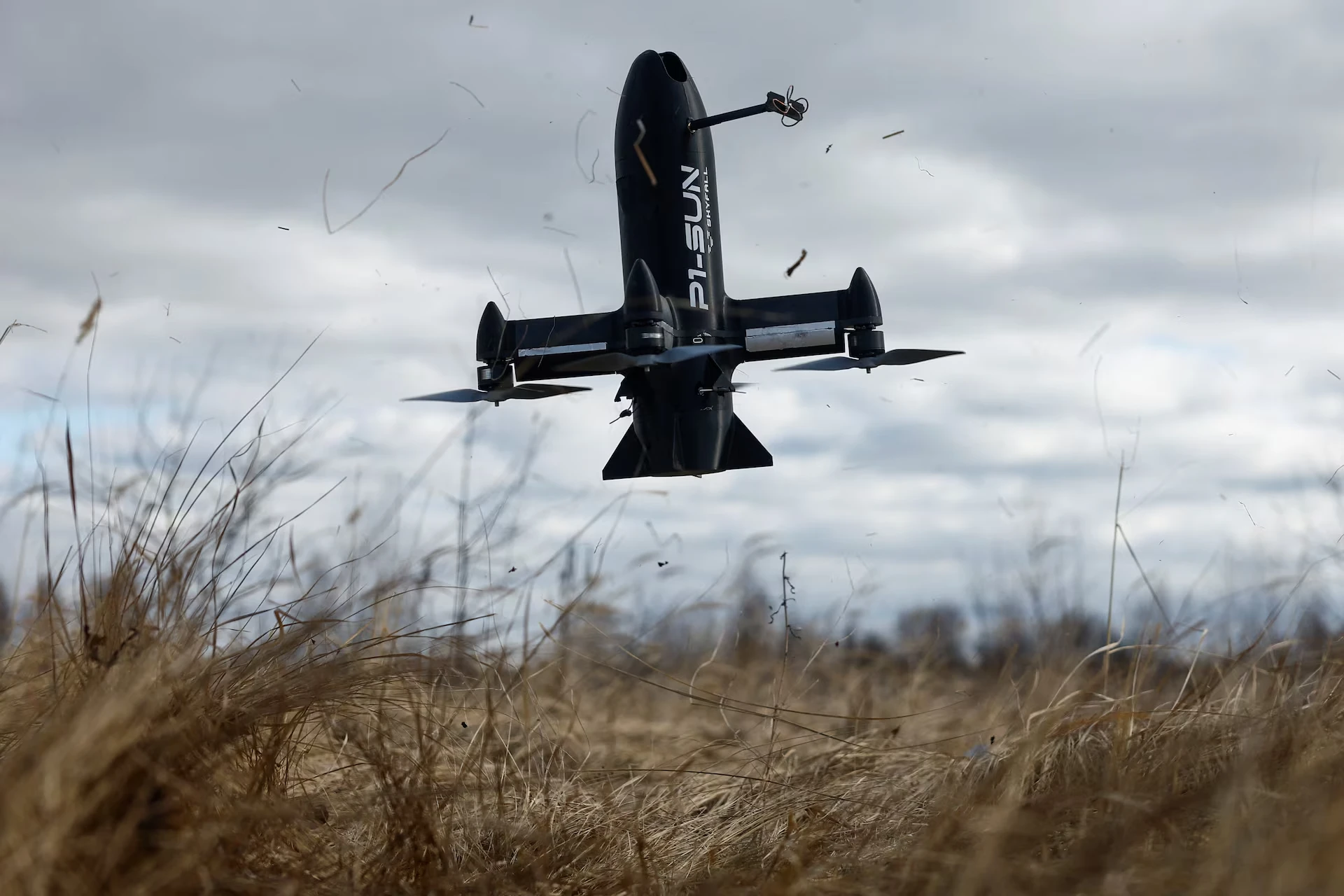
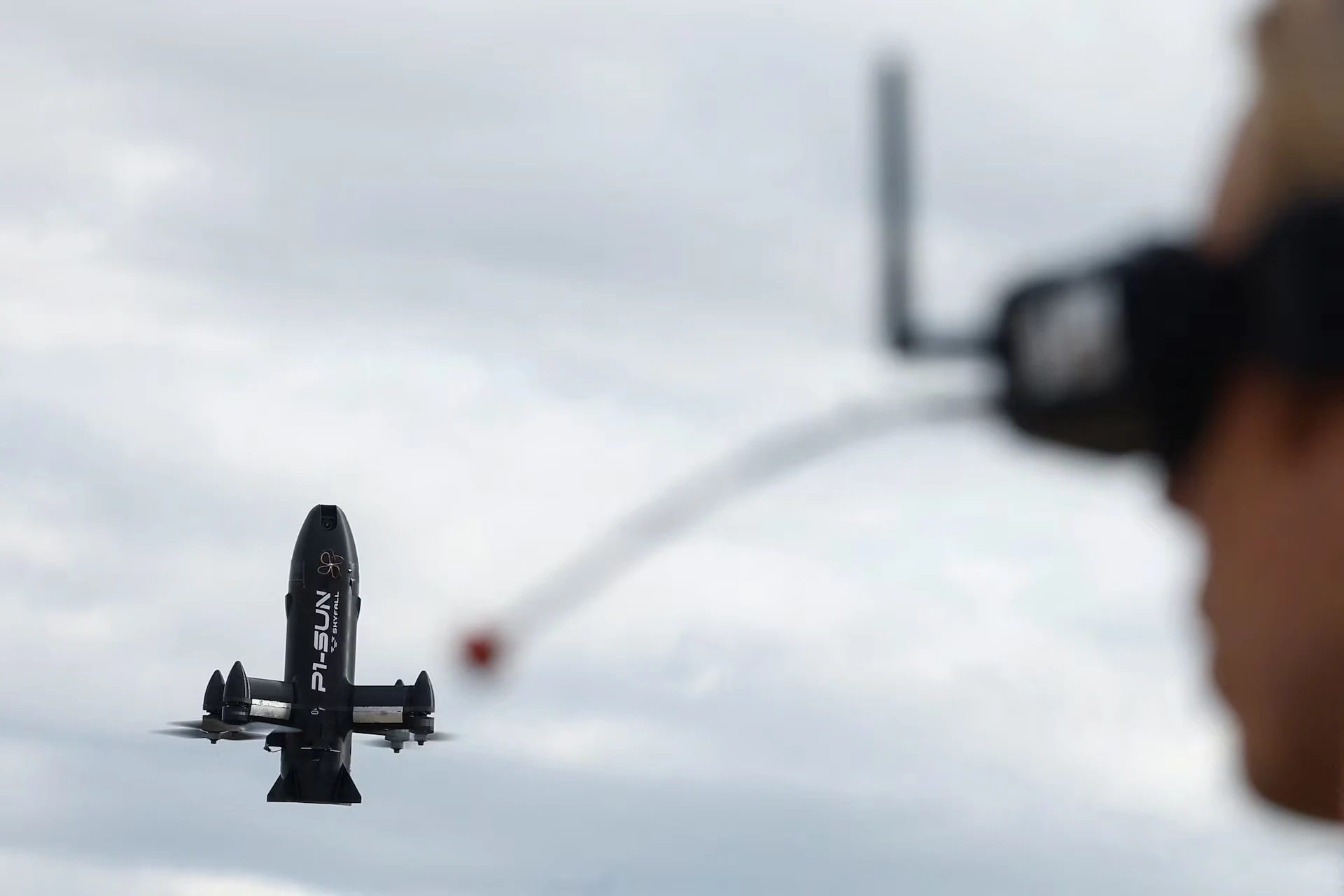


This war increasingly looks less like a clash of individual platforms and more like a contest between ecosystems. The winner is not the side with one best drone or one best robot, but the side that more quickly connects sensors, operators, machines, repair, production, training and tactics. Ukraine’s advantage often arises precisely from that speed.
The human factor, however, does not disappear. Behind every robot stands a crew of operators, mechanics, signal specialists, commanders and infantrymen who define the mission. A machine can move toward a position, but someone must know when to send it, how to bypass danger, where to turn, what to do when the link is lost and when the risk is justified.
Ground robotization is also changing the sociology of the army. Alongside the classic soldier, people who can weld, solder, program, repair controllers, tune antennas, fix tracks, read terrain and understand infantry tactics are becoming increasingly important. This is a new kind of frontline craftsman, somewhere between engineer and fighter.
The Ukrainian army has always had a strong volunteer and workshop culture. It appeared in armored pickups, field workshops, early drones, communications systems and the repair of Western equipment. Ground robots have simply raised that culture to a new level. War has become a place where garage ingenuity can affect outcomes faster than a long bureaucratic cycle.
But scaling creates a new problem. One successful machine in a unit is innovation. Tens of thousands of machines across the army are an industrial system. Standards, training, repair bases, spare parts, communications compatibility, safety protocols, procurement, testing and honest evaluation of what works and what exists only in presentations all become necessary.
Ukraine has already passed through this with aerial drones. The first stage was enthusiasm and chaos. The second was mass production and competition. The third was integration into doctrine. Ground robots are now moving between the first and second stages, but the pace of war is forcing them to leap across familiar institutional steps.

It is important not to fall into the illusion of total robotization. War on land will remain dirty, physical and human. Trenches must be dug, positions must be held, decisions must be made under the fear of death. Robots will not abolish soldiers. But they can ensure that soldiers less often go where a drone, mine or sniper is waiting.
That is the real revolution. Not the image of a robot with a machine gun, but the reduction of unnecessary deaths. Not a fantasy of an army without people, but an army that protects people better. For Ukraine, where every trained fighter carries strategic weight, that difference is not moral rhetoric. It is military reality.
Russia will adapt too. It will look for ways to jam ground systems, strike workshops, copy successful designs, create cheap interceptors and saturate the front with its own robots. As in the air, the advantage will not last forever. Every new Ukrainian tool becomes an object of Russian hunting.
The decisive question will therefore not be who first used a ground robot, but who learns faster how to update it after every loss. War already works like an accelerated evolutionary mechanism: a weak design dies, a successful one is copied, tactics change, the enemy responds and the cycle begins again. On the ground, that cycle is only gaining speed.
Armies around the world are watching Ukraine closely. Many countries have spoken for decades about the robotized battlefield, often in the form of expensive concepts, exhibition platforms and cautious tests. Ukraine is doing it differently: not because the future is beautiful, but because without the future, people die today.
That is why its experience may change military thinking far beyond Donbas. Ground robots will become an important part of armies preparing for war under constant drone observation. Logistics, evacuation, mining, position defense, anti-drone protection and assaults will increasingly be planned with unmanned ground platforms in mind.
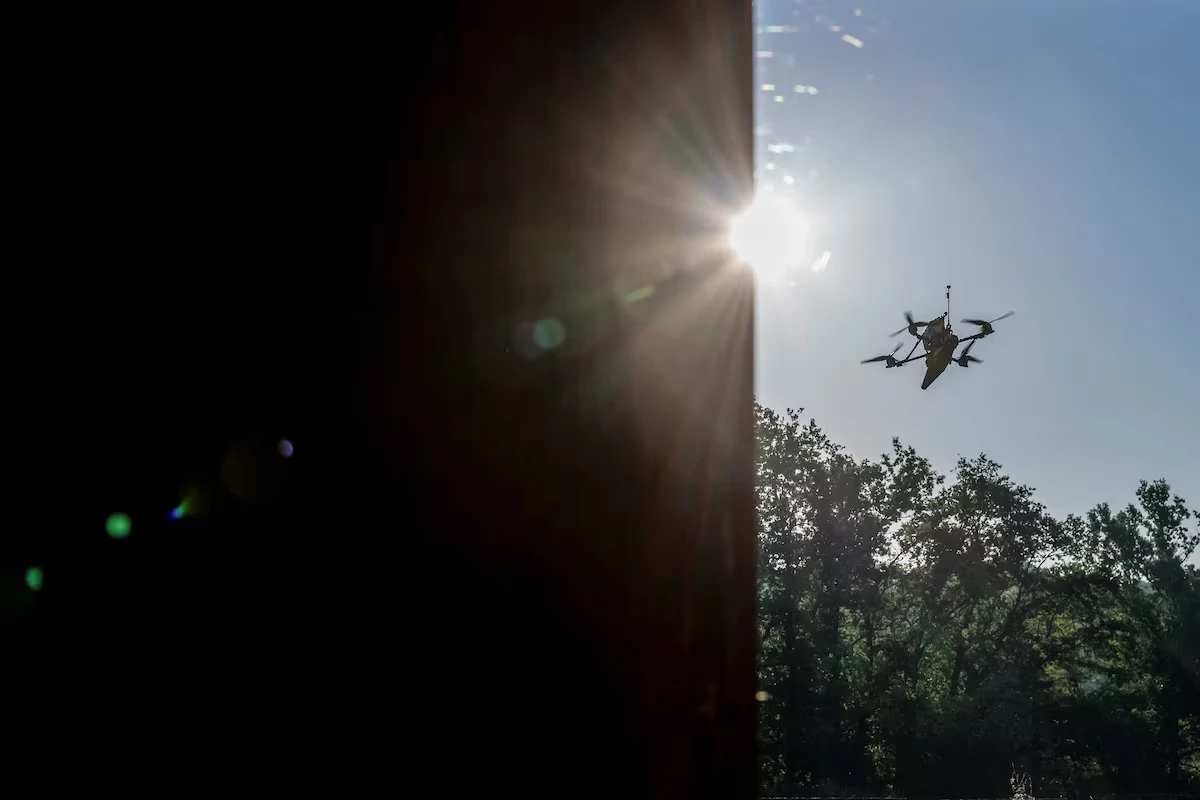 Український дрон з оглядом від першої особи (FPV) пролітає поблизу російського кордону в Харківській області, Україна, 14 червня 2024 року — В'ячеслав Ратинський
For Ukraine, this is not future theory but daily practice. Machines crawl through snow and mud, carry boards for bunkers, return with wounded soldiers, burn under Russian drones, are rebuilt in workshops and head out the next day for another mission. There is no futuristic shine in this. There is a simple frontline logic: if a robot can go instead of a person, it should go.
The war in Ukraine is entering a phase in which robotization is no longer a separate direction, but part of infantry thinking. A soldier in a bunker, an operator with a controller, a mechanic in a workshop, an aerial drone above a position and a ground machine on the route are not separate worlds. They are one new order of battle.
This order is still raw, dangerous and imperfect. Robots break down, get stuck, are destroyed, lose contact and require constant modification. But the first aerial drones once looked the same. The Ukrainian front has already shown that imperfect technology, used intelligently and at scale, can change war faster than perfect technology waiting years for approval.
Ukraine’s ground robot army does not mean future battles will become bloodless. On the contrary, it is being born from an extraordinarily bloody war. But it shows the direction of the modern front: away from the soldier as the universal carrier of all risk, and toward a system in which machines take on some of the most dangerous tasks.
That is the deeper rupture. Ukrainian infantry is not disappearing. It is changing its way of existing on the battlefield. It is gaining metal carriers, medics, sentries and assault troops that have no fear, but do have a price. And if that price preserves a human life, a ground robot stops being just equipment. It becomes a new form of frontline time, bought for those who still have to return alive.