





















Ukraine has turned drones from the forced answer of a weaker army into a strategic technology now watched far beyond Europe. What began as a way to stop Russian columns has become the language of a new defense industry — fast, cheaper, flexible and tested by war.
For Asia, that experience carries particular weight. Japan, Taiwan and the Philippines live in a geography of islands, straits, maritime routes and Chinese military pressure. Their question is not abstract: how to stop a stronger adversary before superiority in fleets, aircraft and missiles becomes political coercion.
That is why UFORCE chief executive Oleg Rogynskyy’s trip to Tokyo was more than a business presentation. His message to Japanese officials and defense companies was direct: produce thousands of Ukrainian drones to defend yourselves and your allies. Behind that sentence stands a war in which the technology has already proved its value.
For Daycom, this story marks a new stage of Ukrainian agency. Ukraine is no longer only a recipient of weapons. It is becoming a supplier of combat knowledge to countries preparing for crises in their own regions and seeking not theory, but tested instruments of deterrence.
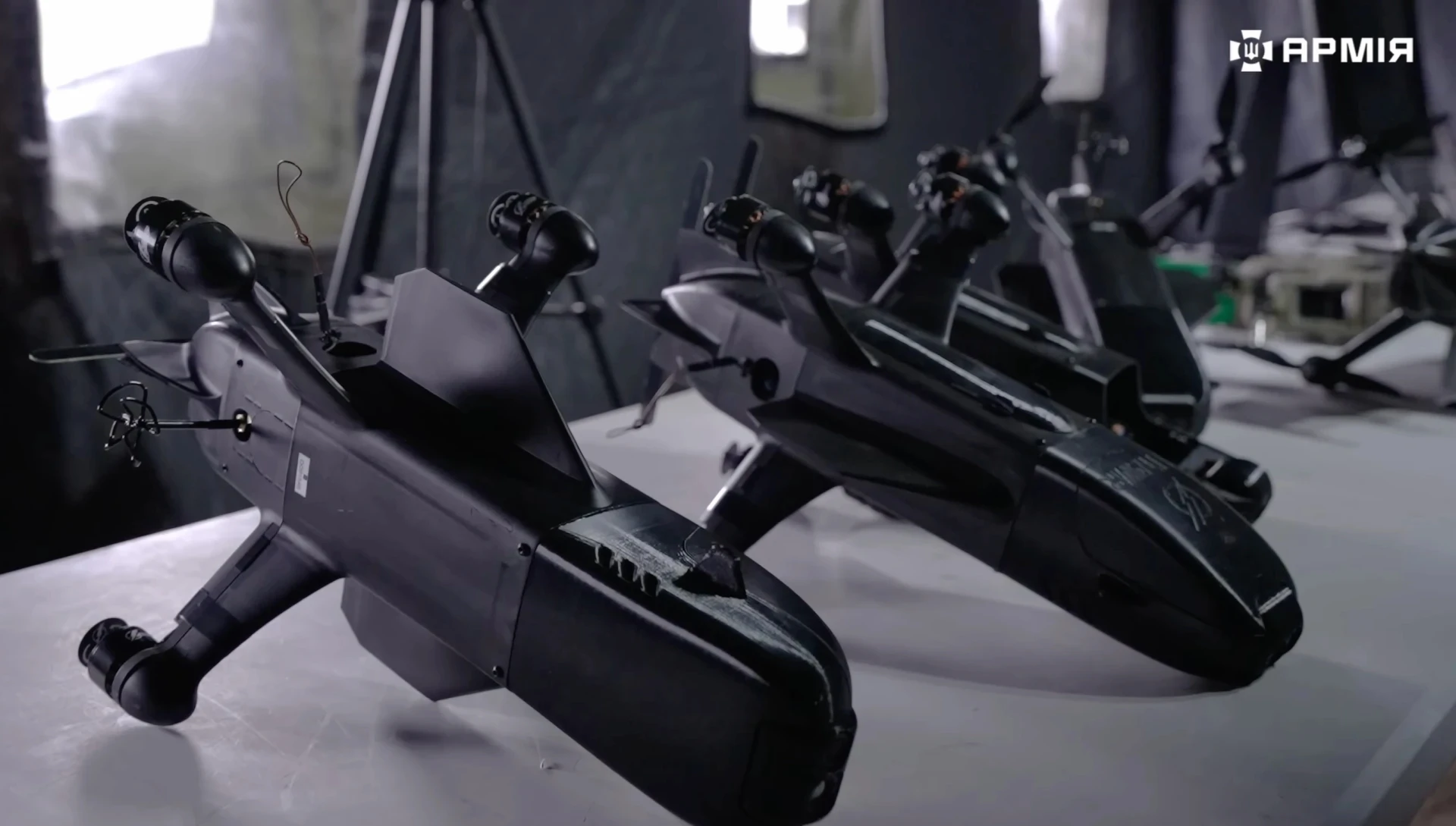
Ukraine’s strongest argument is the sea. Magura surface drones helped change the balance in the Black Sea and turned parts of it into dangerous zones for the Russian fleet. Ukraine did not have symmetrical naval power, but found a way to strike large ships with cheaper, maneuverable and difficult-to-predict systems.
For East Asia, that lesson is concrete. The maritime geography is different, but the logic is similar: islands, narrow passages, bases, amphibious risks, supply lines and the need to buy time for allies. In a Taiwan scenario, drones may not destroy the entire force of an adversary, but they can turn its operation into chaos.
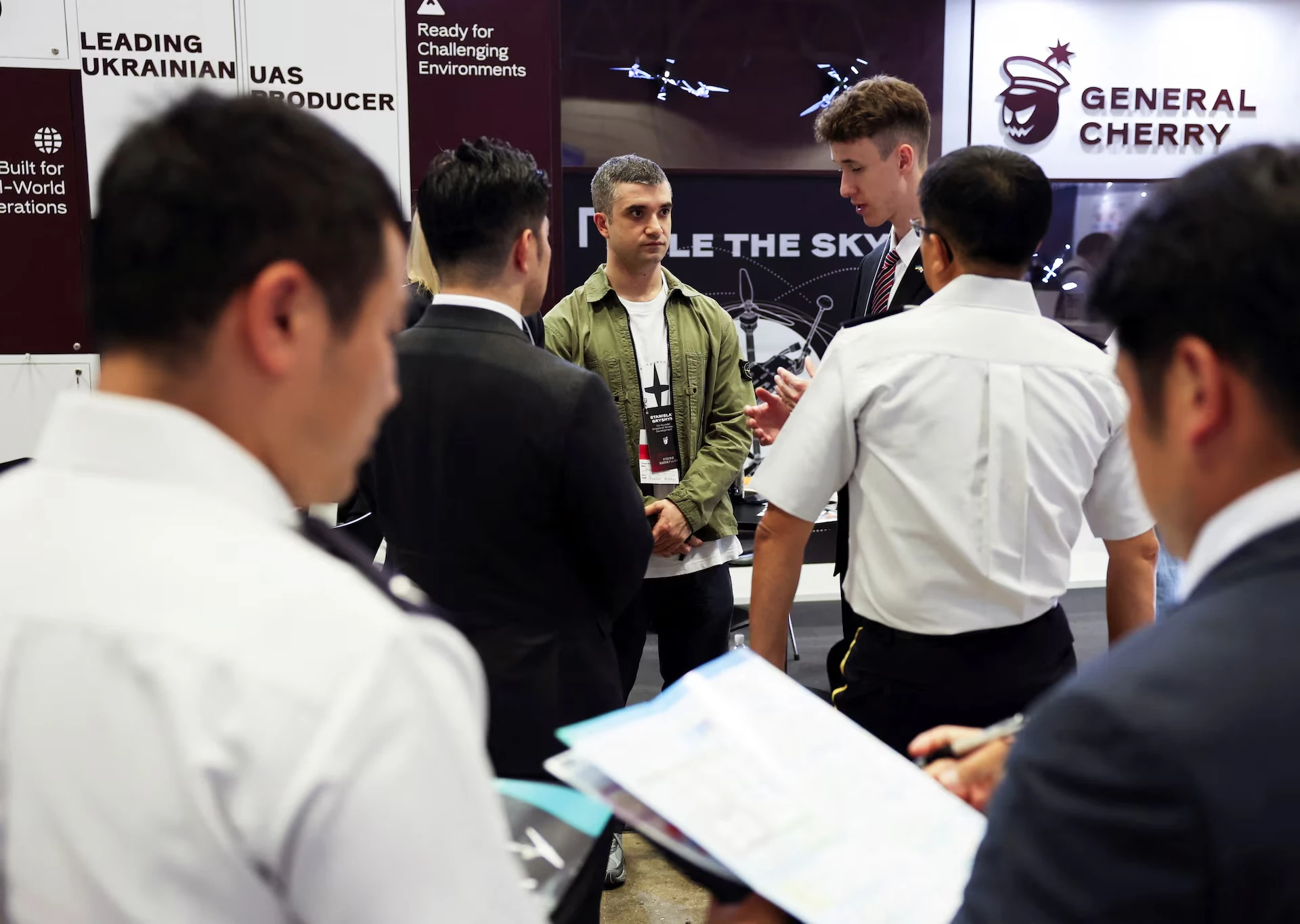 Станіслав Гришин, співзасновник та директор зі стратегічного розвитку та управління проектами української компанії-виробника дронів «General Cherry», спілкується з представниками Сухопутних сил самооборони Японії на стенді компанії під час виставки «Japan Drone 2026» та «International Advanced Air Mobility Expo» у місті Чіба, що на схід від Токіо, Японія, 5 червня 2026 року — Іссей Като
American commanders have already spoken of an “unmanned hellscape” around Taiwan — an area saturated with cheap, mass-produced systems designed to delay a Chinese operation, break the tempo of a landing and give the United States and its allies time to respond. Ukraine’s experience shows that this concept is not fantasy.
This is where UFORCE, Skyeton, General Cherry, Swarmer and other Ukrainian manufacturers see an opening. They cannot compete with major defense corporations in capital, but they possess something different: years of full-scale war, daily iteration, adaptation to electronic warfare, losses, mistakes and solutions born not in presentations, but at the front.
Japan is their main gateway into Asia. It is an industrial power with a deep engineering base, high manufacturing quality and rising defense spending. After decades of restrictions, Tokyo is gradually revising its approach to arms exports and building its own “new way of warfare” — with drones, sensors, missiles and networked systems.
Japan’s interest is easy to understand. The country has more than 14,000 islands, a complicated maritime perimeter, proximity to Taiwan, tensions with China and a need to quickly close gaps in surveillance and defense. Long-range patrol drones from Skyeton or strike systems from General Cherry could become part of that defensive mosaic.
Yet the Japanese market is difficult. Local defense companies have spent decades in a culture of caution, while many large industrial groups earn heavily from civilian goods, including in China. For them, weapons are not only profit, but reputational risk. Ukrainian companies will have to sell not only drones, but a new political norm.
The presence of Ukrainian firms at Japanese exhibitions, meetings with potential partners, technology demonstrations for military units and support from Ukrainian diplomacy show that the process has already moved beyond talk. It remains exploratory and cautious, but major industrial ties often begin exactly this way.
The software dimension is especially important. Swarmer is demonstrating systems that use artificial intelligence to coordinate drone swarms. In the war of the future, the number of aircraft will not be the only decisive factor. What matters will be the ability to command them as a single system: finding targets, assigning roles, attacking, bypassing obstacles and operating under electronic warfare pressure.
The Taiwan track is even more sensitive. Ukraine has no formal diplomatic relations with the island, and China watches any contacts closely. But Taiwan is precisely where Ukrainian drone experience may have its most obvious application: the defense of coasts, ports, straits, airfields and narrow routes of a potential operation.
Here, Ukrainian companies are looking not only for buyers, but also for components. China dominates many links in drone production, from motors and batteries to cameras and electronics. For Ukraine, that is a dangerous dependence, because Beijing can restrict exports or influence the availability of critical parts. Japan and Taiwan offer alternatives.
That is why delegations of Ukrainian manufacturers are traveling to Taichung, Tokyo and other industrial centers. They are seeking cameras, microelectronics, sensors, materials, production partners and the ability to build supply chains without the Chinese bottleneck. In drone warfare, a component can matter as much as the platform itself.
The Philippines adds another layer to the picture. Manila is in an increasingly tense maritime confrontation with China and has already become an important defense customer for Japan. If Ukrainian drones for the Philippine market are manufactured in Japan, a triangle could emerge in which Ukrainian technology, Japanese industry and Philippine demand for maritime deterrence meet in a single project.
There is strategic novelty in this. Ukraine is selling not only a product, but the experience of asymmetry. It is showing Asian states that even a stronger fleet or larger army can lose freedom of maneuver if it is met by a mass of unmanned systems, sensors, strike platforms and software-driven coordination.
 5 червня 2026 року на стенді компанії «General Cherry» — українського виробника дронів — на виставці «Japan Drone 2026» та «International Advanced Air Mobility Expo» у місті Чіба, що на схід від Токіо (Японія), виставлені рекламні листівки — Іссей Като
For China, this trend is uncomfortable. Ukrainian experience adapted in Japan, Taiwan or the Philippines could strengthen precisely the links Beijing would prefer to see weak: the first island chain, maritime approaches to Taiwan, distributed defense, autonomous platforms and the rapid saturation of space with low-cost threats.
For Ukraine, this is also an economic opportunity. Its defense industry, grown under the pressure of Russian aggression, needs markets, partners and scale. Contracts in Asia can bring not only money, but access to high-quality components, production capacity and new technological cycles.
At the same time, the risks are real. Exporting combat technologies into a region where tensions over Taiwan could become a major war requires caution. Ukraine cannot afford an open conflict with China, but it also cannot remain dependent on Chinese components while fighting Russia, which enjoys political support from Beijing.
That is why Ukraine’s strategy in Asia will likely be multilayered: fewer loud declarations, more production contacts; less geopolitical rhetoric, more technological practice; fewer formal alliances, more mutual usefulness. This is how small and medium-sized defense companies can shift large balances.
Ukrainian drones have become a global argument not because they are perfect. They matter because they were born in a war where mistakes cost lives and solutions must work tomorrow. For Japan, Taiwan and the Philippines, that is a value no laboratory can buy.
If Kyiv can connect its combat experience with Asian industrial power, it will gain more than an export direction. It will create a new role for Ukraine in the world: a country that not only asks for protection against aggression, but helps others prepare for it. This is no longer the periphery of war. It is Ukraine’s emergence as one of the centers of the drone revolution.