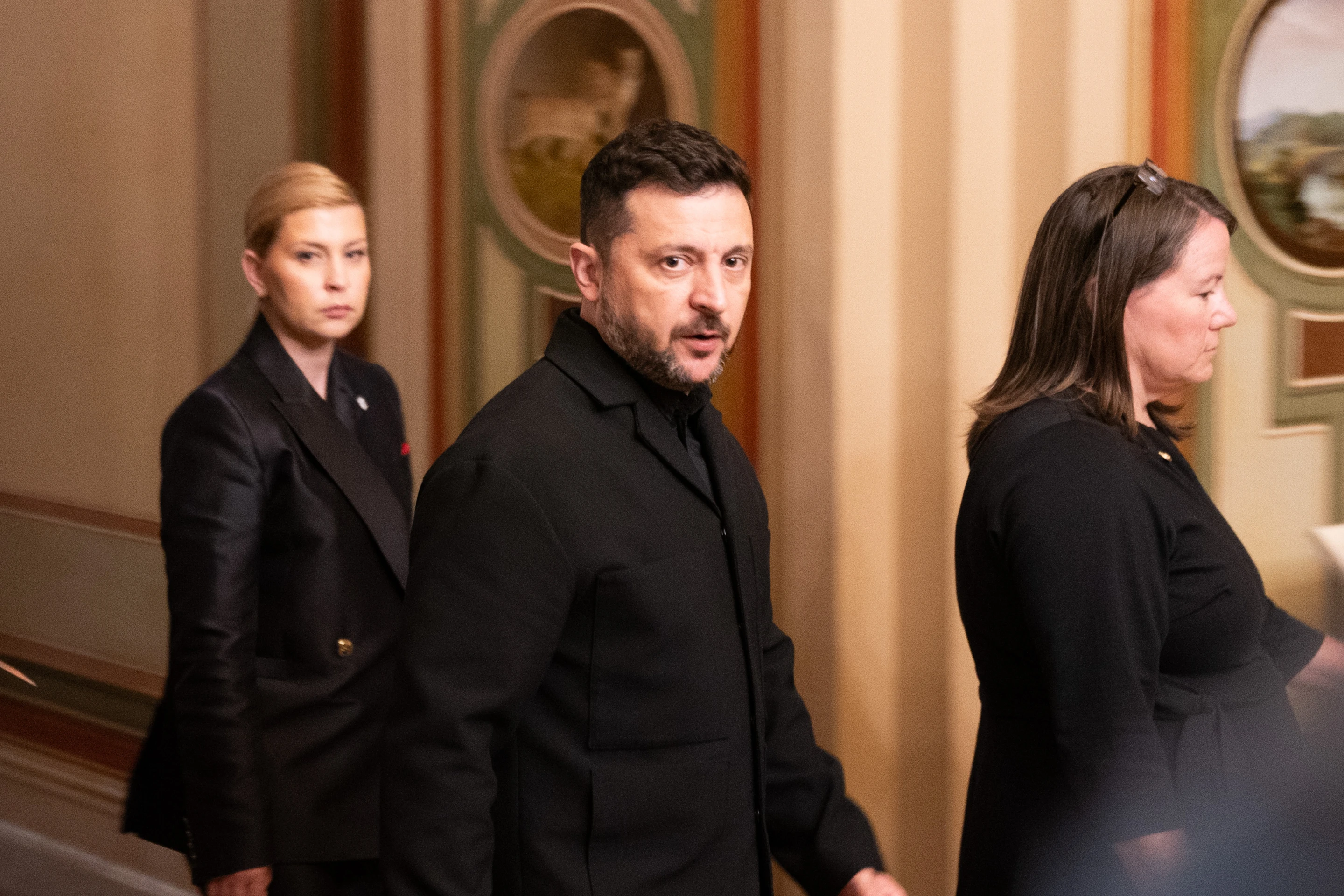


















Volodymyr Zelensky answered the Kremlin’s latest hard-line statement not with a matching diplomatic formula, but with irony. He noted that over more than four years of full-scale war, Russia’s leadership has repeatedly set new deadlines for capturing Donbas — and repeatedly moved them back.
It was more than a jab at Russian military planning. Zelensky was trying to expose a deeper weakness: Moscow speaks in the language of inevitable victory, but its calendar increasingly fails to match battlefield reality. Donbas, which the Kremlin has long presented as the central objective of the war, has still not become a completed Russian conquest.
The remarks followed Vladimir Putin’s rejection of a Ukrainian proposal to limit long-range strikes and his insistence that Russia would continue seeking full control over Donetsk, Luhansk, Zaporizhzhia and Kherson regions. Moscow presents that position as consistency. For Kyiv, it is proof that the Kremlin is not looking for peace unless peace formalizes its territorial claims.
According to Daycom’s earlier analysis, the exchange marks an important shift in wartime rhetoric. Ukraine is arguing less about Russia’s intentions and more about the cost of those intentions. When the Kremlin promises an offensive, Kyiv points to delays. When Moscow insists on strength, Ukraine points to fuel shortages, queues and the vulnerability of Russian infrastructure.
Fuel became the second line of Zelensky’s response. He stressed that a state often described as a “gas station” is now facing shortages of its own. The image carries more political force than dry statistics: the war is returning to Russia not only through drones, but through everyday inconvenience that is harder to conceal.
Kyiv presents Ukrainian strikes on Russian oil infrastructure as a precise response to aggression, not as terror. The distinction is central. Ukraine is trying to show that it targets systems feeding the war: refining, logistics, military supply and routes to occupied territories. Russia, in turn, tries to reduce those strikes to an attempt to “distract” from the front.
But the fact that Putin has to address fuel problems at all shows that Ukraine’s campaign has reached a politically sensitive threshold. Strikes on refineries and fuel nodes may not stop Russia’s advance overnight, but they change the cost of sustaining it. A war of attrition is measured not only by trench lines, but by how many resources a state spends on repairs, protection, redistribution and explanations to its own people.
In that sense, Zelensky’s irony about 15 deadlines carries a wider meaning. It is directed not only at Putin, but also at Russian society, which has spent years hearing promises that the “main objectives” will soon be completed. If every new date is postponed, the war stops looking like a controlled operation and begins to resemble a mechanism that keeps extending itself.
After the failed advance on Kyiv in 2022, Russian strategy did indeed concentrate on Donbas. Moscow captured Luhansk region and large parts of Donetsk, Zaporizhzhia and Kherson regions, but it has not turned its declared annexation into full military control. That gap between the Kremlin’s legal fiction and the battlefield map remains one of the engines of the war.
Donetsk region is now the main arena of Russian pressure. Moscow’s forces continue to advance, but the pace does not match the political rhetoric. Every kilometer comes through losses, logistics, artillery, drones, assault groups and destroyed settlements. For the Kremlin, this is meant to look like irreversible movement. For Ukraine, it is slow exhaustion of the enemy.
When Zelensky speaks about Donbas, he is also trying to break Russia’s myth of time. The Kremlin likes deadlines: by winter, by spring, by an anniversary, by an election, by negotiations. Ukraine’s answer is that none of those dates has become final. Russia can set timelines, but it cannot force the front to obey a political calendar.
This matters for diplomacy as well. Putin’s refusal to limit long-range strikes showed that Moscow views any pause only through the benefit it might bring to its own offensive. If a pause interferes with pressure on the front, it is described as a Ukrainian trick. If negotiations do not lead to Ukrainian territorial concessions, they lose meaning for the Kremlin.
Kyiv, by contrast, is trying to show that Russia is the side rejecting successive paths toward peace. Zelensky has publicly proposed a direct meeting with Putin, but Moscow has refused that logic. Ukraine’s position is now hardening: if Russia will not accept diplomatic exits, it must face more obstacles to continuing the war.
That formula combines politics and military strategy. Ukraine cannot simply wait for the Kremlin to change its intentions. It is trying to change the calculation: to make the war more expensive, more difficult, less predictable and less comfortable for Russia’s internal system. That is why strikes deep inside Russia are no longer an appendix to the front. They are part of the future negotiating architecture.
Fuel queues in Russia carry symbolic weight in this context. They do not mean the automatic collapse of the Russian economy, nor do they cancel the army’s ability to attack. But they damage one of the Kremlin’s core promises to its citizens: that the war can continue far away, for a long time, and with little pain in daily life. Once that promise begins to crack, the political cost of the war rises.
Zelensky directly addressed Russians who have not yet been mobilized and are now arguing in fuel queues. This was not only an information tactic. It was an attempt to move the question of war from television abstraction into personal reality: what awaits those who still considered the front someone else’s problem?
This is the new stage of Ukrainian communication. Kyiv is no longer only asking the world for weapons and sanctions. It is also trying to show Russia the internal logic of consequences. If the Kremlin continues the war, deadlines will be postponed, strikes will deepen, and Russian society will increasingly feel what the state promised to keep outside everyday life.
That approach carries risks. Russia will use every strike on its territory for mobilizing propaganda and attempts to portray Ukraine as a threat to civilians. But Kyiv is betting on a different logic: precise pressure on military and energy infrastructure is meant to show that distant, unpunished aggression no longer exists.
Zelensky’s response to Putin was therefore not simply mockery. It was an attempt to change the frame of the conversation. Russia speaks of “liberating” territories it has itself destroyed. Ukraine speaks of deadlines Russia has failed to meet and consequences that are already reaching Russian citizens.
The Kremlin can announce another date for Donbas. It can call a pause a trap, negotiations weakness and refinery strikes irrelevant. But a war of attrition has its own arithmetic. It accumulates not only losses at the front, but shortages, delays, broken promises and anxiety in the rear.
That is what Zelensky is trying to turn into a political argument. If Russia does not end the war, it will keep postponing its deadlines. If it continues demanding Ukrainian regions, it will increasingly pay for that demand at home. And if Moscow rejects every peace proposal, Ukraine’s answer will no longer be limited to words about peace. It will be built on precision, endurance and the ability to make the war less convenient for the aggressor.