




















A state often reveals its weakness at the precise moment it tries hardest to project strength. The mass arrests in central London were not merely a police response to a demonstration in support of Palestine Action. They became a political message: the British state is increasingly answering disruptive dissent not with persuasion, but with prohibition.
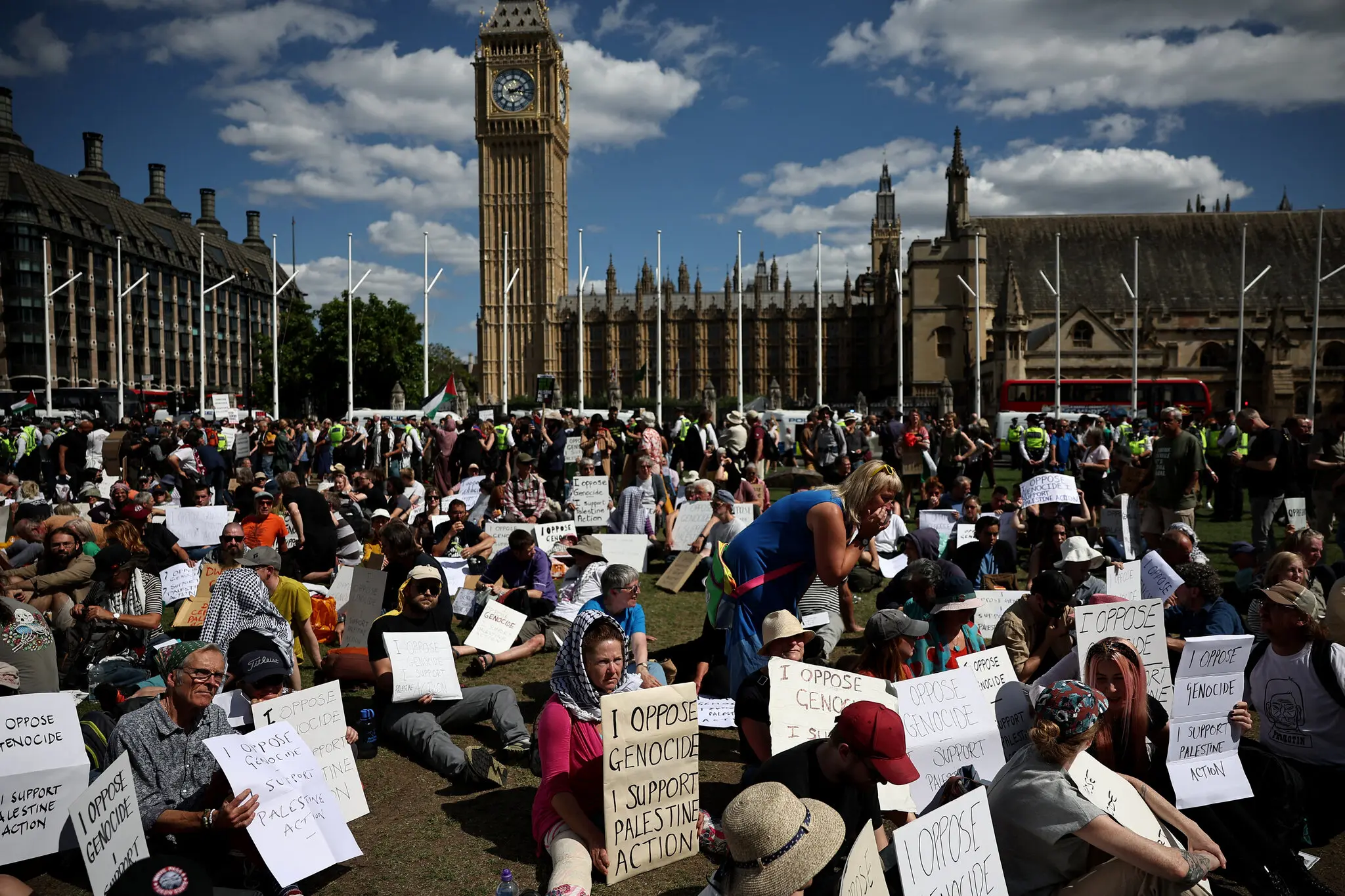
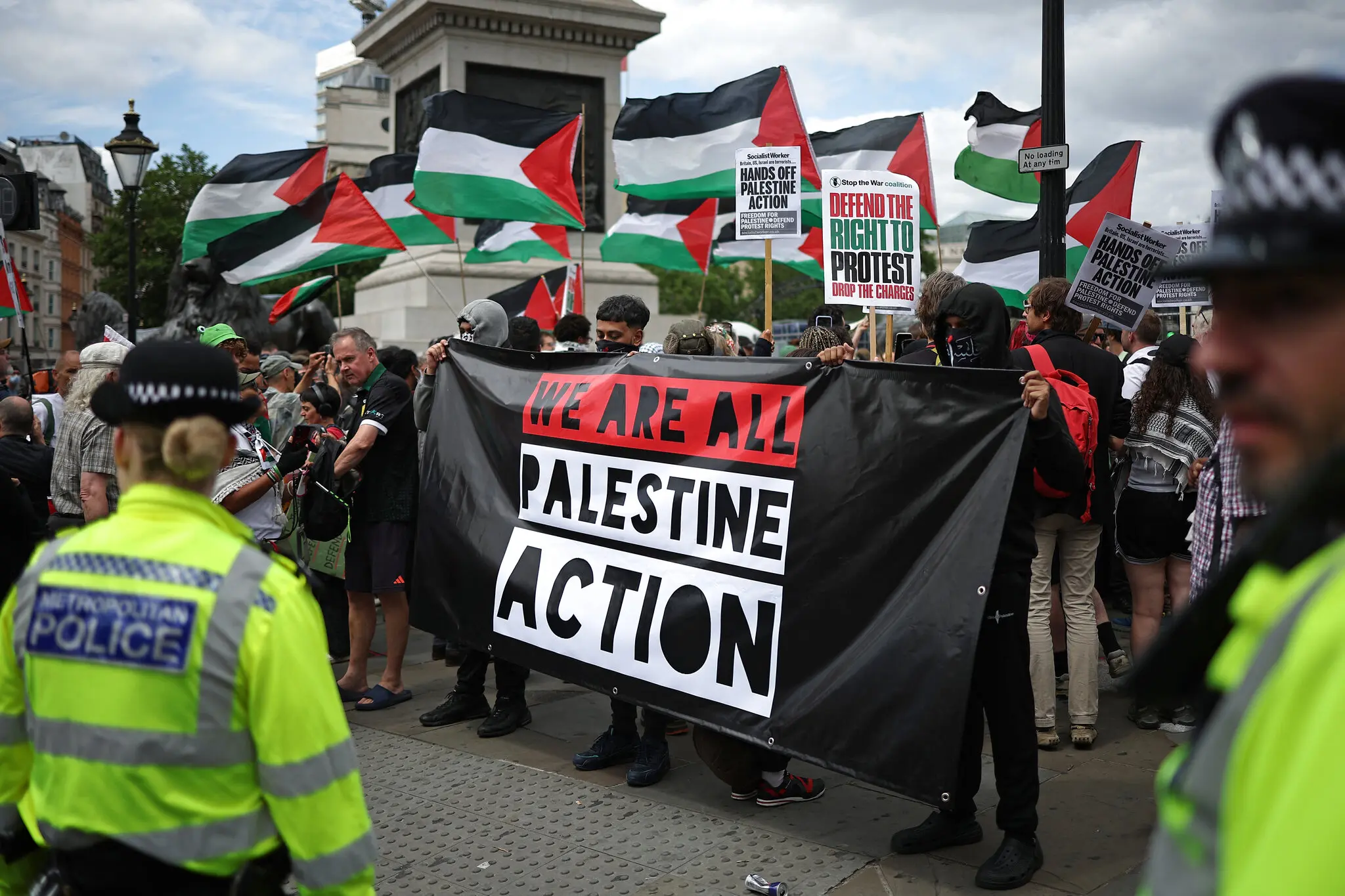
Five hundred and twenty-three arrests in Trafalgar Square are no longer a routine public-order event. That number changes the scale of the story by itself. When hundreds are detained for publicly expressing support for an organization whose status remains legally and politically contested, the issue is no longer only law enforcement. It becomes a struggle over what kind of political gesture the state is prepared to tolerate.
The government’s formal logic is easy enough to understand. After some activists breached a Royal Air Force base, ministers concluded that a red line had been crossed. Banning Palestine Action under anti-terror legislation was meant to send a clear signal: direct action against military infrastructure cannot be shielded by the language of activism. For the government, it was a matter of state authority.
As Daycom noted in earlier analysis, this is exactly where the most dangerous substitution begins. When the state tries to administratively narrow the space for a confrontational but socially visible political position, it risks not weakening protest but transforming it. A ban ceases to be only a legal instrument and becomes part of a symbolic war between government and street politics.
The central problem is that the British state has not managed to preserve the coherence of its own legal argument. In February, London’s High Court ruled that the ban designating Palestine Action as a terrorist organization was unlawful. That did not amount to a blanket endorsement of the group’s methods. But it did mean something important: the state failed to persuade the court that its legal reasoning was sound enough. From that point on, every new forceful use of the ban has acquired a double meaning, both police and constitutional.
That is why Saturday’s protest carried more weight than an ordinary demonstration. It was the first major gathering after the court ruling, which meant its significance extended well beyond the square itself. For the protesters, it was a show of defiance against the idea that solidarity with Palestine can automatically be folded into extremism. For the authorities, it was a chance to assert that even under legal uncertainty, the state would not surrender its monopoly over defining where political expression ends and support for a banned organization begins.
What matters here is the distinction British politics is increasingly blurring. One category is direct action: trespass on military property, damage to infrastructure, attempts to disrupt the functioning of the state. The other is public protest: placards, flags, sit-ins, symbolic expressions of solidarity with Palestinians. When the state responds to the second in the language designed for the first, it begins to erode its own legitimacy.
The issue is not that the state seeks to protect security. The issue is that it is showing a growing preference for using its hardest legal tools in a field where much of society still sees political conflict, not terrorist threat. And the larger the arrest totals become, the harder it is for the government to claim that this is simply a narrow and proportionate application of the law rather than an attempt to discipline an inconvenient form of solidarity.
The war in Gaza has created a particular strain inside British politics. On one side are alliance obligations, the language of national security, and a determination to prevent protest movements from sliding into more radical forms of action. On the other is a large, emotionally mobilized part of the public for whom the Palestinian question has become a measure of Western hypocrisy itself. The confrontation around Palestine Action has emerged directly from that fracture.
That is why this story is no longer really about a single group. It is about how British democracy deals with movements that consciously move beyond the comfortable boundaries of approved dissent. If every more confrontational form of antiwar or anti-state activism is rapidly pushed toward the category of terrorist support, then the line between preserving order and suppressing political challenge begins to disappear.
That creates a risk for the government as well. In the short term, mass arrests may look like a display of control. In the longer term, they suggest something less reassuring: a state so unsure of its political authority that it resorts to hundreds of arrests in response to a public sit-in. When persuasion weakens, the temptation to widen police power grows.
The international context makes the issue even more combustible. Britain is now operating in a space where domestic arguments about protest rights are inseparable from the wider moral conflict over Gaza. Any hard decision taken in London is no longer read simply as an internal matter of public administration. It is also read as a position in a larger dispute over complicity, Western responsibility, and the limits of legitimate resistance. That is why each new arrest carries more political weight than it otherwise would.
The government’s effort to appeal the court ruling only deepens the sense of instability. If ministers continue pressing for the broadest and harshest possible interpretation of the law, they will be signaling that the goal is not merely to resolve a legal disagreement. It will look instead like an attempt to establish a precedent: that public support for a militant or disruptive political movement can be interpreted in the widest possible way, and punished accordingly. In that case, the Palestine Action case will not remain confined to pro-Palestinian activism. It will become a reference point for the future of protest politics in Britain more broadly.
This is why the Trafalgar Square protest matters beyond the number of people detained. It showed that the conflict has entered a new phase. The issue is no longer only Gaza, no longer only one organization, and no longer only the technical scope of police powers. It is about how far a modern European state is willing to go in criminalizing political solidarity once that solidarity becomes too visible, too disruptive, and too difficult to manage.
And that leaves the central question. Is Britain truly defending democratic order when it detains hundreds for a public political stance, or is it revealing that it has failed to find a political answer to a protest movement that no longer fits within familiar boundaries? The answer matters far beyond this one case. It will help determine what British democracy looks like in an age of war, polarization, and mounting state anxiety about disobedience.