




















On Ukraine’s front line, war leaves traces not only in soil, houses and human bodies. It has begun entering the smallest forms of life — grass, trees, fields and bird nests, where strands of dry vegetation now sit beside glistening threads of fiber-optic cable.
One such nest, woven from grass and fragments of cable, was found near the line of combat. It looks like a fragile symbol of a new stage of war: nature does not stop even beside the front, but it is forced to build life from the remnants of human violence.
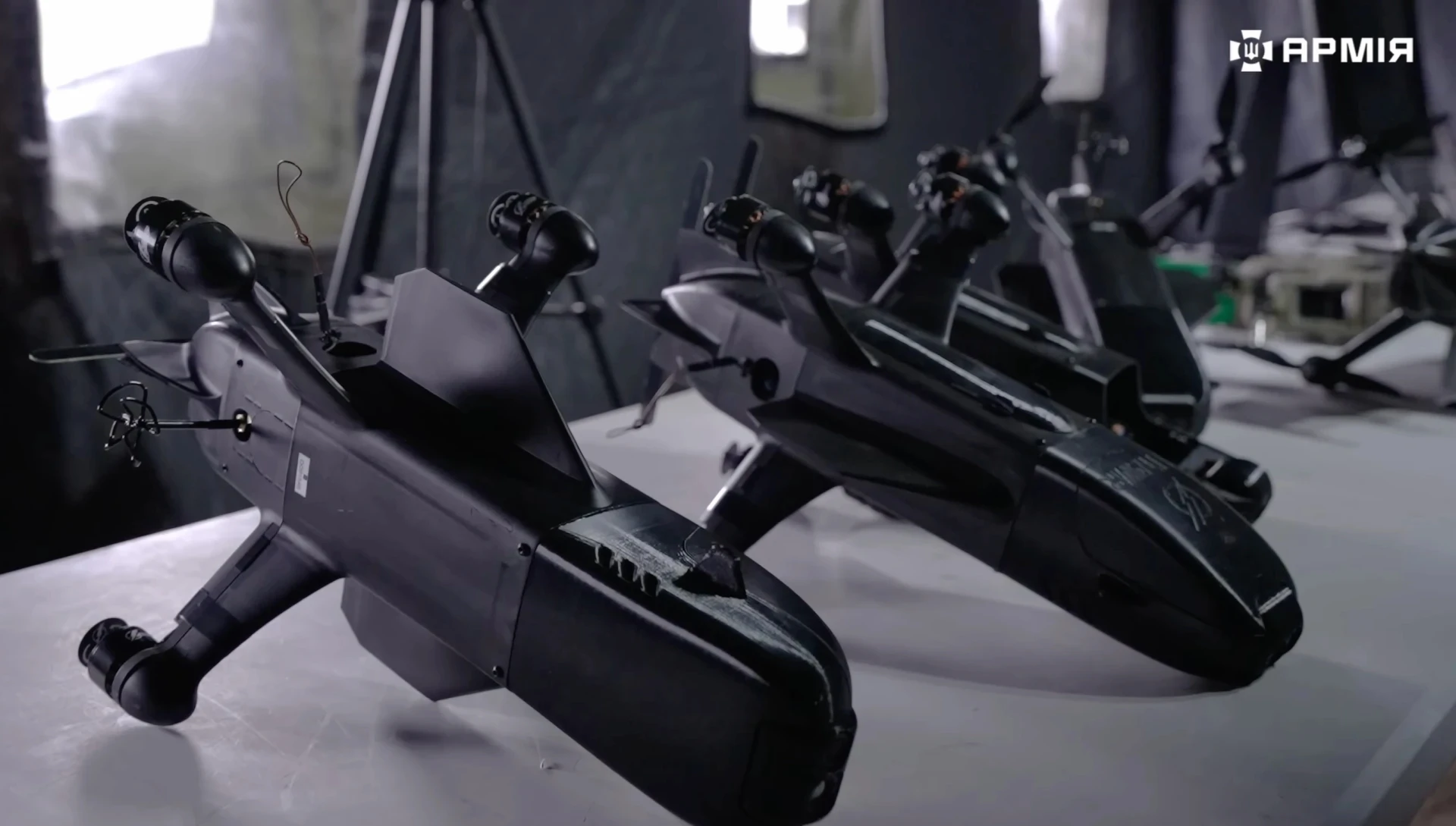
Fiber-optic cables have become part of the modern battlefield. They are used to guide FPV drones, allowing operators to bypass electronic warfare and keep a stable link with the aircraft. Where war once left shell casings, shrapnel and craters, it now leaves kilometers of thin, transparent filament.
According to Daycom’s earlier analysis, these bird nests reveal a rare detail of a larger transformation: the war in Ukraine has become not only a clash of armies, but an environment that reshapes the behavior of living creatures around the front.
The cables can stretch for dozens of kilometers. They hang from trees, tangle in bushes, lie across fields, roofs and roads in front-line towns. In sunlight they resemble giant spider webs, except they are made not by nature, but by the logic of drone warfare.
Ukrainian and Russian forces use these systems for a simple reason: ordinary radio links are increasingly easy to jam. Fiber-optic cable gives a drone a stable connection, makes it less vulnerable to interference and turns a thin strand into a weapon against vehicles, shelters and troops.
But after a flight, the cable does not disappear. It remains on the ground, becoming a new layer of military waste. In Donbas, Kharkiv and Zaporizhzhia regions, these traces are already part of the landscape, alongside metal fragments, anti-tank obstacles, craters and burned tree lines.
Birds nesting in such areas do not distinguish between military technology and natural material as humans do. To them, a thin flexible thread may simply be a useful building element. War enters the nest not as an idea, but as available matter.
This is not the first time birds have used human debris. In cities, they have long woven wire, plastic, string, fishing line and fabric into their nests. But the Ukrainian case has a different scale and meaning: the artificial material here comes not from ordinary life, but from combat.
The consequences may be mixed. Fiber-optic strands can make a nest stronger, help it hold shape and withstand wind. But they may also injure birds, entangle legs, wings or chicks, turning a place meant for protection into a trap.
That ambiguity is what makes the discovery important. Nature is not simply suffering passively from war. It is trying to adapt to it, to absorb its remains into its own cycles, and in doing so it shows how deeply the military reality has entered the environment.
The environmental consequences of war are often described in large categories: mined fields, burned forests, polluted rivers, destroyed reserves, toxic debris, explosives in the soil. A small nest made with fiber-optic cable says the same thing more quietly and more precisely.
It shows that the front is not only a line on a map. It is a space where every meter is saturated with objects of war: cables, fragments, drones, nets, mines, dugout remains and destroyed equipment. For humans, it is a zone of danger. For animals, it is an altered habitat.
More than four years of full-scale war have already created a new ecological archive in Ukraine. It will include not only documents, satellite images and pollution maps, but also physical evidence like this nest: small objects recording how war changes nature.
Scientists may be able to determine which bird species built the nest by studying DNA traces or microscopic remains in the material. But even before laboratory results, the main point is clear: living nature is already interacting with the technologies of war not accidentally, but systemically.
For a museum, such a nest becomes a different kind of exhibit. It does not resemble a weapon, a uniform or a missile fragment. It does not display power directly. On the contrary, it is fragile, almost domestic, and that is why it shows more forcefully how war has entered the fabric of daily life.
A bird’s nest is usually an image of renewal. It means season, offspring, the instinct to continue. But when fiber-optic cable from an attack drone is woven into it, the image changes. Renewal is now taking place inside a damaged world.
This is one of the sharpest signs of modern war in Ukraine. Technologies created for more precise killing do not cease to act after impact. They leave a material trace that is later picked up by wind, grass, an animal or a bird.
Humans often measure war in lost territory, destroyed equipment and casualties. Nature keeps another account — in disrupted migrations, ruined habitats, burned nesting grounds, polluted soils and new dangerous materials entering life cycles.
A bird nest woven with fiber-optic cable will not change the course of the fighting. But it changes our understanding of where war ends. It does not end in a trench, in a report or after an explosion. It remains in a field, where a bird takes a shining thread and weaves it into the future.
That is why this discovery matters more than it first appears. It speaks not of one strange case, but of a new ecology of the front, where life continues among the technological remains of death. Ukrainian nature is not silent about the war. It has begun to weave it into its nests.
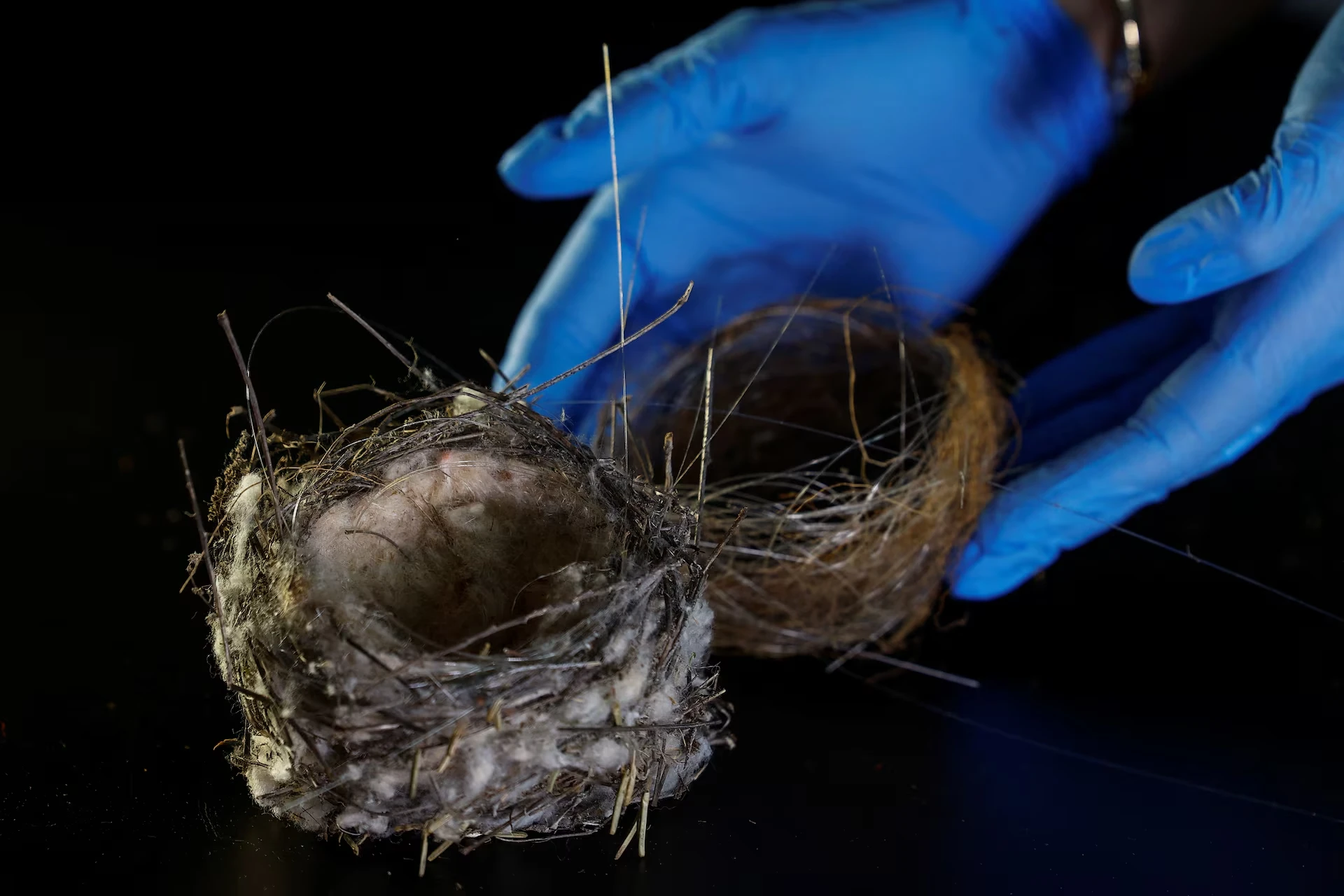 Яна Гринько, старший науковий співробітник Національного музею історії України у Другій світовій війні, показує пташине гніздо, зроблене з фрагментів оптичного волокна, яке знайшов український військовослужбовець на передовій, а потім передав до музею під час нападу Росії на Україну, у Києві, Україна, 23 червня 2026 року. Як українські, так і російські війська використовують дрони, керовані через оптичне волокно, для обходу перешкод радіоелектронної боротьби, залишаючи кілометри надтонких оптичних ліній, що заплутуються в деревах і розкидані по всій землі у прифронтових районах України — Валентин Огіренко