























Viktor Orban wanted to demonstrate control. He produced the opposite. What had long remained a relatively contained annual Pride march in Budapest became, this time, one of the most visible street mobilizations Hungary has seen in recent years. The ban did not stop the parade. It changed its political meaning.
That is the central miscalculation of the Hungarian government. When power tries to frame Pride as a narrow cultural issue, easily contained through rhetoric about child protection, it misses the larger public reading of the moment. The issue no longer concerns only LGBTQ rights. It now touches freedom of assembly, civic dignity, local autonomy and the limits of state power.
As a result, the streets of Budapest filled not only with activists but with people who had never treated Pride as their cause. Many came less for the parade itself than for the act of refusal. According to Daycom’s earlier analysis, this is how political overreach often works: a government tries to isolate one group and instead enlarges the coalition against it.
The legislative move was blunt by design. Fidesz pushed through measures that effectively outlawed gatherings of this kind by extending an earlier campaign against what it called homosexual “propaganda.” For participants, that raised the threat of fines. For organizers, it introduced the specter of criminal liability. The force of the measure only made its political purpose more obvious.
That purpose has been visible for some time. Orban needs to keep his conservative base mobilized at a moment when his dominance no longer looks untouchable. With the economy under strain, public fatigue growing and the opposition gaining confidence, cultural conflict once again became a useful instrument of rule.
The electoral context matters here. The rise of Peter Magyar has altered Hungary’s political geometry. For Fidesz, Budapest Pride was not only an ideological target but a tactical one: a way to drag opponents onto terrain the government prefers, where moral panic, traditional values and fear of liberal Europe can be turned into campaign language.
Yet the city broke that logic. Budapest Mayor Gergely Karacsony recast the event as a municipal celebration tied to Hungary’s regained freedom after the end of Soviet military presence. That was more than a legal workaround. It was a political counterstroke, placing the march inside a national story about liberty rather than leaving it trapped inside a state-defined identity dispute.
That shift explains why the event exceeded its usual frame. The march became a test of who defines public space in Hungary: the central government or the capital, party discipline or civic right, the fear of punishment or the willingness to stand in view of it. The police, by remaining largely on the sidelines, made the state’s ambiguity impossible to miss.
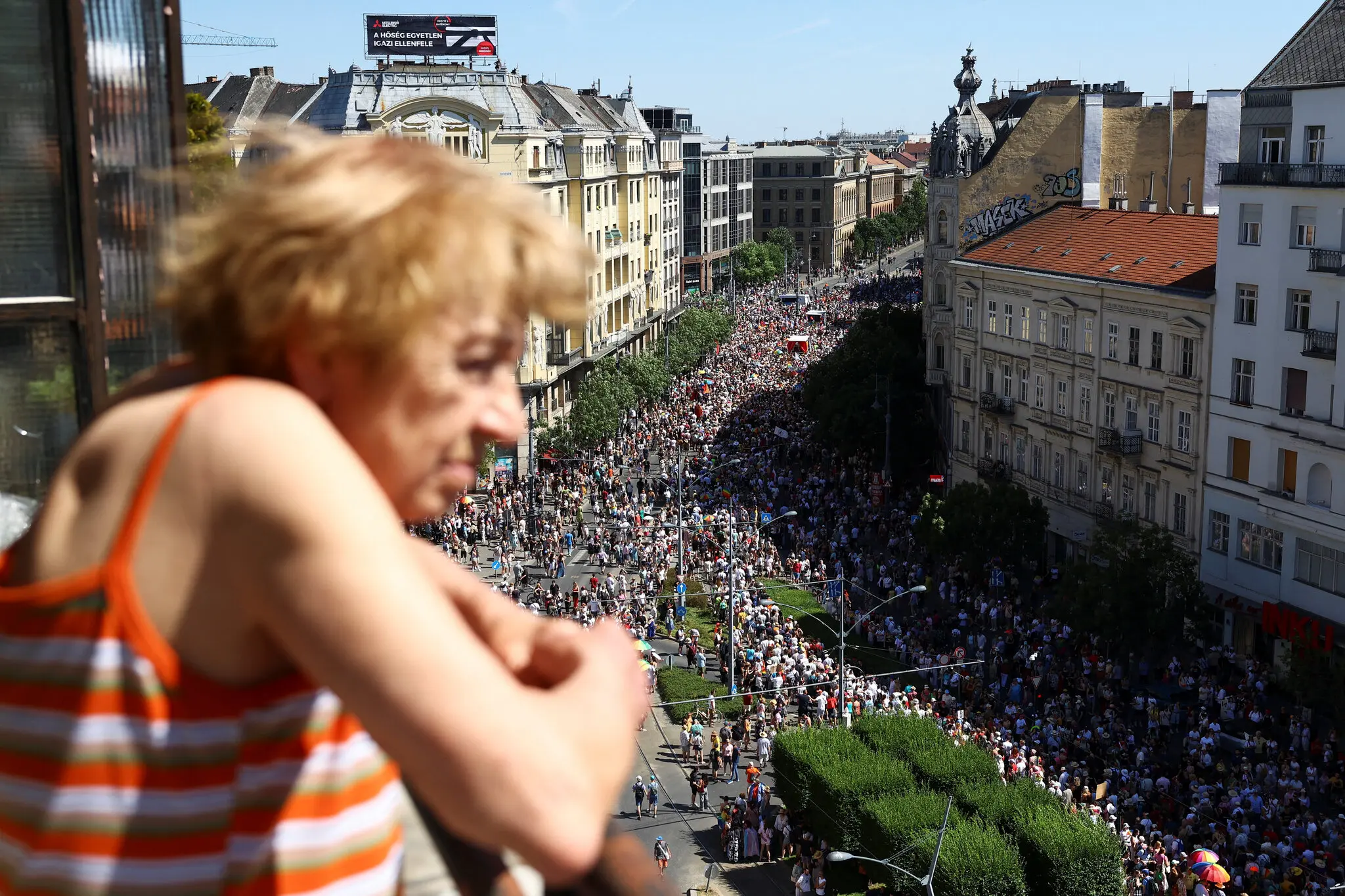 У червні 2025 року на Будапештському прайді зібралися натовпи людей — Бернадетт Сабо
Formally, the government threatened consequences. In practice, it did not dare turn central Budapest into the site of a large-scale confrontation with a massive crowd. For Orban, that is a sensitive line. His political model depends on the projection of resolve, yet it becomes more fragile when rhetoric must be translated into visible coercion before a national and international audience.
Another sign of the government’s failure lay in the composition of the crowd. Many of those who showed up had never attended Budapest Pride before. Some came out of exhaustion with intimidation. Others came out of anger at being treated as if the state alone could decide what counts as danger, morality or public order.
In such moments propaganda can reverse itself. When a government spends weeks preparing the country for imagined chaos, moral collapse and provocation, and the public instead sees a large, disciplined and mostly peaceful march, more than a single narrative falls apart. Trust in the machinery of political exaggeration begins to weaken with it.
For the European Union, the episode carries weight beyond Hungary. Budapest has long clashed with European institutions over rule of law, minority rights and democratic standards. But freedom of assembly marks a sharper threshold. Once a government inside the EU moves to ban a long-standing peaceful march, the dispute is no longer merely cultural. It becomes structural.
That is why the international presence in Budapest mattered. It signaled that this was no longer just a dispute over one parade. The deeper question is how far a government can go in consolidating an illiberal order through family policy, anti-gender rhetoric, media pressure and the constant manufacture of internal enemies.
The opposition, too, received a lesson. Not every political crisis is won through direct participation in the event itself. But every such crisis demands clarity. If Orban turns Budapest into a theater of symbolic coercion, his opponents cannot answer with evasion. They have to defend civil liberties, democratic space and the right to peaceful dissent in direct terms.
The day’s real significance lies not only in the size of the turnout. The banned march proved stronger than the ban itself. The government set out to display the vertical power of the state and ended up exposing the limits of its control. Budapest answered a repressive impulse with a public fact: when power narrows freedom, society can still widen it by showing up and refusing to retreat.