
















China’s missile launch into the Pacific Ocean was not just a military test. It was a political signal aimed at Washington, U.S. allies in Asia and a region increasingly shaped by the possibility of a future clash between great powers.
The missile, launched from a submarine, flew over the ocean and landed near the Solomon Islands. For China, this was a rare format: for decades, Beijing mostly tested missiles within its own territory. Entering international air and maritime space shows a new willingness to demonstrate power openly.
The most important part of the test was not the trajectory, but where it came from. This was about the sea-based component of China’s nuclear arsenal — the area that has long been Beijing’s weakest link. China has rapidly expanded its land-based missiles, but nuclear missile submarines require a different level of capability: silence, endurance, reliability and the ability to strike after an enemy attack.
According to Daycom’s assessment, the launch was China’s attempt to show that its nuclear strategy is moving from a restrained defensive model toward a fuller triad. Beijing wants not only land-based missiles and aircraft, but also undersea forces capable of surviving a crisis and leaving the United States exposed to the risk of unavoidable retaliation.
A nuclear triad matters because of the logic of a second strike. A state whose submarines can remain hidden at sea with ballistic missiles becomes a far more difficult target. Even if its land-based forces are hit, an adversary cannot be sure it will avoid retaliation from the depths of the ocean.
This is where China is trying to catch up with the United States. American ballistic missile submarines have for decades been one of the most reliable elements of global nuclear deterrence. They are quiet, experienced and integrated into a broad system of intelligence and command. China is still building that capability, but the speed of its progress is already changing military calculations in the Pacific.
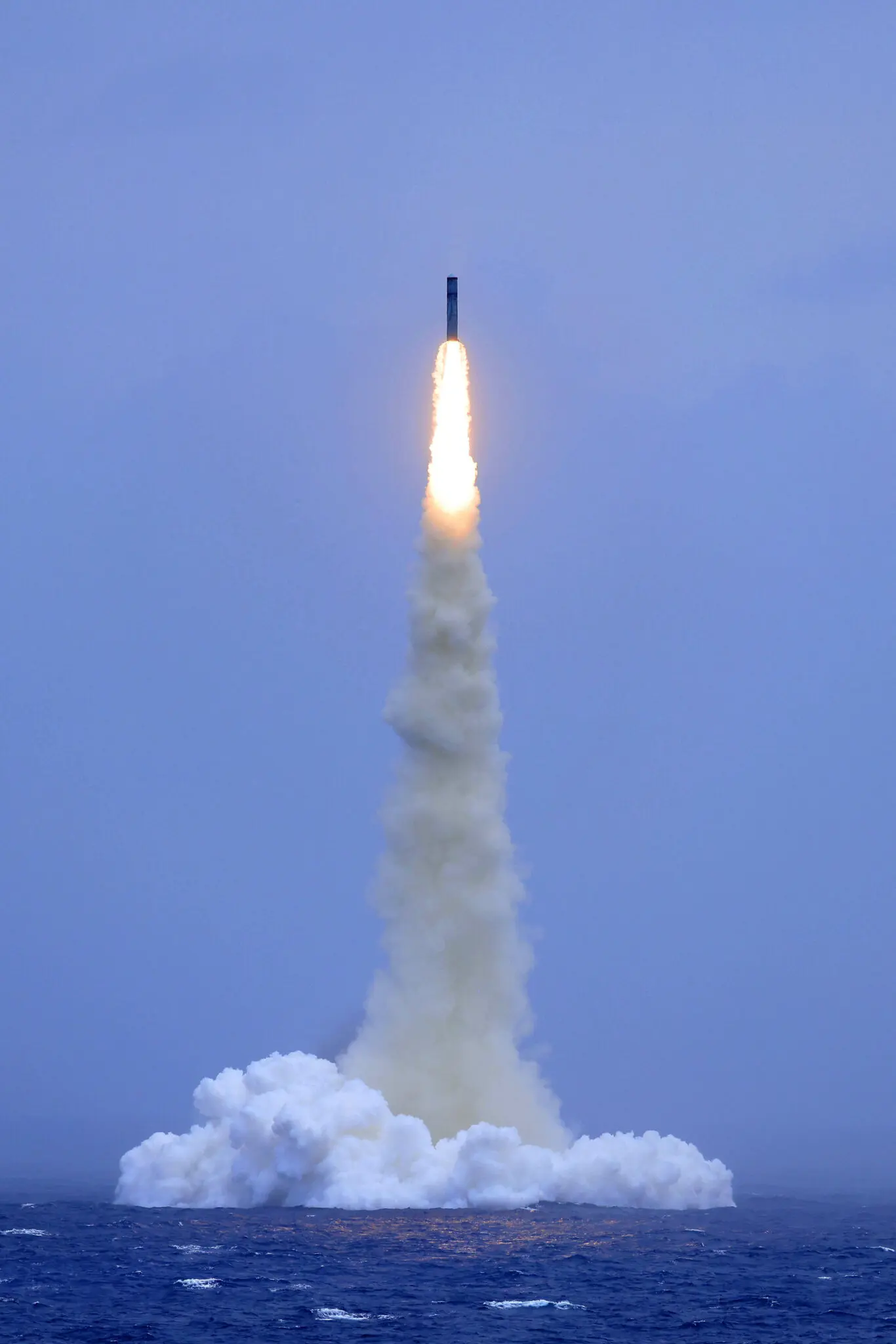 Китайські державні ЗМІ опублікували фотографію, на якій видно випробування балістичної ракети великої дальності, запущеної з китайського підводного човна в понеділок. Це лише третє випробування ракети великої дальності Китаєм через Тихий океан — Лі Сянчао/Сіньхуа, через Associated Press
Beijing’s official rhetoric presents the test as another upgrade of the national nuclear triad. There is exaggeration in that claim: China still does not have the same undersea freedom of action as the United States or Russia. Its submarines have long been considered noisy, vulnerable to detection and limited in their patrol areas.
Yet even an incomplete capability can have strategic effect. If China can launch intercontinental missiles from submarines operating in areas protected by its own forces, it already forces the United States, Japan, Australia, Taiwan and the Philippines to account for a new level of risk. That does not make Beijing equal to Washington, but it narrows the space of American advantage.
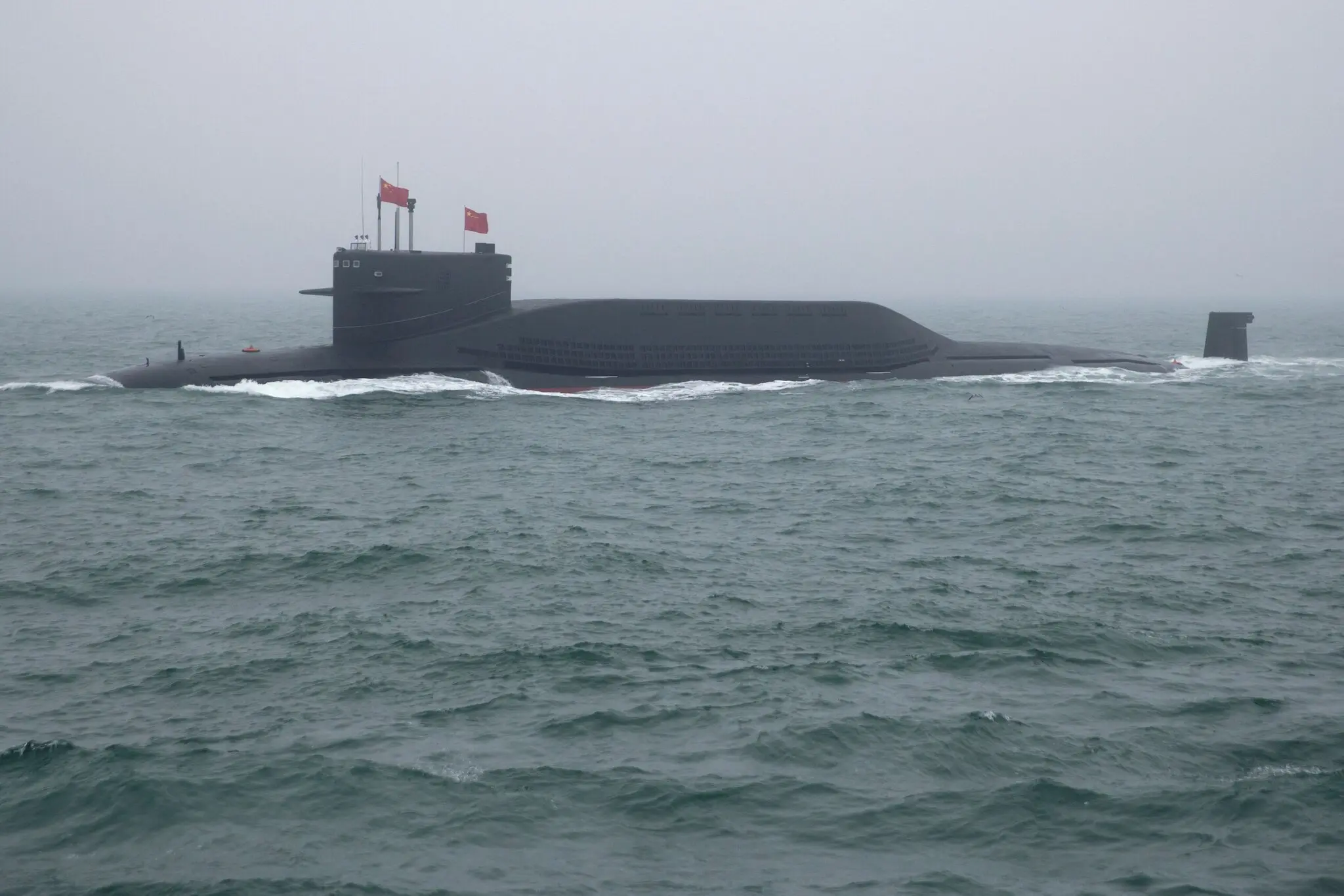
The launch was most likely connected to a JL-3-class missile and a Type 094 submarine, though China traditionally releases few technical details. The demonstration itself matters more than transparency. Beijing is showing not blueprints, but intent: its fleet is no longer limited to coastal defense and regional pressure.
The launch location remains a matter of assessment. Some indications point to the South China Sea; others to the Bohai Bay area on China’s northeastern coast. Both possibilities are revealing. In the first case, China demonstrates confidence in Asia’s most contested maritime space. In the second, it tests a long trajectory from a relatively protected coastal zone.
That fits into what is often called a bastion strategy. Chinese submarines may not immediately try to compete with American submarines across the open ocean. Instead, they can operate near China’s own coast, under the protection of aircraft, surface ships, coastal missiles, sensors and anti-submarine defenses. From those zones, long-range missiles could already threaten significant parts of the U.S. West Coast.
For Beijing, this is a more practical path than an immediate global undersea presence. If China cannot yet guarantee invisibility anywhere in the ocean, it can create areas where American forces would struggle to safely hunt its missile submarines. Deterrence in that model is built not on full freedom of movement, but on protected depth close to home.
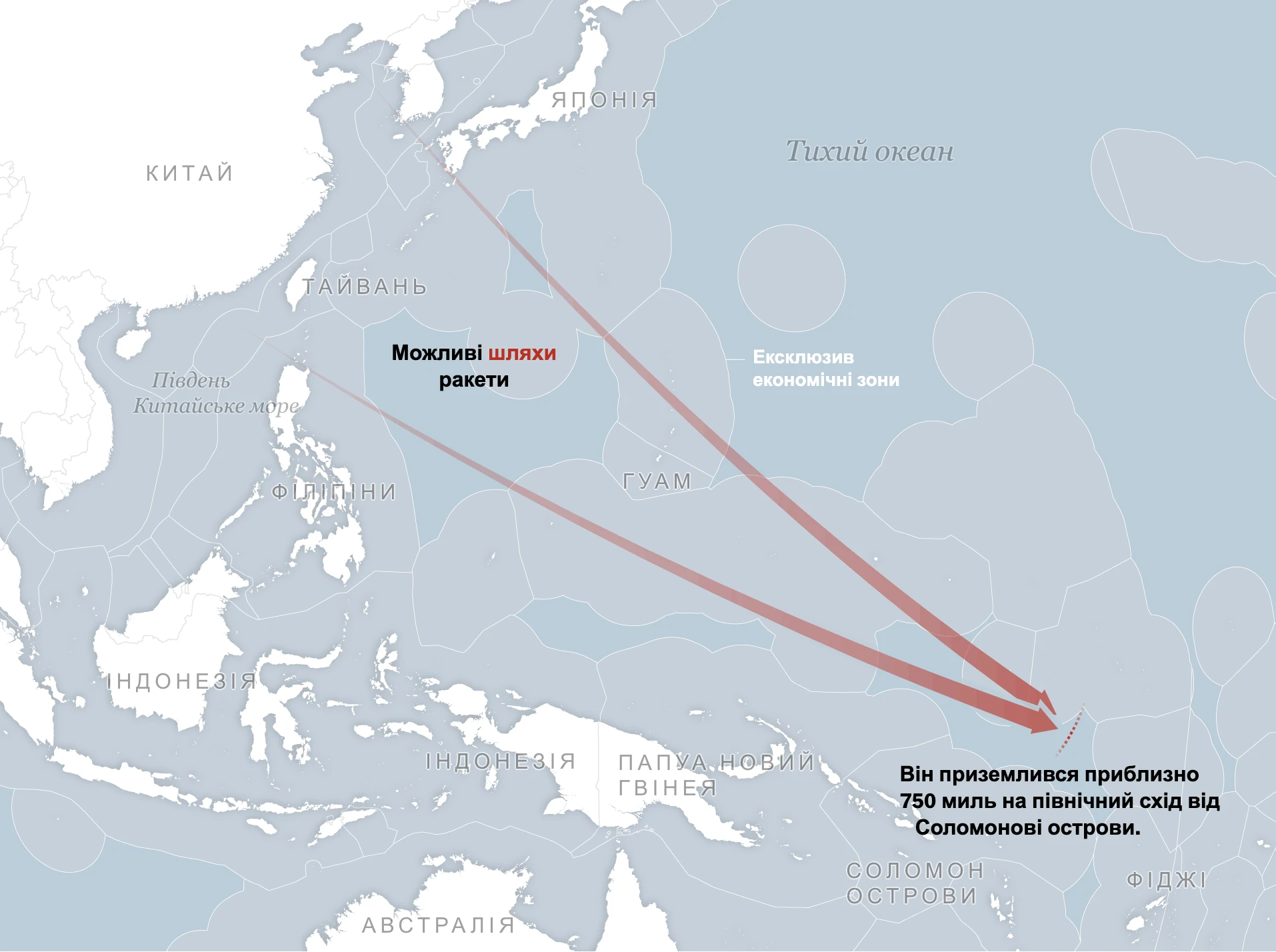 Джерела: Адміністрація морської безпеки Китайської Народної Республіки, Рада національної безпеки Тайваню — Пабло Роблес
The launch also has a regional dimension. In recent years, China has reacted increasingly sharply to the activities of Australia, Japan and the United States in the Pacific. Canberra’s security agreements with island states, Japan’s rearmament, American bases on Guam and support for Taiwan all feed Beijing’s sense of encirclement.
A missile landing near the Solomon Islands is therefore not only a message about technical progress. It is a signal to island nations, Australia and Japan that China can project force far beyond the first island chain. In a region where infrastructure diplomacy and lending have long been intertwined with military competition, such a gesture carries particular weight.
For Taiwan, this is another element of pressure. China’s nuclear triad is not designed for a local landing operation, but it changes the background of any crisis around the island. If Beijing feels more confident that it can deter the United States at the strategic level, it may act more aggressively at the regional one.
That is why Washington watches not only the number of Chinese missiles, but also the quality of China’s submarine fleet. Nuclear balance is not determined by warheads alone. It depends on whether a state can hide its launch platforms, preserve command in a crisis, transmit orders underwater and ensure reliable launch under real conditions.
China’s armed forces are also passing through a difficult internal period. Mass removals of commanders, accusations of corruption and disloyalty, and reshuffles in missile and naval structures have raised questions about the quality of military management. Against that background, a successful public launch also serves a domestic purpose: to show that modernization has not stopped.
For Xi Jinping, nuclear forces are not only a military instrument, but a symbol of status. China claims the role of a state that can compete not only economically, but also withstand strategic confrontation with the United States. A full nuclear triad, in that logic, becomes a mark of great-power maturity.
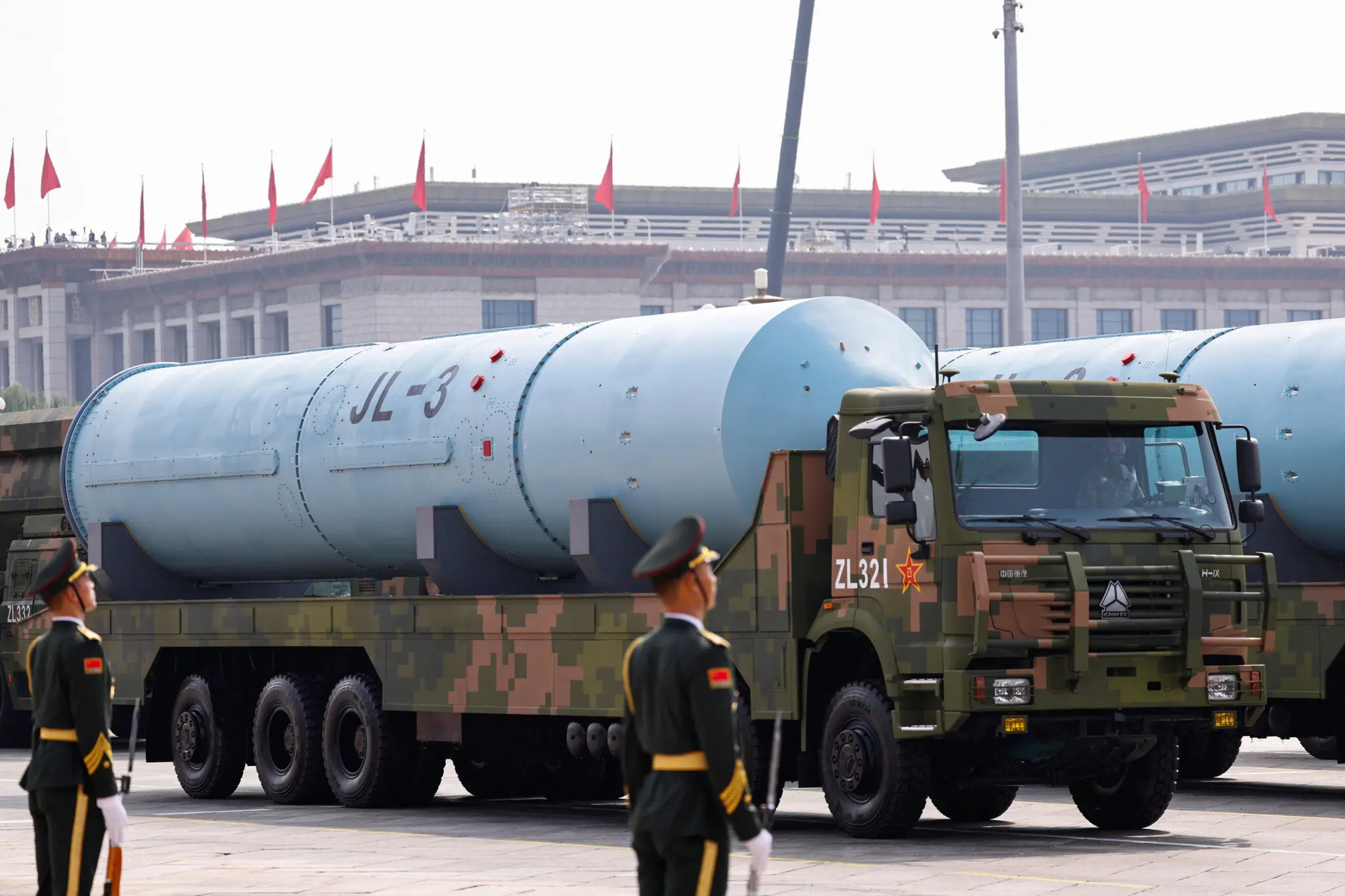 Міжконтинентальна балістична ракета JL-3, продемонстрована під час військового параду в Пекіні минулого року. Пентагон заявив, що ракети були встановлені на підводних човнах типу 094 — Тіншу Ван
But building such power has its own price. The more actively China tests missiles in international space, the more its neighbors see it not as a restrained player, but as a force willing to intimidate the region. Criticism from Japan, the Philippines, Taiwan, Australia and the United States shows that every Chinese signal of strength also pushes others toward countermeasures.
That is how a new race of deterrence is taking shape in Asia. The United States strengthens alliances, Australia develops submarine programs, Japan raises defense spending, and the Philippines opens more space for American presence. China responds with missiles, naval expansion and nuclear buildup. Each step is presented as defensive, but together they create an increasingly dense military tension.
More such tests are likely. China cannot prove the reliability of its sea-based nuclear component without long-range launches under realistic conditions. A domestic test range cannot provide the same experience as an oceanic trajectory, with thermal, atmospheric and navigation conditions closer to wartime use.
For the world, this means that China’s nuclear modernization is entering a more visible phase. Beijing is no longer limiting itself to building silos, mobile launchers and conducting closed tests. It is beginning to display what it once preferred to keep in the shadows: a claim to global sea-based deterrence.
That does not mean China has already caught up with the United States. The gap in experience, submarine numbers, quieting technology, command systems and alliance networks remains significant. But the strategic importance of the moment lies elsewhere: Beijing is showing its direction, its pace and its willingness to risk international alarm in order to display power.
The Pacific launch was a warning about a future in which nuclear stability will no longer be a two-sided story between the United States and Russia. China is entering it as a third major pole — not yet equal in every measure, but powerful enough to change the calculations of others. That is the real meaning of the missile: it fell into the ocean, but its political wave reached every capital in the Pacific region.