






















The drone that crashed into a residential building in Galați, Romania, became another reminder that Russia’s war against Ukraine no longer stays within Ukraine’s borders. It spills into airspace, alerts, fragments, diplomatic notes and the exposed nerves of NATO’s eastern flank.
Romania said the aircraft was a Russian drone that entered its territory during an attack on Ukraine. NATO condemned the incident as dangerous and irresponsible behavior and again stressed its readiness to defend every inch of allied territory.
Vladimir Putin responded in the Kremlin’s familiar manner: he said it was too early to speak of the drone’s Russian origin, suggested it might have been Ukrainian and called on Romania to share information and fragments so Moscow could conduct its own investigation.
According to Daycom’s earlier analysis, that reaction is the key point. Moscow is not so much proving its innocence as trying to create a zone of doubt between the fact of the incident and political responsibility. In modern hybrid war, the pause between impact and conclusion becomes an instrument in itself.
For Romania, this is not a single nervous episode. Since the beginning of the year, the country has recorded airspace violations by drones, found fragments of munitions and repeatedly scrambled aircraft for air policing. Russian attacks on Ukrainian areas near the border constantly increase the risk of another crossing.
That is the danger for NATO. One drone can be explained as a navigation error, interception, electronic warfare or the chaos of a mass attack. But when such incidents repeat, coincidence stops being a convincing framework.
The Kremlin understands the value of uncertainty. A direct strike on NATO territory would be too risky. A series of “ambiguous” incidents, however, allows Moscow to test allied reactions, exhaust air-defense systems, force aircraft into the sky, evacuate civilians and trigger endless debates about intent.
Putin’s formula — first an examination, then conclusions — looks legally careful only on the surface. In practice, it works as a political brake. While allies inspect debris, Moscow gains time and tries to shift the discussion from aggression to procedure.
That is especially clear in his references to earlier drone cases in Finland, Poland and the Baltic states. The Russian president is not merely defending himself. He is building a wider narrative: that the West reflexively blames Russia and later fails to prove guilt.
That narrative has two audiences. For the Russian public, it sustains the image of a country unfairly accused. For the West, it creates fatigue around proof, forcing each incident to begin from zero, as if the broader context of the war did not exist.
But the context does exist. Russia regularly attacks Ukrainian port, energy and civilian infrastructure near EU and NATO borders. Drones and missiles move through an environment in which a trajectory error can instantly become an international crisis. Responsibility for that risk belongs to the state conducting a massive war of aggression.
For Bucharest, the Galați incident has not only military but social meaning. When a strike aircraft falls on a residential building, security stops being abstract. It enters apartments, hospitals, insurance claims, evacuations and political pressure on the government.
For NATO, the problem is broader still. The Alliance was built to deter major attacks, but Russia’s war keeps presenting less convenient scenarios: debris, drones, border crossings, brief airspace intrusions and incidents without an obvious order to attack.
These situations are among the most difficult. They do not always automatically trigger the logic of a major response, but every overly soft reaction creates the risk of another test. If Moscow sees that the threshold for response is high, it may grow bolder in operating near it.
Romania is one of the most vulnerable points in this configuration. Its border with Ukraine, proximity to Danube ports, the Black Sea and export routes make it a natural risk zone. Russian strikes on Ukrainian logistics near the Danube almost inevitably create danger for Romanian territory.
NATO has already strengthened air policing in the region, while Romania has expanded its air-defense capabilities and gained stronger legal tools to respond to drones in its airspace. But an incident in a residential district shows that the problem of low, cheap and mass drone threats cannot be solved by fighter jets alone.
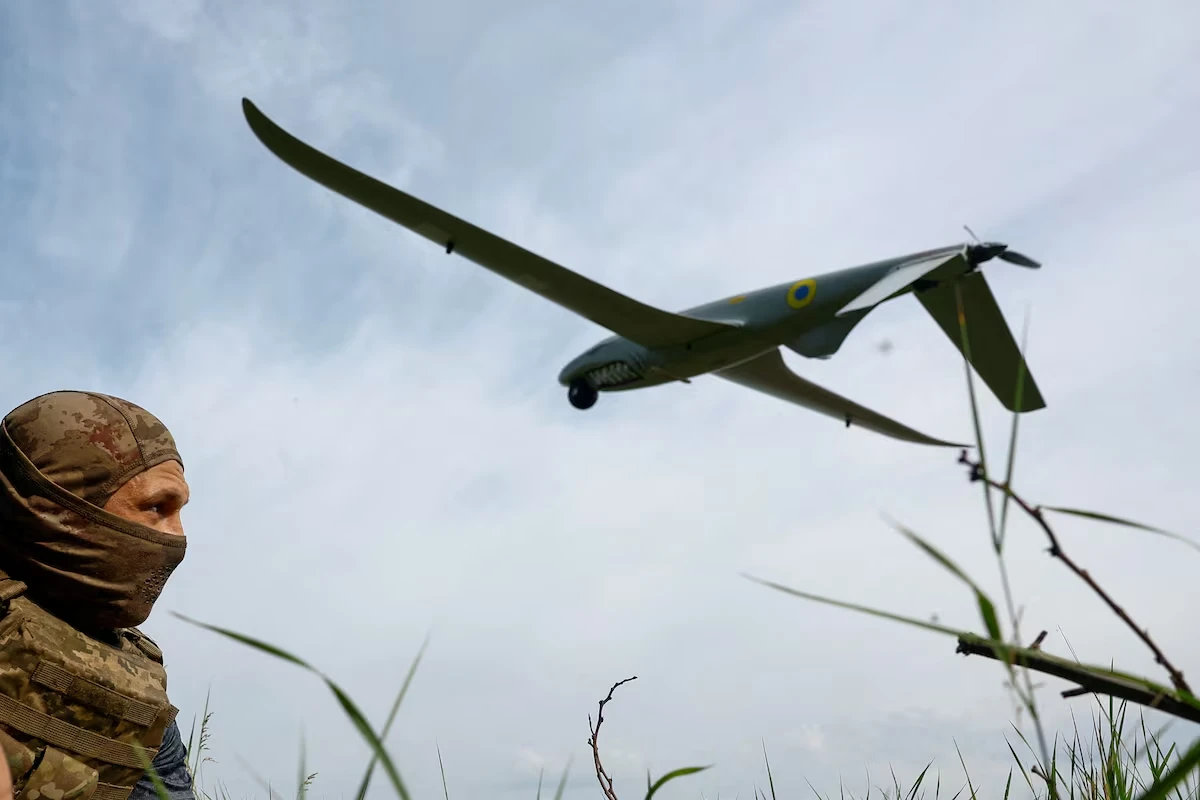
This is a lesson Ukraine absorbs every day. Against cheap drones, a layered system is needed: radars, mobile groups, electronic warfare, small-caliber weapons, interceptors, rapid data exchange and readiness to act within seconds. NATO’s eastern flank is now being forced to learn the same lesson quickly.
Putin’s proposal that fragments be handed to Moscow for its own investigation sounds almost cynical. A state conducting a war and launching mass drone attacks asks to receive evidence so it can determine for itself whether it is connected to the consequences of that war.
But that cynicism is the method. Russia wants to be both the source of danger and a participant in the investigation, both a party to the conflict and an arbiter of doubt. This allows it to delay reaction, blur responsibility and demand equal respect for its version.
The Alliance’s answer must be calm but firm. Not every drone should lead to escalation. But every drone that falls on NATO territory should lead to stronger defenses, faster anti-drone programs and a clear signal: accident cannot serve forever as a shield.
The incident also matters for Ukraine. Every fragment on allied territory reminds Europe that Ukrainian air defense protects not only Kyiv, Odesa or Izmail. It is effectively the forward layer of security for neighboring NATO states.
If Ukraine lacks sufficient interception capabilities, the risk spreads farther west. Helping Ukrainian air defense is therefore no longer only support for a partner. It is protection of Europe’s own border from the chaos of Russia’s air war.
Galați showed the central point: Russia does not need to openly declare an attack on NATO to place the Alliance before a dangerous choice. It is enough to launch a wave of drones at Ukraine, allow a border crossing, deny responsibility and wait to see whether allies again get stuck on the question of whether it was intentional.
That is why the origin of the specific aircraft matters, but does not exhaust the problem. Even if forensic examination is necessary, the strategic picture is already clear: Russia’s war is creating more and more dangerous points of contact with NATO.
Putin says it is too early to draw conclusions. In reality, Europe has long had enough evidence for one conclusion: as long as Russia continues this war, its drones, missiles and denials will keep approaching allied borders. Each case will test not only the origin of the debris, but the strength of the entire deterrence system.