















The European summer increasingly looks less like a holiday season and more like a stress test for states. Western Europe is under a heatwave that is breaking temperature records, taking lives, closing schools, changing work schedules and forcing cities to open temporary cooling spaces.
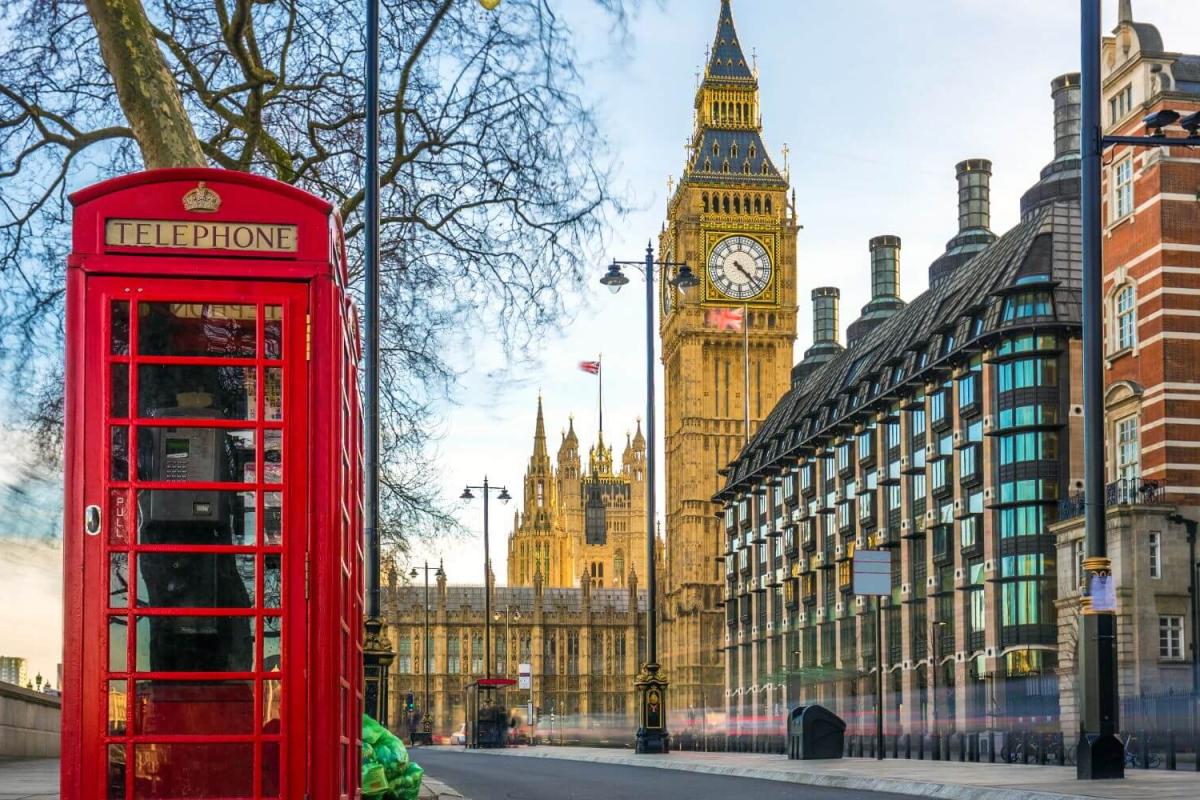
In Britain, temperatures reached 36.1°C in southern England, surpassing the previous June record of 35.6°C, first set in 1957 and matched in 1976. France was hit even harder: in the southwest, temperatures rose above 44°C, while Paris recorded more than 40°C.
This is not simply a series of local anomalies. A persistent atmospheric block formed over part of the continent, trapping hot air and preventing cooler systems from moving quickly into the region. This “Omega block” acts like a lid over an overheated space: heat accumulates, nights fail to let bodies recover, and cities become thermal traps.
According to Daycom’s earlier analysis, the current heatwave matters not only because of the records. It shows that European infrastructure, labor law, energy systems, tourism and urban planning are already living in a climate that is changing faster than political and administrative systems can adapt.
France has become one of the centers of the crisis. Red alerts covered dozens of departments, while the national weather service described the current wave as exceptional in intensity. The country has recorded numerous deaths among people trying to cool off in water, as well as tragic cases of children dying in overheated cars.
Extreme heat quickly breaks the familiar logic of urban life. The Eiffel Tower and the Louvre shortened opening hours, air-conditioning problems in Florence halted ticket sales at one of the country’s leading galleries, London scaled back outdoor ceremonies, and rail operators imposed speed restrictions because of overheated infrastructure.
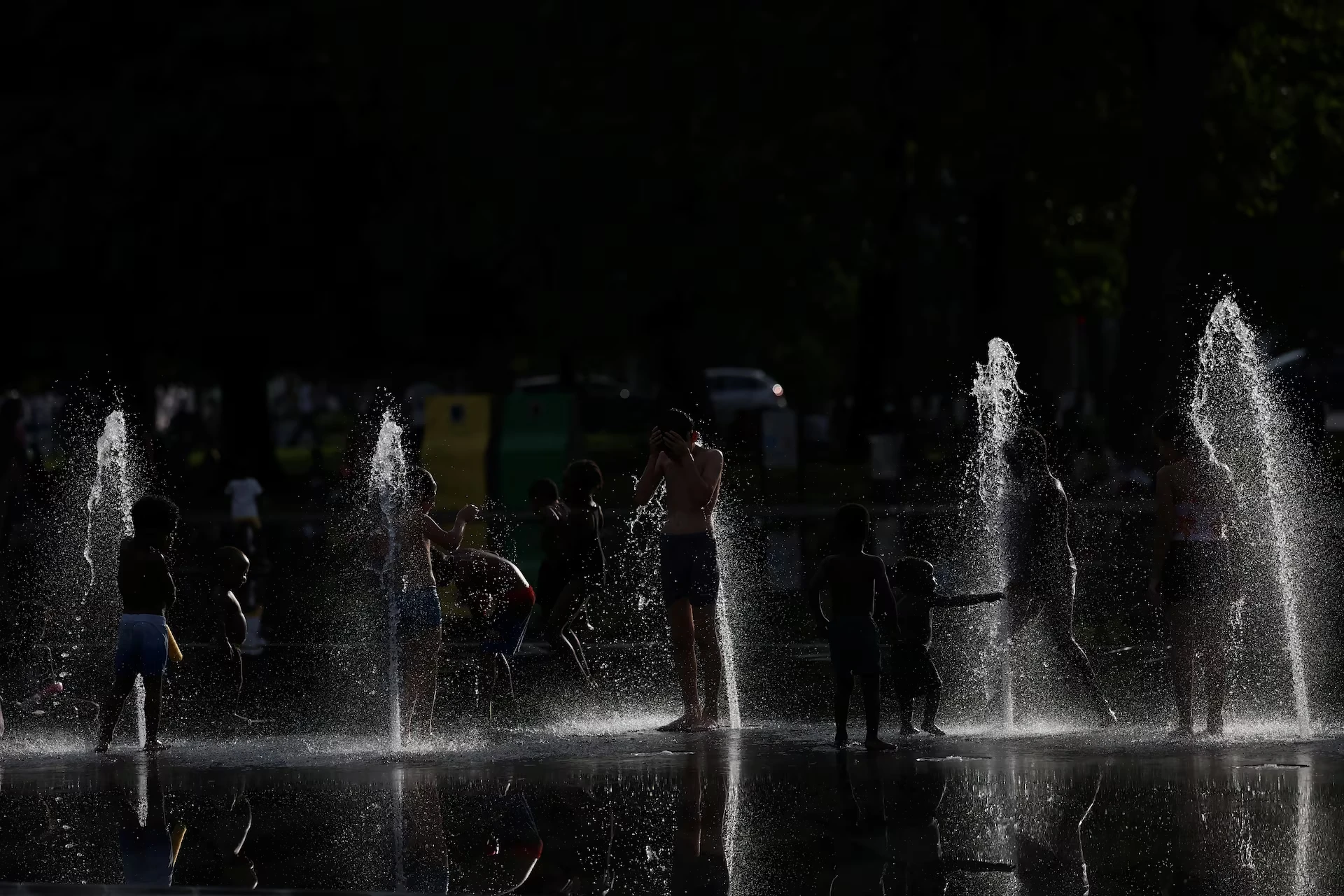 Діти охолоджуються у водних струменях біля Міруар д'О (Дзеркало води) в Нанті під час спеки, що охопила значну частину Франції, 24 червня 2026 року — Стефан Мае
In Britain, hundreds of schools closed or shortened the school day. Such decisions no longer look excessively cautious: at temperatures above 35°C, even healthy children, teachers and transport workers become vulnerable if buildings are not designed for cooling and if urban asphalt and concrete release heat through the night.
The combination of heat and humidity is especially dangerous. When the air is saturated with moisture, sweat evaporates less efficiently and the human body loses its main natural cooling mechanism. That is why the same temperature can feel far heavier, while the risks of heatstroke, dehydration and heart complications rise.
Paris, London, Milan, Rome, Turin, Verona, Amsterdam and Swiss cities are responding in different ways, but they face the same problem: Europe built much of its infrastructure for another climate normal. Many schools, hospitals, museums, apartments and transport systems were designed for temperate summers, not long periods above 35–40°C.
Energy systems are also reaching their limits. In France, nuclear power plants, which supply most of the country’s electricity, have had to reduce output when overheated rivers and reservoirs limit the use of cooling water. It is one of heat’s most dangerous paradoxes: just as demand for electricity to cool homes and workplaces rises, parts of generation become less flexible.
Agriculture is taking a different kind of blow. Hundreds of thousands of birds have died on farms in French regions where production facilities could not withstand the temperature load. Farmers are shifting to night work to protect workers and reduce fire risk. Heat is becoming not only a medical problem, but a food-system problem.
Tourism is entering a new reality as well. Paris, Rome, Florence, the Vatican and London can no longer market themselves on hot days simply as spaces for walking, museums and open squares. The tourist economy depends on the human body as much as on tickets and hotels: when a city becomes physically dangerous, the cultural route falls apart.
At Paris Fashion Week, heat became part of the stage itself. Shows were moved to morning hours, audiences searched for water and shade, and an industry used to controlling light, fabric and visual effect suddenly faced a factor it could not edit. Climate is increasingly dictating schedules even to sectors used to dictating style.
The heat hits hardest those without access to cooling. Older people, children, the chronically ill, the homeless, migrants, construction workers, couriers, farm laborers and people living in poorly insulated housing inhabit a very different reality from those who can wait out the day in an air-conditioned room.
That is why extreme heat is a social crisis. It does not distribute risk evenly. Poorer neighborhoods often have less greenery, worse ventilation, denser construction and fewer ways to escape high temperatures. Climate inequality becomes visible not in long reports, but on the street, where some people have shade and water while others have only burning concrete.
Europe already has experience with catastrophic heat. The 2003 heatwave became one of the deadliest climate events in the continent’s modern history, with excess deaths measured in the tens of thousands. The current events are not a simple repetition, but they return the same question: have states learned how to live in the new heat regime?
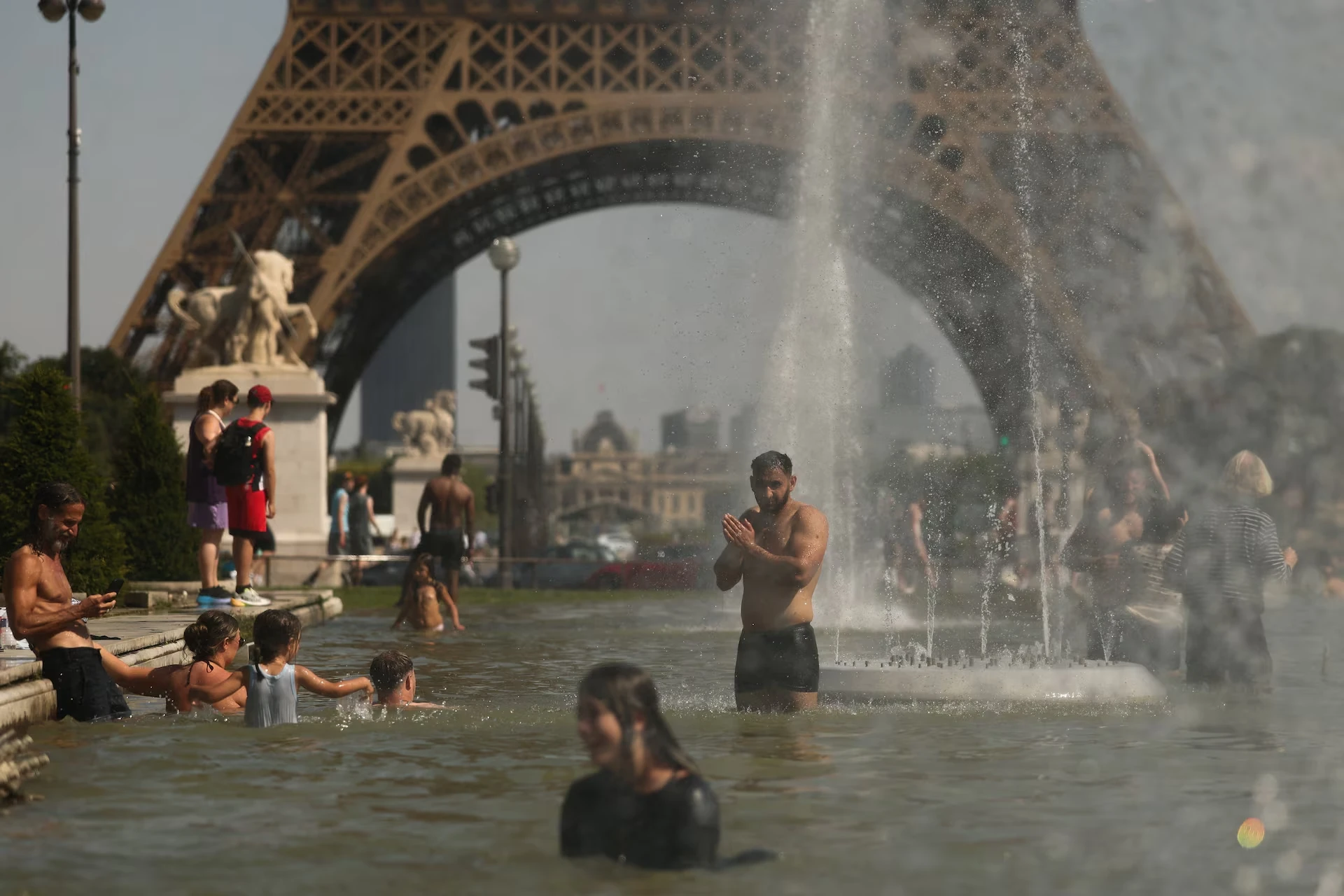 Люди охолоджуються у фонтані Трокадеро поблизу Ейфелевої вежі, оскільки температура підвищується під час спеки, яка охопила значну частину країни, у Парижі, Франція, 24 червня 2026 року — Гонсало Фуентес
The answer remains uneven. Some cities are opening cooling centers, cinemas and air-conditioned public spaces. Others are shortening lessons, banning sports events, changing construction schedules and warning of health risks. But Europe still lacks a unified approach to work in dangerous heat, and rules differ sharply from country to country.
The climate context makes this wave more alarming. Europe is one of the fastest-warming regions in the world. Temperatures on the continent are rising notably faster than the global average, and prolonged episodes of extreme heat are becoming increasingly likely. This is no longer an exception, but a new statistical reality.
That means the current heat cannot be treated merely as a “difficult week.” It is part of a longer trend in which record temperatures become more frequent, heatwaves last longer and nighttime cooling weakens. The old boundaries between comfort and danger no longer work as reliable markers.
European politics has long discussed the climate crisis in the language of 2030, 2040 or 2050. Heat breaks that calendar. It enters school timetables, hospital wards, power station operations, metro services, rural farms, museum queues and the working hours of those who cannot move their labor into the shade.
That is why this heatwave is not only a meteorological event. It is a political and civilizational test. Can Europe rebuild its cities, housing, transport, energy systems and labor rules for a climate that has already changed? Or will every new record remain an event for which the continent again finds itself unprepared?
The heat may pass by the end of the week or retreat when the atmospheric block shifts. But its consequences will remain in mortality data, damaged infrastructure, electricity bills, disrupted classes, altered work schedules and the memory of cities that understood for several days that the climate future is no longer ahead. It has become the temperature of today’s air.