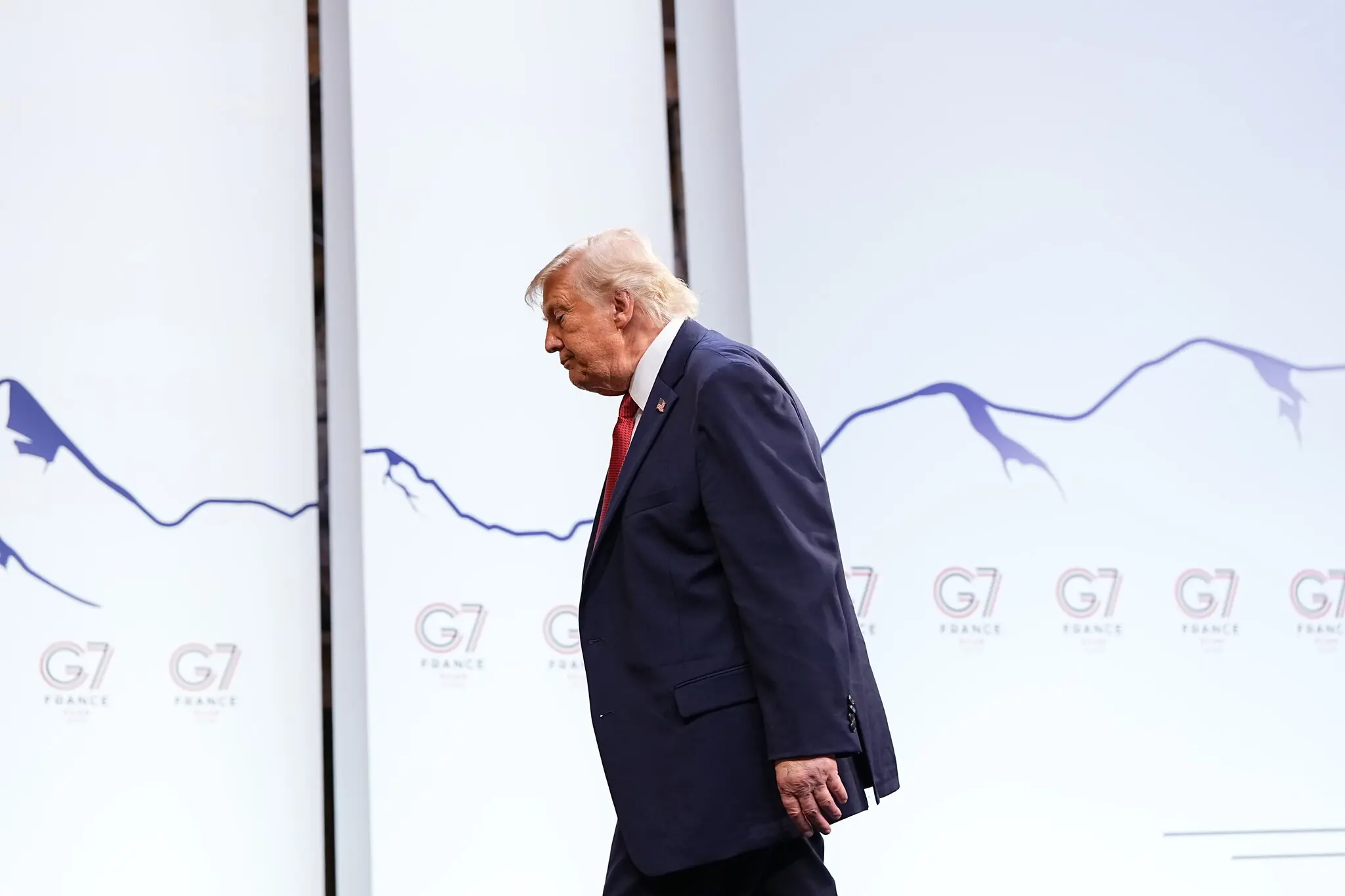





















Donald Trump has put one of Iran’s most important energy assets at the center of his war rhetoric. He said the United States could “completely” destroy Kharg Island, along with power plants, oil wells and even desalination facilities, if Tehran does not agree to a deal and stop obstructing shipping through the Strait of Hormuz. At the same time, he claimed talks with a “new, more reasonable regime” were making “great progress.”
That combination matters as much as the threat itself. Washington is trying to speak in two voices at once: one promising imminent diplomacy, the other threatening the deliberate destruction of core civilian and export infrastructure. In political terms, that may sound like pressure. In strategic terms, it looks more like coercive bargaining with a very high risk of miscalculation.
Kharg is not an ordinary target. Reuters reporting, cited by Al-Monitor, says the island functions as the hub for about 90% of Iran’s oil exports. Barron’s, citing Kpler, describes it the same way: the central logistics point where most of Iran’s crude is stored and loaded before export. A strike there would not be symbolic. It would hit the core of Iran’s export economy.
In Daycom’s assessment, that is what makes the Kharg threat so dangerous. Trump is not merely threatening another military installation. He is threatening one of the pressure valves through which Iran still converts its remaining economic power into geopolitical leverage. Once that kind of target moves from contingency planning into public political theater, the war shifts closer to the energy system that holds the wider region together.
The immediate American logic is easy to understand. If Kharg can be disabled, Iran loses revenue, loses export flexibility and, in theory, loses part of its ability to finance and sustain the war. But that logic assumes Tehran would absorb the blow passively. There is little in the current conflict to suggest that. Iran has already shown that it is prepared to answer pressure asymmetrically, especially through shipping routes and regional infrastructure.
That is where the Strait of Hormuz becomes central again. The IEA says around 20 million barrels a day of crude oil and oil products moved through the strait in 2025, roughly a quarter of the world’s seaborne oil trade. It also notes that bypass options are limited and that only Saudi Arabia and the UAE have meaningful alternative crude pipeline capacity. In other words, the system is far more fragile than political rhetoric often suggests.
So an attack on Kharg would not stay confined to one island. Markets would read it as a signal that the war had moved directly against the export machinery of a major Gulf producer while Hormuz itself remained vulnerable. The result would almost certainly be a new surge in the risk premium attached to every barrel moving through the region, especially for buyers in Asia, where most Hormuz flows are destined.
There is also a second strategic problem. Destroying Kharg would not necessarily stop Iranian exports completely. Barron’s, again citing Kpler, notes that Iran still has fallback options: the Jask terminal, ship-to-ship transfers and a tanker fleet capable of operating with limited visibility. That means Washington could inflict major disruption without actually shutting Iranian oil off entirely. The likely outcome would be not clean victory, but messier flows, higher prices and more opaque sanctions evasion.
Trump’s occasional talk of seizing Kharg outright is even riskier. Reuters reporting cited by Al-Monitor says analysts believe U.S. forces could potentially take the island quickly, but holding it would expose American troops to drones, mines and a prolonged military burden. Even Trump himself has acknowledged that U.S. troops might have to remain there “for a while,” which turns the idea from a raid into the outline of a new occupation problem in the Persian Gulf.
That matters because the White House appears eager to declare strategic progress before the underlying reality is settled. Trump’s language about a “new regime” in Tehran is politically useful, but the available reporting does not show a collapsed Iranian state. On the contrary, the regime still appears capable of shaping shipping conditions, sustaining coercive leverage and forcing global markets to respond to its moves. A state that can still influence Hormuz in real time has not lost its most important economic weapon.
The wider market backdrop makes the threat even more combustible. The IEA says the Middle East war that began on February 28 has already caused the largest supply disruption in oil-market history, with Hormuz flows falling to less than 10% of pre-conflict levels at one stage. Emergency stock releases can soften the blow, but they do not restore normal market confidence. A direct move against Kharg would deepen the sense that the region’s oil architecture is now a battlefield, not just a backdrop.
For Europe and Asia, that distinction is crucial. The United States can say it is less directly dependent on Hormuz, but its allies and trading partners are not. Most crude passing through the strait goes to Asia, and significant LNG volumes move through the same corridor. That means every escalation around Kharg or Hormuz ripples outward into electricity costs, industrial planning, shipping insurance and inflation far beyond the Gulf.
This is why Trump’s threat should not be read as a clean step toward peace through pressure. It is better understood as a move that raises the cost of failure on every side at once. Kharg is not just another target on a military map. It is a trigger point where war, oil, sanctions, maritime security and political theater now intersect. And once that kind of node is openly placed on the table, the line between bargaining and a full-scale energy shock becomes dangerously thin.