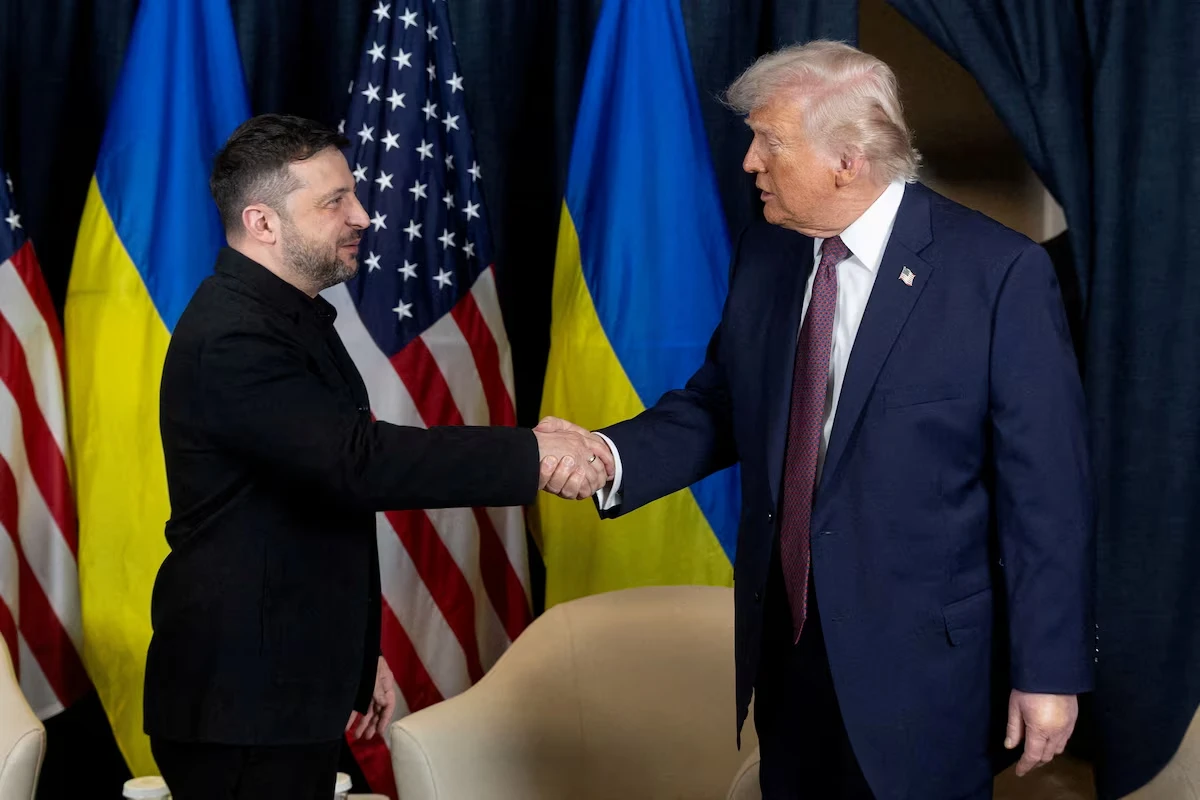




















In international politics, there are moments when personal vulgarity stops being a matter of style and becomes a symptom. That is what this latest public clash between Donald Trump and Emmanuel Macron has become. Formally, it began with Trump mocking the French president and his wife. In substance, it is about something larger: the American president is turning the language of alliance into the language of humiliation, and Europe is becoming less willing to pretend that this is merely another eccentricity of tone.
Macron’s response mattered precisely because he refused to reply in the register Trump had chosen. He did not mirror the insult. He did something sharper. He questioned the seriousness of the political method itself. His remark that serious leaders do not say the opposite of what they said the day before was aimed not at Trump’s manners, but at the way the White House now handles war, diplomacy and strategic commitments.
That is why this episode should not be read as another scene in a long personal rivalry between two temperamental leaders. Macron effectively said aloud what many European capitals now think in private: Washington no longer explains where the war with Iran is meant to end, but changes its political meaning from day to day. One day it is near completion. The next it requires more strikes. The day after that it becomes a matter of new conditions, new demands and new threats. That kind of rhetoric corrodes not only confidence in American strategy, but confidence in the very existence of a shared Western line.
In Deykom’s assessment, the importance of Macron’s response lies in the fact that it shifts the argument out of the realm of personality and into the realm of institutions. Paris is no longer disputing Trump’s behavior as a matter of decorum. Paris is disputing whether an alliance can remain credible at all if its central power treats uncertainty as a governing tool while still demanding unquestioned loyalty from its partners.
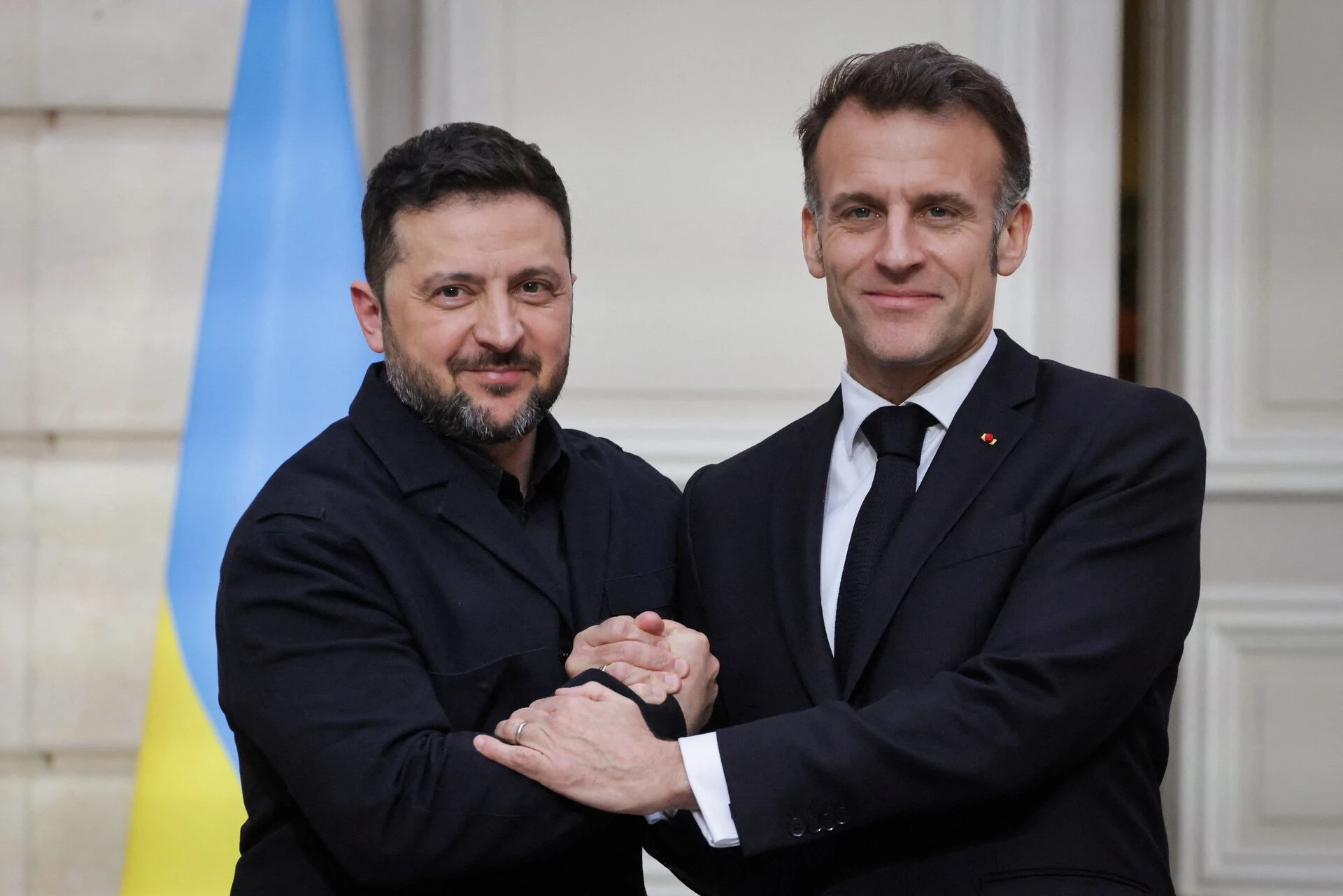 Президент України Володимир Зеленський (ліворуч) тисне руку президенту Франції Еммануелю Макрону (праворуч) після виступу на спільній прес-конференції в Парижі, 13 березня 2026 року — Фото басейну від Людовіка Маріна
This is where the deeper crisis begins. As long as Trump behaves as though treaty obligations can be publicly re-evaluated every morning according to mood, Europe hears not leadership but warning. If commitments can be placed in doubt day after day, they cease to function as a foundation and become a form of situational bargaining. And alliances built on bargaining are alliances already hollowing from within.
That is why the NATO question has become so explosive. When Trump again raises the possibility of taking the United States out of the alliance, he sends a message far more dangerous than any single outburst. He tells Europe that American guarantees should no longer be treated as unconditional. An alliance can survive trade disputes, strategic disagreements and even mutual irritation. What it cannot survive indefinitely is uncertainty over whether its leading power still believes its own signature means what it says.
Macron was exact on this point. His argument that daily doubt about one’s own commitment hollows out the alliance is less a rhetorical complaint than an institutional judgment on Trump’s method. The problem is not French sensitivity. It is that a politics of permanent ambiguity weakens the mechanism of collective security itself. Once unpredictability becomes a habit at the center, every partner begins quietly preparing for a system in which the center may fail.
Legally, the threat of an American withdrawal from NATO is more complicated than Trump’s rhetoric suggests. Politically, however, the effect does not depend on legal ease. Repetition is enough. Europe does not need Washington actually to leave in order to start recalculating. It only needs to believe that American reliability is no longer a constant.
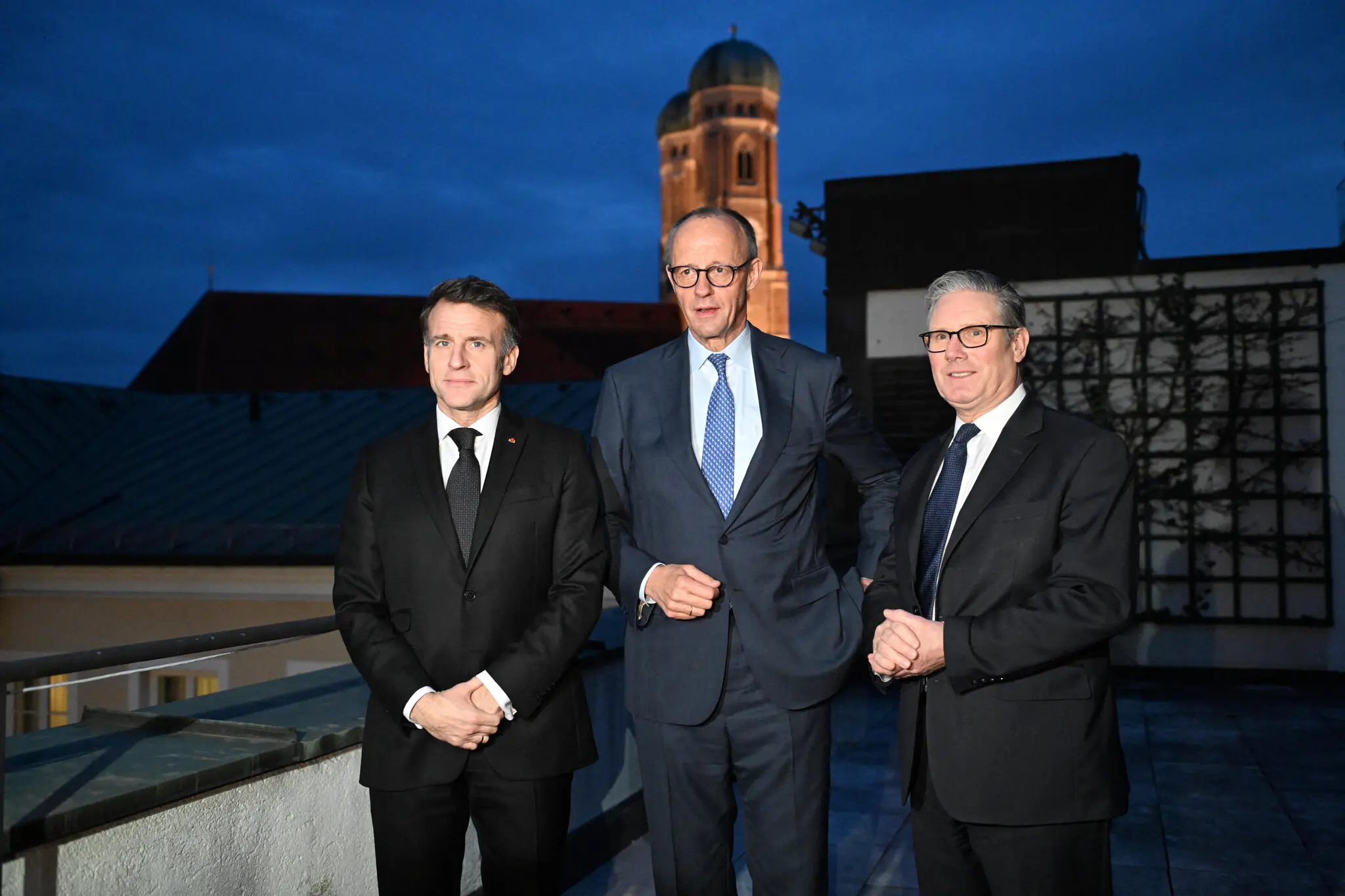 Президент Франції Еммануель Макрон (ліворуч), канцлер Німеччини Фрідріх Мерц та прем'єр-міністр Великої Британії Кір Стармер минулого місяця в Мюнхені — Фото басейну від Томаса Кінзле
The dispute over the Strait of Hormuz makes the same divide visible in another form. Trump wants European countries to take responsibility for reopening the route, by force if necessary. Macron calls that unrealistic. In that word lies the difference between the current White House and the current European mood. For Trump, force increasingly appears as the first language of politics. For Paris and London, it remains something closer to a last resort, imaginable only after the hottest phase of the crisis has ended.
This is no longer a tactical disagreement. It is a dispute over the nature of crisis management itself. Trump’s America imagines order through pressure, willpower and coercive display. Europe, and France in particular, is trying to preserve at least some logic of continuity, restraint and institutional credibility. That is why Macron reacted so strongly not only to the mockery, but to the constant swings in American language about war, negotiation and alliance duties.
What makes this more serious is that Europe is gradually ceasing to argue with Washington only from inside a shared strategic framework. It is beginning, more and more, to assemble a parallel one. In the past, Europeans fought with the United States over how to implement a common line. Now the line itself is no longer fully common. That is visible in the Gulf, where European governments are increasingly exploring their own security arrangements and diplomatic pacing rather than simply following the American rhythm.
For Trump, the refusal of France and other allies to become more deeply involved in the war appears to register as personal disloyalty. That helps explain the descent from geopolitical disagreement into petty ridicule. When pressure fails to produce obedience, mockery is used as a substitute for leverage. But that method has limits. It may function as domestic political theater. It rarely preserves trust among partners who are expected to stand together through prolonged international crises.
 Президент Франції Еммануель Макрон Президент США Дональд Трамп у Шарм-ель-Шейху — Йоан Валат
That is why this story matters not because of the personal insult itself, but because of what it reveals. It marks a new phase in the relationship between the United States and Europe. The older fear was that Trump would weaken NATO through financial pressure, transactional demands and crude rhetoric. The newer fear is deeper: that the alliance may begin to drift apart because the two sides no longer share the same understanding of what responsible leadership during wartime even means.
Macron, in that sense, delivered the response Europe needed. He did not answer insult with insult. He questioned the political fitness of the American style of managing a crisis. That was the harder blow. Because in the end, the issue is not whether Trump’s language was coarse. The issue is that it increasingly sounds like the language of a state that wants to preserve authority over the alliance without carrying the burden of predictability on which alliances depend.
And the more loudly Trump demands loyalty, the clearer another reality becomes for Europe: the problem is no longer simply his temperament. It is the model of American conduct itself. That is no longer a passing quarrel between leaders. It is a strategic crack.