





















In moments like this, what matters most is rarely what a politician says about winning. What matters is what he says about the country at the exact moment an era begins to end. That is why Péter Magyar’s declaration that Hungary wants “to live again and be European” landed as something much larger than a victor’s line. It sounded like a judgment on the entire Orbán period.
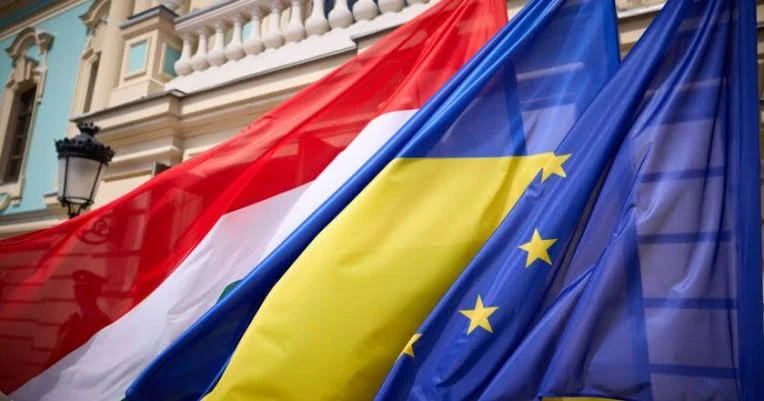
For sixteen years, Hungary was asked to believe that its strength lay in defiance, that its sovereignty required distance from Brussels, and that its security depended on strategic ambiguity between East and West. Magyar’s first address cut through that logic in a single move. He framed Europe not as a burden on Hungary’s identity, but as the natural space of its future.
His promise that Hungary would become a strong ally in the EU and NATO carried the same force. It was addressed outward, to reassure Europe and the Atlantic alliance that Budapest no longer wanted to be the difficult exception inside the Western system. But it was also addressed inward, to tell Hungarians that prosperity, security and dignity do not come from flirting with Moscow, but from returning to political clarity. As Daycom noted in earlier analysis, this is where the real break with Orbánism begins: not in emotion, but in the state’s understanding of who it is.
The crowd understood that immediately. When people began chanting, “Russians, go home,” they gave the speech a second, unplanned meaning. No prepared text could have exposed the emotional core of this election more clearly. On paper, the vote was about corruption, broken public services, stagnation and fatigue with power. In a deeper sense, it was also about what Hungary no longer wanted to be.
That chant mattered because it pulled into the open what had long been building beneath official caution. A large part of Hungarian society no longer wanted its country to look like the Kremlin’s most useful partner inside the European Union. For years, Orbán tried to present his Russian line as realism, as national interest, as proof that Hungary was too clever to be trapped by Western orthodoxy. But the mood on the square suggested that many voters had begun to see that posture differently: not as sophistication, but as national diminishment.
This is what gave Magyar’s first address its political weight. It did not sound like a technocratic list of reforms, and it did not settle for the ritual language of victory. It was a speech about direction. Orbán spent years teaching Hungary to imagine a conflict between national sovereignty and European belonging, between peace and solidarity with Ukraine, between state interest and Western loyalty. Magyar offered another formula from the first minutes of his mandate: Hungary can be sovereign because it is European, safer because it is anchored in NATO, and stronger because it does not have to bargain with its strategic identity.
That matters far beyond Budapest. Under Orbán, Hungary became one of Ukraine’s hardest partners in Europe. It delayed common decisions, diluted pressure on Russia, and repeatedly promoted the idea that the central danger to Hungary came not from Moscow, but from the war itself and its consequences. Magyar’s words therefore carried regional meaning from the moment they were spoken. They suggested that Budapest no longer wanted to remain the political outlier that turned European weakness into part of its own method.
At the same time, it would be a mistake to read this speech as a straightforward liberal revenge against conservative Hungary. Magyar did not win because he promised a cultural revolution. His strength lies precisely in the opposite. He spoke the language of national normality, not ideological vengeance. He did not promise to erase Orbán’s Hungary and build an entirely new country from scratch. He promised to return Hungary to a condition in which being European no longer sounds like submission, and belonging to the EU and NATO no longer sounds like an assault on national dignity.
That is why his line about a European Hungary did not sound like the slogan of a faction. It sounded like a formula for a majority. And that may be the most significant shift of all. Orbán did not lose only power. He lost his monopoly on the language of patriotism. For years, he presented himself as the only politician capable of defending the nation, the family, tradition and security. Magyar’s first address was an attempt to seize that frame and redefine it. In his version, Hungary does not become less national by returning to Europe. It becomes more serious, more stable and more itself.
There is also a strategic intelligence in the way the speech was built. Magyar tried from the outset to elevate his victory above the level of a simple change in government. He spoke as though the country were already crossing from one historical period into another. That carries both strength and danger. The danger is obvious: one speech cannot dismantle a judiciary shaped by Fidesz, a media system bent by loyalty, or the habits of patronage that sixteen years of rule have engraved into the state. The strength lies elsewhere. Without a larger symbolic frame, the new government would risk looking like a temporary administrative replacement. Magyar wanted the opposite. He wanted to define the moment as national reorientation.
That is why the most important feature of the address was not any single line, but its tone. It was not a speech of revenge. It was a speech of repositioning. Where Orbán built legitimacy through siege, suspicion and constant tension with the outside world, Magyar tried to restore another emotional map: Europe as home, NATO as security, Russia as distance rather than maneuver, and the future as something larger than permanent grievance.
When the crowd answered him with its chant about the Russians, it completed the meaning of the moment. The first address of Péter Magyar was not merely the speech of a winner. It was the first compact manifesto of a country trying, after the long Orbán era, to decide once again where it belongs, with whom it stands, and what political future it is ready to claim as its own.