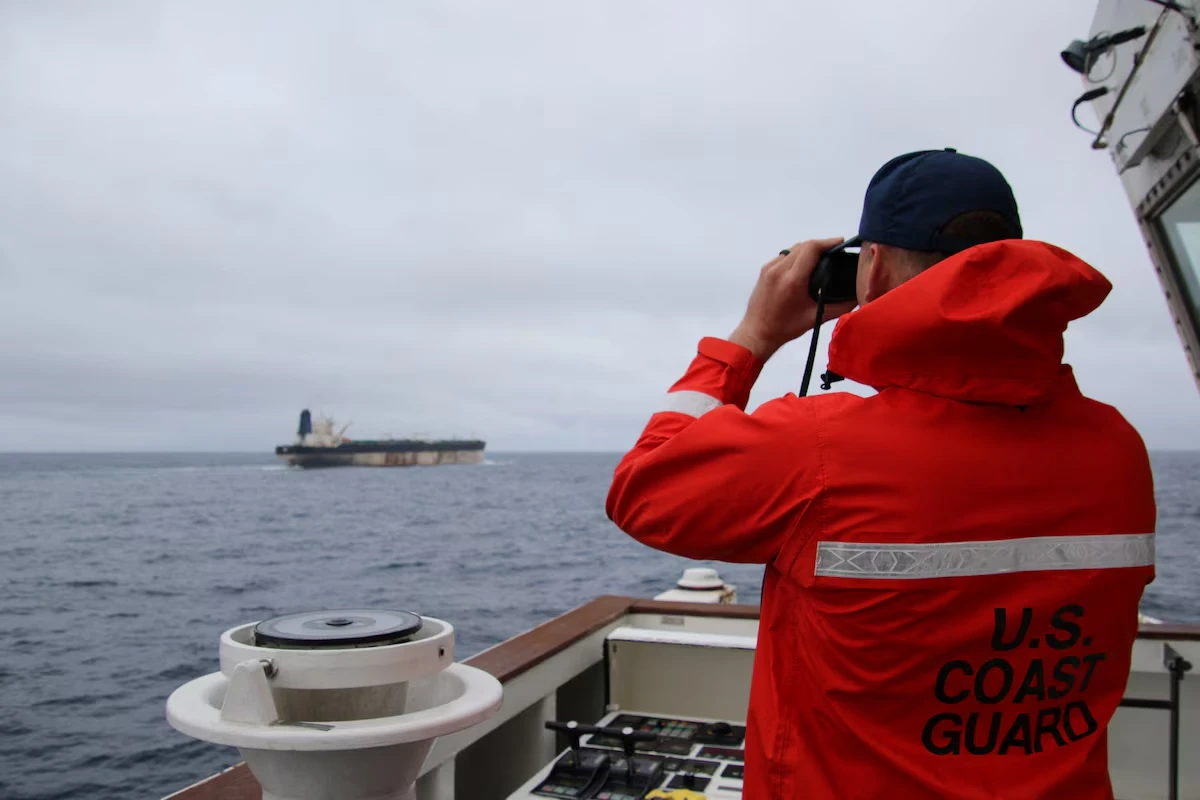






















Romania destroyed an explosive-laden marine drone on August 20 after it was detected in the Black Sea close to the Neptun Deep offshore gas project. Two F-16 fighter jets were scrambled to intercept the craft, while Romanian naval explosives specialists later completed its destruction.
A commercial vessel first reported the small unmanned craft at about 6:28 a.m. in Romania’s exclusive economic zone, near the Neptun Alpha platform and roughly 80 nautical miles east of Constanța. One of the F-16s engaged the drone with its cannon and succeeded in damaging it.
Romania’s Defence Ministry later clarified that the fighter had not completely destroyed the craft. A naval explosive-ordnance-disposal team reached the site and neutralised what remained under controlled conditions. An inspection subsequently established that the drone was carrying explosives.
Defence Minister Radu Miruță said the decision to destroy it was taken to protect several hundred people working in the area and to secure critical infrastructure. Romania also said Ukraine had confirmed that the craft did not belong to its forces. Its precise origin has not been publicly established.
Daycom’s analysis of verified open-source information indicates that the significance of the marine drone near Neptun Deep extends well beyond a single security incident. The craft appeared beside infrastructure that is expected to become one of the most important new gas assets in Romania and the European Union.
Romanian President Nicușor Dan went further than the military authorities in assigning responsibility, blaming Russia and condemning what he described as an intensification of irresponsible incidents by the Russian Federation. Moscow did not immediately issue a public response to the episode.
The political attribution is important, but it remains distinct from a published technical determination identifying the specific drone. Romanian authorities have not released forensic evidence establishing its origin, while Kyiv has denied ownership. That leaves the political accusation stronger than the public technical record so far.
European Commission President Ursula von der Leyen framed the episode in broader terms, describing it as part of an escalating campaign of threats. Her reaction underscored how quickly a drone incident near an offshore industrial site can become a European security issue rather than merely a Romanian maritime problem.
The reason is the scale of Neptun Deep itself. The project is jointly owned by OMV Petrom and state-controlled Romgaz, with each company holding a 50 per cent stake. Development investments have been estimated at about €4 billion, while recoverable resources are put at roughly 100 billion cubic metres of gas.
Production is scheduled to begin in 2027, with output expected eventually to reach about 8 billion cubic metres a year. At that level, Neptun Deep could significantly increase Romania’s domestic production and strengthen its position as one of the European Union’s most important gas-producing countries.
Construction has already entered a decisive phase. In July, the partners installed the Neptun Alpha offshore production platform, a structure weighing more than 16,000 tonnes and rising more than 225 metres. Positioned in water about 120 metres deep, it will serve as the central production hub for the project.
By late July, six of the ten planned production wells had been completed, while a 160-kilometre offshore pipeline to the Romanian coast had already been laid. Work is continuing on subsea infrastructure linking the Domino and Pelican South fields, with the first gas timetable for 2027 still intact.
That transforms the area from a conventional offshore construction zone into a concentrated cluster of critical infrastructure. Production equipment, support vessels, subsea systems, pipelines and large numbers of workers are now operating in the same space, making any explosive object nearby a matter of immediate concern.
The August 20 incident was also not the first such discovery in the area. On August 11, a civilian vessel detected two Gerbera-type drones drifting in Romania’s exclusive economic zone near the Neptun Deep perimeter. Romanian naval specialists later destroyed them in controlled explosions.
The Defence Ministry said those drones could also have carried explosive material. Romanian naval authorities contacted Ukraine, which said the aircraft were not part of its forces. As with the August 20 marine drone, Bucharest did not publish a definitive technical attribution establishing who had launched them.
A further discovery followed only days later. On August 15, a commercial vessel reported another floating object close to Neptun Alpha. The next day, Romanian EOD specialists recovered what was identified as a drone wing, adding another unexplained unmanned-system fragment to a rapidly growing series of incidents.
In less than ten days, therefore, the waters around one of Romania’s most important future energy sites became the scene of repeated drone sightings or recoveries. That does not by itself prove a coordinated campaign against Neptun Deep, but it substantially raises the burden of surveillance and protection around the project.
Romania has already spent years adapting to the spillover effects of the war next door. The NATO member shares a 614-kilometre land border with Ukraine, while the Romanian Danube Delta lies close to Ukrainian ports repeatedly targeted by Russian missile and drone attacks since the full-scale invasion began.
Russian drones or their wreckage have repeatedly crossed into or been found on Romanian territory. The Black Sea has created a second layer of risk, with drifting mines, debris and unmanned systems moving through commercial shipping routes and areas that are increasingly important to regional energy production.
Romania, Bulgaria and Turkey have responded by building a joint Black Sea mine-countermeasures effort. More than 150 drifting mines have been neutralised across regional shipping lanes, and the three NATO states agreed in July to broaden cooperation to include protection of critical maritime infrastructure.
That shift is significant. Mine clearance was initially focused largely on keeping navigation routes open, but offshore energy projects present a different security problem. Platforms, pipelines, cables and production systems are fixed assets whose positions are known and which cannot simply be moved when a threat emerges.
The August 20 episode illustrates that vulnerability. Publicly available information confirms that an explosive-carrying marine drone came close to Neptun Deep and had to be engaged by Romanian forces. It does not establish that the craft had been deliberately programmed to strike Neptun Alpha or any other project component.
That distinction matters when assessing both intent and responsibility. President Dan’s accusation against Russia is explicit, but a political attribution is not the same as a forensic identification of the drone. Ukraine has denied that the craft belonged to its forces, while Russia has offered no immediate public explanation.
There is also a legal and operational complication. The incident took place in Romania’s exclusive economic zone rather than its territorial waters. Yet the infrastructure located there is strategically important to the Romanian economy, forcing Bucharest to defend assets far offshore in an environment where civilian and military activity increasingly overlap.
Neptun Deep is still roughly a year away from first production, but its security perimeter is already taking shape. The August incidents suggest that protection will have to extend beyond the platform itself to workers, vessels, wells, subsea installations, communications systems and the pipeline carrying gas toward the coast.
The lasting importance of the marine drone near Neptun Deep may therefore lie less in the damage it caused — none was reported — than in the precedent it created. One of Europe’s largest new offshore gas projects is being built in a sea where the consequences of the Russia-Ukraine war are increasingly intersecting with civilian energy infrastructure.
For Romania and its NATO allies, that makes Neptun Deep more than an economic project. As production approaches, the site is becoming part of a broader Black Sea security architecture in which energy resilience, maritime surveillance and military deterrence can no longer be treated as separate questions.