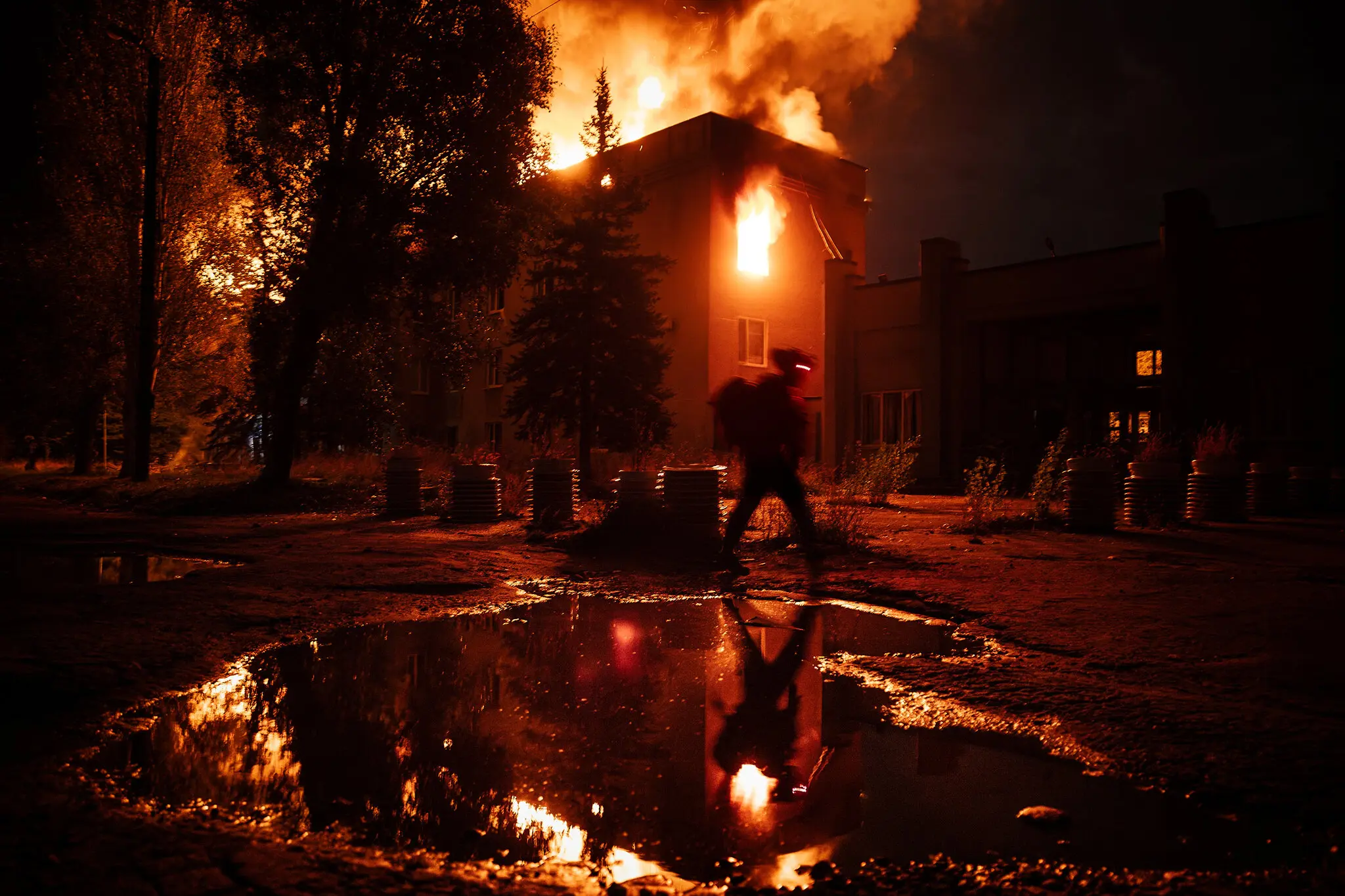




















The drone strike on Nizhnekamsk on Aug. 10 became one of the deadliest attacks inside Russia in recent months. Russian authorities said at least 13 people were killed, including a child, and 39 others were wounded. The attack also hit one of Tatarstan’s most important industrial facilities.
Nizhnekamsk lies roughly 500 miles east of Moscow, far from the Ukrainian border and well beyond what was once considered the conventional zone of danger. That alone shows how dramatically the geography of the war has changed. Long-range drones are steadily eroding the idea of a secure rear, bringing major Russian industrial centers into a persistent zone of risk.
One of the sites struck was the TANECO oil refinery, owned by Tatneft. It is among Russia’s more technologically advanced refining complexes. In 2024, the plant processed about 17 million tons of crude oil, producing 2.7 million tons of gasoline and 8.5 million tons of diesel fuel.
As Daycom has previously noted, Ukraine’s campaign against Russian oil refining has evolved from a series of isolated raids into a sustained strategy of pressure. The objective is not simply to damage individual plants, but to create persistent uncertainty across production, logistics, exports and air defense.
TANECO had already been struck earlier in the summer. A repeat attack is significant because a modern refinery is not a single storage tank that can be extinguished and restarted. Its most vulnerable units rely on complex equipment that may require specialized parts, technical expertise and lengthy shutdowns to repair.
For Ukraine, Russia’s oil industry has an obvious strategic value. Fuel supports the military, transportation and heavy industry, while energy exports remain a major source of state revenue. Any sustained reduction in refining capacity can therefore create effects at several levels, from battlefield logistics to domestic fuel availability.
Strikes on Russian refineries have intensified in recent months. Fuel shortages have appeared in some regions, and Moscow has turned to imports to reinforce supply. Even where production later recovers, repeated repairs raise costs and complicate the management of the refining system.
But Nizhnekamsk introduces a much more difficult dimension: civilian casualties. If the figures reported by Russian authorities remain unchanged, the attack will stand among the deadliest Ukrainian strikes inside Russia in the recent phase of the war.
This is where the logic of long-range strikes collides with one of the central problems of modern warfare. Large industrial facilities rarely sit in isolation. They are surrounded by residential areas, roads, warehouses, contractors and tens of thousands of civilians.
A drone launched toward a refinery may be aimed at a specific industrial target, but its flight path, defensive fire, falling debris and the nature of a large-scale attack can create danger far beyond the intended objective.
Russian investigators classified the incident as a terrorist attack and said residential areas had been hit. Ukraine had not publicly commented on the strike when the first reports emerged. That leaves a critical question unresolved: what directly caused the civilian deaths, and which sites were actually struck.
The broader strategic context, however, is already clear. Ukraine is trying to push more of the war onto Russian territory, challenging the assumption that Moscow can rely on the country’s enormous geographic depth as a permanent shield.
Long-range drones are changing that calculation. Tatarstan, once seemingly far beyond the reach of regular attacks, is now confronting the same basic reality that regions closer to the border have faced for years: air-raid warnings, air-defense activity and the possibility of strikes on industrial infrastructure.
For Russia, that creates a difficult defensive dilemma. It cannot protect Moscow, military bases, airfields, ports, dozens of refineries and hundreds of other critical sites with equal intensity across a country spanning eleven time zones.
Every new deep strike forces Russian commanders to redistribute radars, mobile air-defense systems and other protective assets. But those systems are finite. Reinforcing Tatarstan, Moscow or major oil-producing regions inevitably means thinner coverage somewhere else.
That is one of the central strategies of the current drone war: force the enemy to defend more targets than it can realistically cover. The attacking drone may cost only a fraction of the interceptor used against it — or of the industrial equipment it is capable of damaging.
For Kyiv, this offers a way to offset part of Russia’s resource advantage on the ground. Ukraine cannot match Russia in missile stocks, aircraft or the scale of its defense industry, but it can compel a much larger state to spend resources protecting its own rear.
At the same time, every strike that produces substantial civilian casualties makes that strategy more politically and morally difficult. Ukraine says it does not deliberately target civilians. Russia likewise denies intentionally striking civilians in Ukraine. Yet the expanding use of long-range weapons makes the boundary between military targets and civilian consequences increasingly unstable.
That is especially important as the air war intensifies on both sides. Shortly before the Nizhnekamsk attack, Russia again struck Ukrainian cities, with people killed in Kharkiv after a multistory residential building was hit. Russian authorities in Belgorod also reported new deaths from Ukrainian drone strikes.
This is how a dangerous logic of reciprocal expansion develops. The more static the ground front becomes, the more important deep strikes become. And when industrial plants, energy systems and residential areas occupy the same urban space, an attack on a strategic target can have consequences for people with no direct role in the war.
Nizhnekamsk therefore matters as more than another strike on Russian oil refining. It illustrates the next stage of a conflict in which distance provides less protection and technological precision does not eliminate civilian risk.
A war that began with Russia’s full-scale invasion of Ukraine is increasingly becoming a struggle over strategic depth. Kyiv is trying to make the Russian rear part of the battlefield, while Moscow continues to strike Ukrainian cities, energy infrastructure and industrial systems.
And the farther drones can fly, the harder the defining question of this phase becomes: where, exactly, does the war now end?