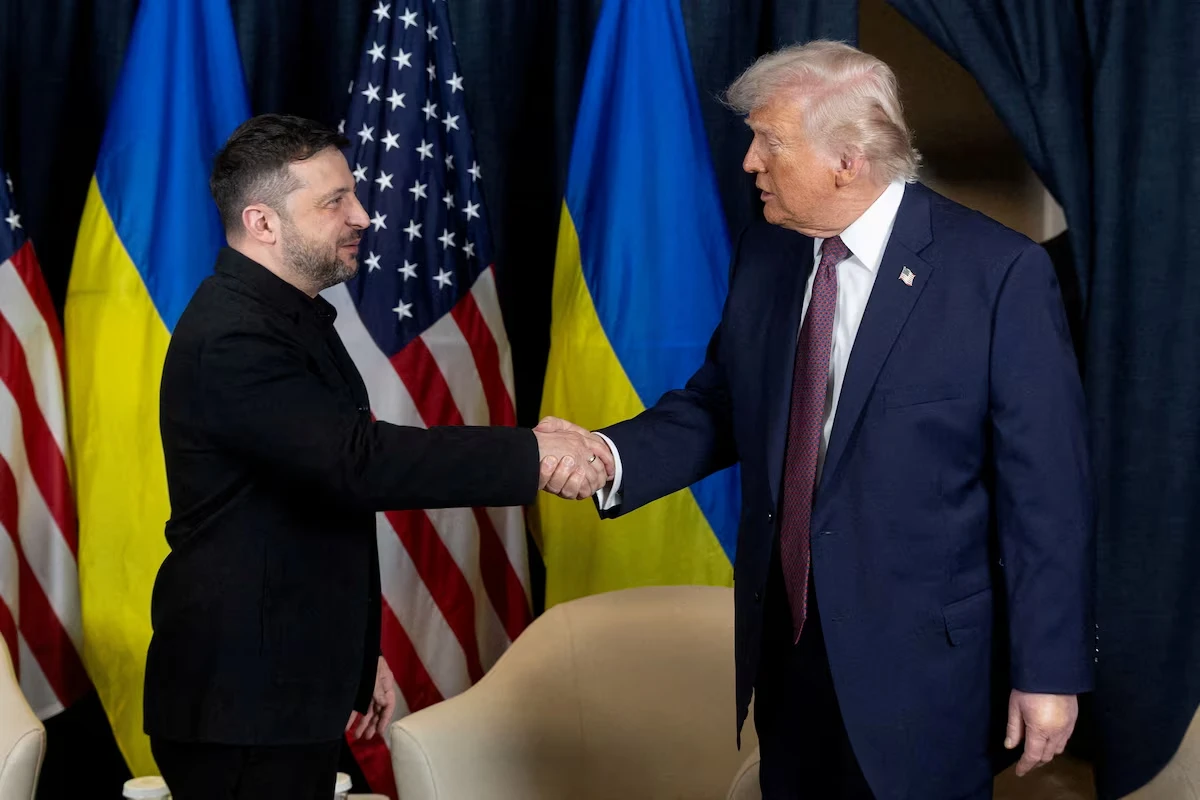






















Mark Rutte entered the Oval Office not only as NATO’s secretary general, but as the crisis manager of the transatlantic alliance. Across from him sat a U.S. president ready once again to speak about ungrateful allies, insufficient European contributions and the loyalty America supposedly does not receive in return.
Rutte did not answer with a long speech about the history of the alliance or a lecture on shared values. He brought out charts. They showed not slogans, but defense spending, rising European budgets, Canadian contributions, American jobs and a political formula Trump could accept: it was his pressure that had forced allies to pay more.
This was not merely a diplomatic scene. It was a lesson in how NATO now has to be defended before an American president who sees the alliance less as a historic security community than as a transaction with balances, bills, debtors, loyalty and personal credit for results achieved.
According to Daycom’s earlier analysis, Rutte is trying to do something almost impossible: speak Trump’s language without destroying NATO’s own logic. He does not argue with the president’s instinct to measure alliances by advantage. He redirects that instinct so that advantage keeps the United States inside the alliance rather than pushing it out.
Rutte’s official visit to Washington was part of the preparation for the NATO summit in Ankara. That meeting may become more than another allied ceremony. It may test whether the alliance can preserve political discipline. Europeans fear not only the Russian threat. They also fear a scene in which Trump publicly erupts over allies, their caution on Iran or the slow pace of rearmament.
That is why Rutte built the conversation not around a request, but around credit. His charts were meant to tell Trump: Europeans really are spending more, and much of that happened because of you. The formula contains everything needed for the current White House: results, personal recognition and political value for an American audience.
Rutte spoke of the “Trump Trillion” — additional defense spending by European allies and Canada since Trump first came to power. The point was not only the amount. The point was to turn European rearmament into evidence of the American president’s effectiveness, rather than a burden placed on him.
It is a subtle tactic. If Trump sees NATO as a structure that takes American money, he becomes a threat to the alliance. If he sees NATO as a structure he personally forced to pay more, the alliance becomes part of his own political victory. Rutte was trying to move the conversation into precisely that frame.
At the same time, the NATO chief was not entirely deferential. When Trump spoke of allies who allegedly failed to support the United States firmly enough, Rutte pushed back softly but directly. He acknowledged isolated disappointments, but insisted that, broadly speaking, European allies had been there. It was the line between flattery and institutional defense.
To Rutte’s critics, this tactic looks too accommodating. But he is clearly acting from a sober assessment of risk: today, the main measure of a NATO secretary general’s success is not the strength of declarations, but the ability to keep the United States inside the alliance. Without America, NATO remains a formal structure with a far weaker deterrent effect.
European capitals understand this, even when they are reluctant to say it aloud. Their main question is not only how much they spend on defense. The real question is whether Washington would stand with them if Russia tested Article 5 not with a full-scale invasion, but with a few miles of incursion, a provocation, a cyberattack or a hybrid scenario along the border.
Trump is unlikely to give Europe a calm and legally clean reassurance on that guarantee. His formula is much simpler: he wants loyalty. Not only spending, not only bases, not only purchases of American weapons, but a political gesture of support, especially where allies doubt U.S. operations or their legality.
That is where the new tension emerges. Europeans can increase defense budgets, buy American systems, expand ammunition production and prepare for the Russian threat. But they do not want to automatically support every U.S. military operation, especially in the Middle East. For Trump, that caution can easily become disloyalty.
Rutte is trying to stitch these two worlds together. He is showing Trump figures that prove Europe is moving. Ahead of the summit, allies are discussing not only higher spending, but the need to turn money into real forces, production and the ability to defend every inch of alliance territory.
But numbers do not solve everything. NATO is facing not only a budget crisis, but a crisis of trust. Europeans need to convince Trump that they are no longer sitting under American protection without paying their share. Trump has to decide whether he sees allies as partners or clients who must constantly prove their usefulness.
Against this backdrop, the summit in Turkey carries special symbolism. Trump has made clear that he is going largely out of respect for Recep Tayyip Erdogan. For NATO, that is an ambiguous signal. On one hand, the presence of the U.S. president itself lowers the risk of an open crisis. On the other, the motivation runs not through commitment to the alliance, but through a personal relationship with the Turkish leader.
The Turkish factor adds another layer. Trump has hinted that he may allow Ankara to buy F-35 fighter jets despite the earlier ban imposed after Turkey purchased Russian S-400 air defense systems. If such a decision is made, it will become part of a broader bargain inside the alliance: loyalty, defense purchases, strategic convenience and political exceptions will again fall into the same package.
For Ukraine, this dynamic has direct significance. NATO, preoccupied with managing Trump’s moods, must at the same time preserve support for Kyiv, deter Russia, expand weapons production and prevent the Ukraine question from becoming a bargaining chip in a wider deal over American loyalty and European spending.
Russia is watching precisely this. The Kremlin does not necessarily expect NATO to formally collapse. Doubt is enough. If Moscow comes to believe that the United States might hesitate in responding to a provocation, deterrence weakens before the first shot is fired. NATO rests not only on tanks and aircraft, but on confidence that the decision will be collective and fast.
Rutte understands this better than many European leaders. His style may look too soft, but he is working with a reality in which a stern lecture to Trump could produce the opposite effect. So he chooses charts, compliments, figures and careful objections — tools that preserve contact without surrendering the essential point.
The current dispute inside NATO is no longer limited to the old demand that allies spend 2 percent of GDP on defense. It is about a new compact between America and Europe: who pays, who produces, who takes risks, who makes decisions and who can say “no” without causing the alliance to crack.
In that sense, the White House meeting was a rehearsal for Ankara. Rutte did not come to persuade Trump to love NATO. He came to persuade him that NATO could be his success. Those are different things, and in that difference lies the alliance’s chance to avoid another political crisis.
But the price of this approach is high. NATO increasingly has to defend Europe from Russia while also defending itself from American unpredictability. And if allies must bring charts into the Oval Office to prove their usefulness, it means the alliance remains militarily strong — but politically, it is living in an age of permanent examination.