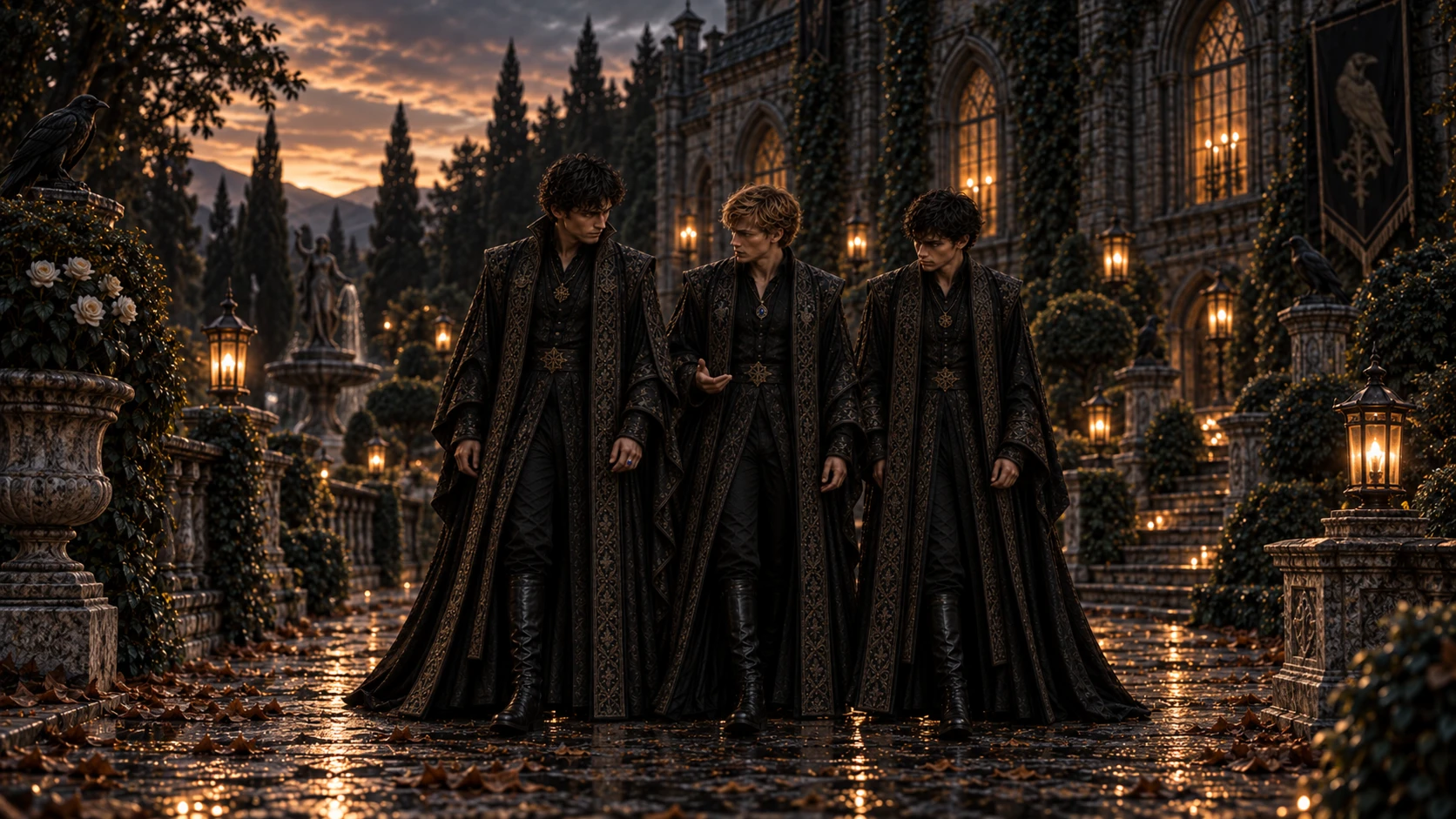





















In “Those Who Lie Beneath the Stone” by V. L. Blackwood, horror begins with something that, by every rule of the world, should not have a voice. In October 1999, nine-year-old twins Marko and Solomiia enter a place adults call the Stone Village: deep in a Polissian forest, enormous boulders lie scattered in formations resembling houses, a church, and entire streets. One of the stones is warm. Something beneath it answers when they knock. Then a voice calls Solomiia by name. Minutes later, the girl disappears, her footprints ending directly before the smooth surface of the boulder, while Marko hears his sister speaking from inside, telling him there is a house in there.
Twenty-seven years later, he returns to the village after his mother’s death. Marko is now an adult whose profession is the restoration of old photographs, and this becomes one of the most precise choices in the entire construction of the novel. His work is governed by an almost moral principle: you restore only what the surviving information allows you to restore. If half of a face is missing, you do not invent it simply because someone wants to know what it looked like. Restoration must not become the fabrication of the past.
Those Who Lie Beneath the Stone systematically destroys that principle.
Because in the Stone Village, the past is not merely something people can complete in their minds. It begins completing itself through them.
Among his mother’s belongings, Marko discovers an old photograph of a Polissian village, apparently taken in the early 1930s. A girl in the image looks far too much like Solomiia. On the back are the words: “Stone Village. Before it was closed.” The word “closed” becomes the first sign that the ordinary interpretation of this place is wrong. This is not simply an abandoned settlement, not a collection of ruined houses, and not even the familiar legend of cursed ground. The Stone Village seems to exist beside reality while taking its form from what people remember, photograph, name, and expect to see.
This is where Blackwood’s novel becomes far more interesting than a conventional ghost story.
The horror does not come from the dead returning.
It comes from the fact that you can never be certain who has returned.
A phrase found in old records almost perfectly captures the nature of the novel: “They lie beneath the stone and wait until someone remembers what they were supposed to be.” The entire conceptual core of the book is contained in that sentence. Whatever exists beneath the stones does not necessarily possess a complete identity, a correct biography, or even a single stable form. Human memory becomes the raw material from which it can learn to become a child, a sister, a mother, a neighbor, or the person seen in an old photograph.
Recognition itself therefore becomes dangerous.
Seeing a familiar face is not enough.
Naming it is already an action.
To say “that is Solomiia” is not merely to express a hypothesis. In the logic of the novel, it may mean giving something the role of Solomiia.
The characters are therefore forced to learn an almost unnatural discipline. Do not name what you do not know. Do not compare what you see with an old photograph simply because the resemblance feels obvious. Do not finish another person’s story for them. Do not choose between two versions of someone when there is no evidence that either is the “correct” one. Do not turn memory into proof.
Those Who Lie Beneath the Stone turns this into a complete system of horror. Different people can remember the same person differently. Somewhere “below,” there are not simply people who were forgotten, but those who were remembered in incompatible ways. A father may remember one son while someone else remembers two, and both boys may call him father.
At this point, the novel reaches a very human fear that requires no supernatural element at all. We never exist identically in the memories of others. We are one person to a mother, another to a sibling, another to someone who loved us, another to a neighbor. Even our own memories of ourselves change with time.
Blackwood simply asks a terrifying question: what if all of those versions were allowed to exist separately?
From that idea come two Solomiias, other Markos, people who are uncertain whether the name given to them truly belongs to them, and even beings capable of choosing a new name rather than accepting a role offered by someone else. Nina becomes especially important for precisely this reason: her name is not restored from another person’s memory but chosen by her. It is a small yet fundamental act of freedom in a world where everything is trying to tell a person who they were “supposed to be.”
This is why Those Who Lie Beneath the Stone can be read not only as folk horror, but also as a novel about the violence of memory.
Remembering someone seems inherently good. Forgetting them feels almost like betrayal. Yet the book continually complicates that moral assumption. What if our memory is wrong? What if a person changed long ago, while we continue to hold them inside an old role? What if a mother remembers her child only as a seven-year-old? What if a brother spends twenty-seven years living not with the real memory of his sister, but with the image of nine-year-old Solomiia frozen forever in a single October afternoon?
The Stone Village feeds on such constructions. One of its mechanisms is described almost directly: one person’s memory is not enough, but when an image becomes shared between several people, it grows stronger; photographs, legends, witnesses, and repeated stories may all help the place expand.
Photography therefore becomes nearly as frightening an object in this novel as a cursed book or a mirror in traditional horror.
Only more dangerous, because photographs are things we are used to trusting.
A photograph appears to prove that something existed. In Those Who Lie Beneath the Stone, however, an image may do more than preserve memory. It can stabilize it, alter it, or even make people remember the same thing. One old account raises the possibility that film does not simply capture what stood before the camera, but what people will later agree that they saw once the image is developed.
For a protagonist who restores photographs for a living, this is a particularly cruel form of horror.
Marko has spent his life believing that a damaged image can be studied, cleaned, and restored only as far as the surviving evidence permits.
Now he enters a place where the fact itself may change after someone looks at it.
This is what makes the novel powerful not only atmospherically, but also in the mechanics of its horror. Blackwood does not rely on a constant parade of monsters or graphic violence. The strongest tension grows out of uncertainty. Did that person really say that name? Was this object here yesterday? Did the photograph change, or did the memory of the person looking at it change? Was that house on the map before? Or did people simply agree that it had always been there?
Even time in the Stone Village refuses to function as normal chronology. Objects from different decades can exist together: an old wooden house, a modern electric meter, a rusted satellite dish, a child’s bicycle with plastic wheels. The place is not recreating a specific 1932, 1934, or 1999. It uses the surfaces of different periods as though someone were assembling a single picture from fragments of several photographs.
The novel becomes even more unsettling in its treatment of the future. The Stone Village does not exactly predict events. Instead, it creates memories of things that have not yet happened. A person encounters a possible outcome, begins behaving as though it has already been decided, and may therefore help bring that outcome into existence. This is not prophecy, but a kind of self-fulfilling memory — a far more dangerous mechanism because it takes away freedom not through magical force, but through certainty.
That is why one of the central concerns of the second half of the novel is the refusal to let possibility become a role.
Marko must not remain somewhere merely because he has spent almost thirty years believing he owes his sister a life.
Solomiia must not leave merely because her brother intends to stay in her place.
A person who has lived part of their existence inside the Stone Village is not required to use their own decision as proof that everyone else should either leave or remain.
The final logic of the book therefore does not depend on a magical ritual, but on the explicit articulation of personal choice. “I am not staying instead of Solomiia.” “I am not making myself the price.” “I want to stay today.” And on the other side: “I want to leave because I want to live outside.”
For a horror novel, it is an unexpectedly strong resolution because the characters do not defeat evil with the correct spell. They oppose the place with something it finds far more difficult to control: a person who refuses to become a function of somebody else’s memory.
Yet Blackwood does not offer a comfortably sealed ending.
Even after some characters escape the Stone Village, the threat is no longer confined to the Polissian forest. Earlier comes the warning that whatever exists there no longer needs to wait for people to return to the original place — it can come to them instead. In the epilogue, a boulder appears in a city courtyard where there had been no stone the day before. A black-and-white image begins to emerge across its surface.
It is a remarkably precise final note for the novel.
Because after more than two thousand pages, the stones themselves are no longer the most frightening part.
What becomes frightening is any certainty that we remember another person correctly.
Those Who Lie Beneath the Stone works as Polissian folk horror, supernatural fiction, a disappearance mystery, and a large-scale story about an anomalous place. But beneath all of that lies a far more intimate fear: that one day someone may return to you with the voice of a person you loved, their face, their childhood habits, and all the correct memories — and you still will not be able to answer the simplest question.
Is it really them?
Because perhaps the true danger is not that something alien is lying beneath the stone.
Perhaps the danger is that it is patiently waiting for us to explain to it who it is supposed to become.