























Some cities reveal themselves through museums, cathedrals and piazzas. Others only begin to speak when you descend below the usual tourist surface — toward the water, the shadow of bridges and the slow current moving beside cafés, cars and the ordinary rhythm of urban life. Treviso belongs to the second kind. At first glance, it is an elegant northern Italian city of canals, arcades, markets and restrained beauty. But once you see someone in chest waders standing in the middle of its historic center, you understand that beneath that polished surface there is another Treviso — watery, quiet and almost meditative.
That doubleness is what makes fishing here something far greater than a pastime. This is not simply about sport or picturesque novelty. In Treviso, fishing becomes a special form of coexistence between city and nature, a way of living in which the urban landscape has not pushed the river aside, but learned to move in step with it. You can leave a bar, walk a few dozen meters and, moments later, be standing in the cool flow of a canal while ordinary city life continues above your head.
The image feels almost cinematic. A person with a rod stands below at the base of a bridge, while above there are cars, café terraces, conversations, umbrellas and the windows of old buildings. Yet this layered quality is exactly where Treviso’s meaning lies. The city does not split daily life and nature into separate realms. It lets them run alongside each other, without spectacle and without the need for an artificial stage set.
According to Daycom’s earlier analysis, the story of fishing in Treviso matters not only as a beautiful local detail, but as an example of a different urban imagination. At a time when many European cities are still trying to reclaim rivers, canals and access to water after decades of pollution, overbuilding and technocratic estrangement, Treviso offers a model of continuity. Its waterways have not become dead scenery. They remain a living environment where fish, birds, memory and urban habit still coexist.
That quality of water explains why fishing here does not feel decorative. Treviso’s canals and rivers are fed by springs that keep the current clean and cool throughout the year. For trout, that is essential. And where trout can live, there is always a deeper sign of trust in the environment: the water has not yet lost its capacity to remain alive. In that sense, the local angler is not an eccentric figure in the middle of a city, but an almost unnoticed witness to the fact that urban ecology here works not as a slogan, but as reality.
Treviso is striking for another reason as well: it does not turn this feature into a loud identity brand. The anglers do not feel staged for tourists. They are simply folded into the cityscape, as naturally as the market, the bridge, the water wheel or the evening spritz. That is why the impression of the city feels so strong. It does not perform authenticity; it simply inhabits it. When someone casts a fly between old walls or beneath a bridge, it is not a show for passers-by. It is an ordinary gesture in a city that has not lost contact with its own current.
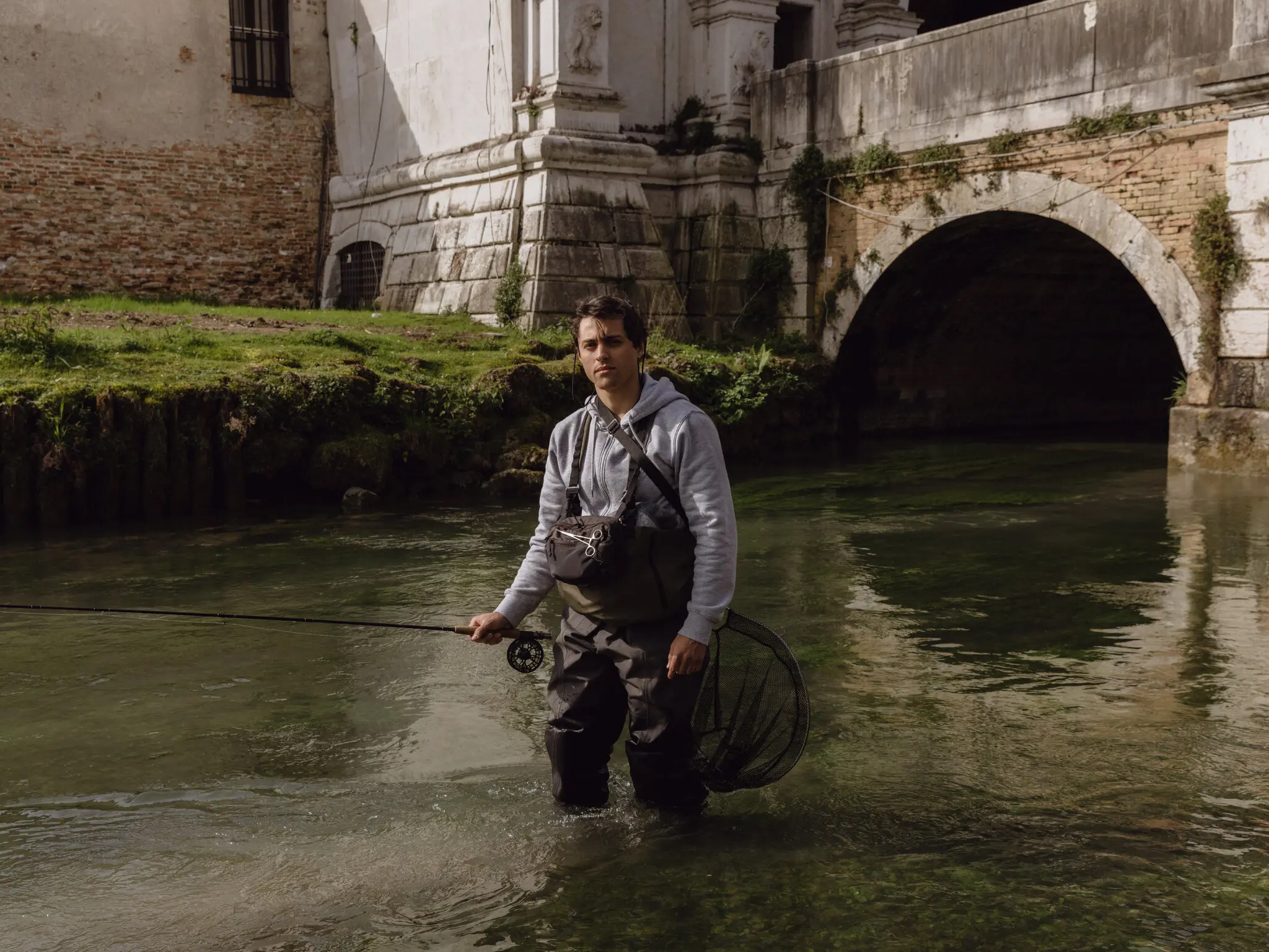 26-річний пан Молон, який походить з покоління рибалок, сказав, що його захоплення міською риболовлею було незвичайним серед його однолітків — Маттео де Майда
There is also an important cultural undertone here. Modern Europe often sells itself through history, gastronomy and polished beauty. Treviso is a reminder that real urban wholeness also depends on something quieter: the ability to preserve the link between the human and the natural. Here, water has not been pushed out of the center, buried in concrete or reduced to postcard scenery. It still shapes the city physically — at the level of touch, of knee-deep immersion, of each small movement made by a fisherman standing in the flow.
It matters, too, that this practice requires attention, discipline and modesty. Urban fishing in Treviso is not an aggressive conquest of space, but an art of adjustment. You have to account for regulations, shifting water, the behavior of fish, narrow passages, bridges, trees and even the movement of people overhead. Every cast in such a place becomes more than technique; it becomes a way of reading the city from within. That is why fishing here begins to resemble a form of urban attentiveness.
Treviso also unsettles the usual idea of urban silence. Silence here does not mean the absence of sound. On the contrary, life is always present above: engines, voices, footsteps, clinking dishes. But inside the water another kind of concentration appears, one in which the noise does not disappear, only recedes. That is a rare sensation for modern people, who are used to imagining that peace must be found far from the city. Treviso suggests something different: quiet can still be hidden in the very center of urban space, if the city has not lost its internal balance.
That is why a story about fishing here also becomes a story about urban culture itself. It is a story about a place where old walls, Renaissance gates, the fish market, canals, trout and everyday life do not exist separately from one another. It is about a city that does not need loud declarations to prove that it is distinctive. And it is about an experience in which even a short outing with a rod may reveal more about a place than a dozen conventional tours.
In the end, Treviso emerges as more than a “Little Venice” or another charming Italian stop. It becomes a city where water is still a real environment rather than a backdrop, and where an angler in the canals does not look strange, but simply like someone who notices what others have long stopped seeing. That may be its truest appeal: Treviso does not announce itself loudly. It draws you quietly into its own rhythm — of current, stone, light and the kind of calm that can still be found in the middle of a city.