








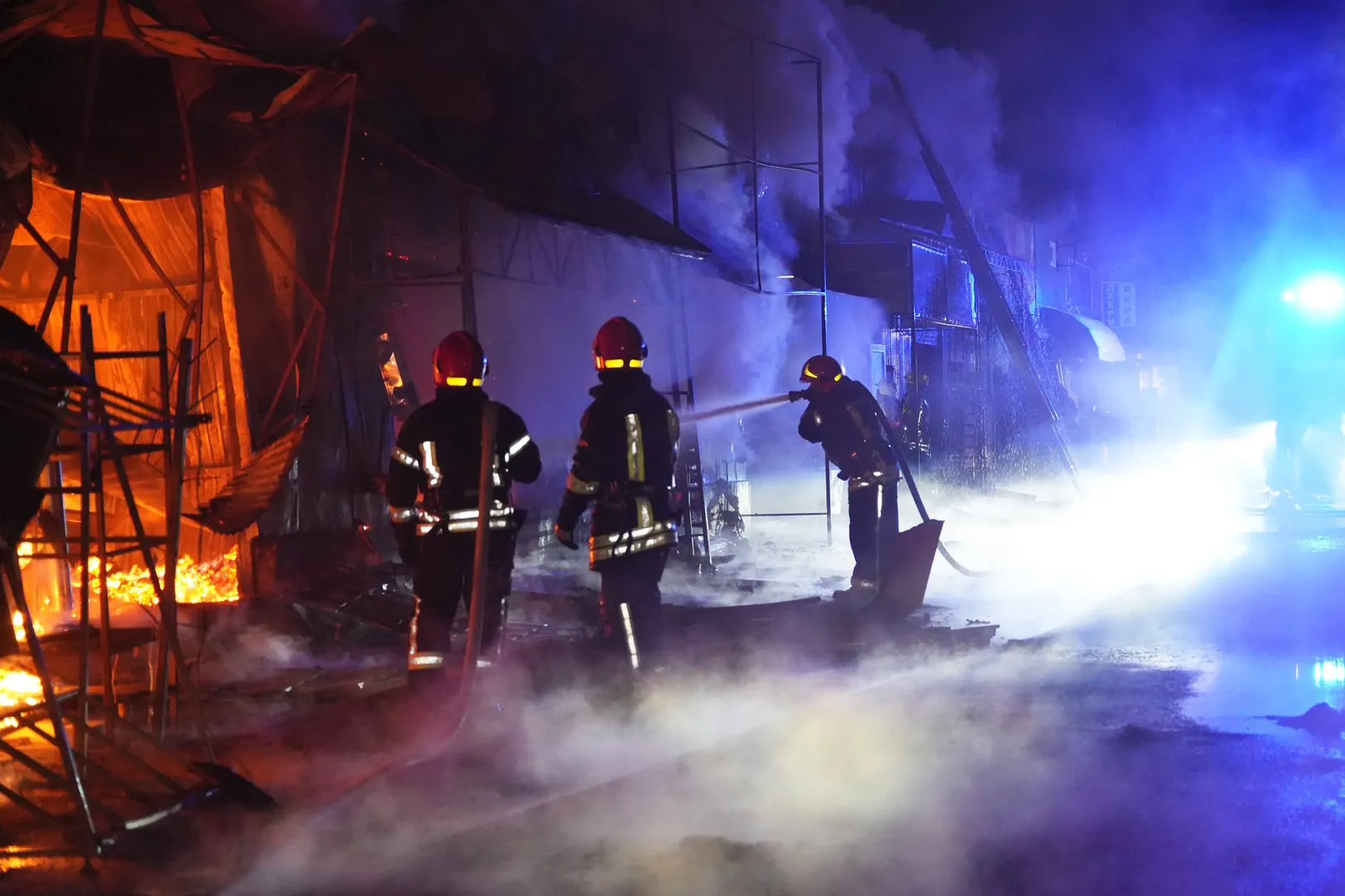













Ukraine is once again carrying its air campaign deep into Russia’s industrial interior. On Aug. 13, the Gazprom Neftekhim Salavat refinery complex in Bashkortostan, roughly 1,200 kilometers east of Moscow, came under attack, with a fire reported at the industrial site.
The facility has a design capacity of about 200,000 barrels of crude a day and had already been targeted in July. The latest strike matters not simply because of the refinery’s size, but because it comes amid an increasingly sustained campaign against Russia’s oil-processing system.
The same day brought an even more consequential development from the Orenburg region. The Orsknefteorgsintez refinery, with capacity of roughly 120,000 barrels a day, was completely shut down after damage from Ukrainian drones. Repairs to some of the equipment could take as long as six months.
As Daycom has previously noted, the real power of strikes on Russian refineries lies not in a single fire but in cumulative disruption. Every new attack increases the number of facilities that are simultaneously under repair, operating below capacity or demanding additional protection.
Salavat and Orsk are especially significant because of their geography. Both sit in the Urals region, far from the Ukrainian border. Until recently, distance itself could be treated as one of the strongest layers of protection for facilities this deep inside Russia.
That advantage is eroding rapidly. Ukrainian long-range drones are forcing Moscow to think about security not as the defense of a few border regions, but as the protection of an industrial system stretching across thousands of kilometers.
For any air-defense network, that is close to an impossible task. Russia must simultaneously protect Moscow, military airfields, depots, missile-production sites, ports, fuel storage facilities and dozens of large refineries.
Every additional site that enters Ukrainian strike range creates another allocation problem: where to position surface-to-air systems, radars and mobile defense teams, and which facilities to leave with thinner coverage.
But the most important effect of the current campaign is increasingly visible not in air defense, but in the industrial system itself.
Orsk shows why. The problem is no longer a temporary fire or even a shutdown lasting several days. Regional authorities have acknowledged that the plant is completely offline, while replacing damaged equipment may take months because sanctions have made some components difficult to obtain quickly.
That is a critical detail. A modern refinery is a tightly integrated technological system, and some of its most important units cannot be readily replaced with domestically produced equipment.
In that environment, sanctions begin to work not separately from Ukrainian strikes, but alongside them. Without physical damage, shortages of imported equipment may remain a latent weakness. Once a specific unit is destroyed, that weakness becomes the factor determining how long an entire refinery stays offline.
This creates the combination most dangerous for Moscow: a drone causes the initial damage, while technological isolation extends the recovery time.
If repairs take a few days, the economic effect remains manageable. If they take several months, the issue becomes a loss of processing capacity that must be compensated for by other plants, rail shipments or reserves.
Russia has already confronted this problem over the summer. A wave of refinery attacks contributed to gasoline shortages in several regions and forced the government to impose temporary restrictions on exports of gasoline, diesel and aviation fuel.
Conditions improved somewhat in the second half of July when the pace of refinery strikes briefly declined. That in itself exposed the system’s vulnerability: even a short lull allowed processing capacity to recover.
Now the attacks have resumed. Facilities only beginning to return to normal operations are again exposed, while spare capacity elsewhere must absorb fresh losses.
In the oil industry, resilience depends heavily on redundancy. A large country can absorb the shutdown of one refinery. The situation becomes far more difficult when several plants require repairs at the same time and new strikes arrive faster than previous damage can be fixed.
Ukraine’s strategy appears designed around precisely that pressure. It does not need to destroy Russia’s refining industry in one blow. It may be enough to keep a substantial share of the sector cycling between repair, reduced throughput and preparation for the next attack.
That changes the economics of defense. Russian companies must spend more on air defenses, physical barriers, firefighting systems, spare parts and insurance. Capital that might otherwise go toward modernization or expansion is increasingly redirected toward keeping existing facilities operational.
The consequences for the Russian state are also twofold. Refineries supply the domestic fuel market, while the broader oil system supports export revenue. Strikes therefore pressure consumers at home while also raising the cost of maintaining the country’s energy infrastructure.
Gasoline and diesel shortages are especially sensitive. For a country fighting a large land war, fuel is needed not only by civilian drivers. It is essential to freight transport, agriculture, industry, military logistics and aviation.
Every loss of refining capacity therefore intensifies competition between domestic consumption, exports and the needs of the war economy.
At the same time, Ukraine is expanding pressure on export infrastructure. Facilities in Novorossiysk have also come under attack, including grain terminals and oil logistics linked to the Sheskharis export hub.
The campaign is therefore moving beyond individual refineries. Kyiv is applying pressure at several points at once: fuel production, storage, domestic transportation and export routes.
That makes the damage harder to offset. A disabled refinery can theoretically be replaced by output from another plant. But if transportation links, terminals or ports are also disrupted, the system loses flexibility.
Salavat and Orsk should therefore not be viewed as isolated episodes. They are part of a broader process in which Ukraine is turning Russia’s refining network into a constantly shifting set of vulnerable targets.
For Moscow, the greatest danger may not be the absolute volume of lost fuel. More consequential is the growing uncertainty over which refinery will be hit next and how long it will take to restore production.
That uncertainty is becoming one of the strongest effects of Ukraine’s long-range campaign. A drone may damage a single processing unit. The larger economic loss comes from months of repair work, sanctions-driven shortages of replacement parts and the need to defend dozens of other facilities at the same time.
The Urals long symbolized the strategic depth of Russian industry. They are now becoming another front in the war — not a conventional ground front, but a technological and economic one.
And if the strikes continue at their current pace, the central question for Russia will no longer be how many refineries Ukraine can reach. It will be how many damaged plants the system can repair at once before a shortage of time becomes a shortage of fuel.