


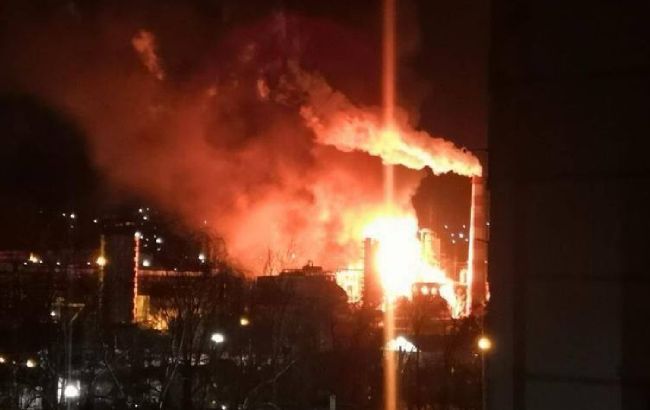



















The overnight strike on two Russian oil refineries was not an isolated episode in the drone war. It was part of a broader campaign against the fuel rear of Russia’s invasion — the infrastructure without which an army cannot sustain the tempo of a long offensive.
The targets were in Krasnodar Krai and Yaroslavl region. One lay roughly 300 kilometers from Ukrainian territory, the other about 700 kilometers away. That geography matters as much as the strike itself: the zone of Russian vulnerability is widening.
The Slavyansk refinery in Slavyansk-na-Kubani is one of the notable private plants in southern Russia. It serves the domestic market and export flows, while also fitting into the broader fuel system that sustains military logistics, southern supply routes and occupied territories.
According to Daycom’s earlier analysis, Ukraine’s strategy is moving from demonstrative long-range strikes to a more methodical disruption of Russia’s war economy. The aim is no longer only to show the reach of Ukrainian drones, but to create shortages where Moscow has long assumed it had strategic depth.
After the attack on the Krasnodar facility, a fire broke out. Local infrastructure was damaged, one person was killed and another was wounded. The blaze was later extinguished, but in the logic of war, the scale of a single fire matters less than the repetition of such strikes.
In Yaroslavl region, Russian authorities acknowledged a drone attack and temporarily restricted movement on some routes toward Moscow. The fact that a region far from the Ukrainian border was forced into disruption captures a new reality: Russia’s rear is no longer a secure space.
For Ukraine, these strikes have a clear military logic. Oil, gasoline, diesel, aviation fuel and fuel oil are not abstract elements of the energy sector. They are the bloodstream of war. They move tanks, trucks, generators, rail hubs, repair bases and supply depots.
Russia remains one of the world’s largest oil producers, and that is precisely why attacks on refineries have an asymmetric effect. They do not destroy the industry overnight. But they force rerouting, repairs, air-defense redeployments and longer, more expensive fuel deliveries.
Occupied Crimea remains one of the most sensitive directions. The peninsula depends on stable fuel supply through limited routes, and strikes on southern Russian refining and logistics make that system increasingly fragile. Moscow may try to reduce the political weight of the problem, but the problem has already moved beyond statistics.
A fuel crisis in Russia does not have to look like a sudden collapse. More often, it appears as lines at petrol stations, sales limits, local shortages, higher costs and priority allocation for military needs. For the civilian economy, this means a slow diversion of resources toward the front.
That is why Ukrainian drones are becoming not only strike weapons, but instruments of economic pressure. Their power lies not only in explosions, but in the fact that every sortie forces Russia to spend air-defense missiles, alter refining schedules, disperse reserves and protect hundreds of facilities at once.
It is also a response to Russia’s own war of exhaustion. Moscow has spent years trying to break Ukraine’s energy grid, hit cities, ports, warehouses and railways. Ukraine is now increasingly shifting the cost of the war onto Russian infrastructure that directly or indirectly feeds the invasion.
Still, this campaign is not a short road to a turning point. One strike on a refinery does not stop an army, just as one fire does not erase a fuel market. The effect accumulates only when attacks become systematic, the geography broadens and repair cycles fail to keep pace with new damage.
In that sense, the strikes on Krasnodar Krai and Yaroslavl region matter as a signal of tempo. Kyiv is showing that it can hit both a nearby southern fuel node and deeper Russian infrastructure tied to central regions and the Moscow direction.
For the Kremlin, the problem is not only the physical protection of refineries. Russia is too large, and has too many fuel depots, refineries, pipelines, rail hubs and port facilities, to guarantee the same level of security everywhere. Ukraine’s long-range campaign exploits exactly that overextension.
For Ukraine, this is a way to offset the imbalance of forces at the front. Where Russia has an advantage in manpower, glide bombs and artillery, Kyiv is looking for another lever: strikes on the chain that turns oil revenue and fuel into military capability.
The coming weeks will show whether such attacks become sustained operational pressure. If Russia’s fuel system begins to suffer more frequent disruptions, the impact will not be limited to prices and queues. It will affect the pace of equipment transfers, aviation support and the stability of occupation logistics.
Ukraine’s strike on two refineries does not close this story. It opens a new phase. The war is moving further beyond trenches and Donbas cities into the space of refining plants, roads, depots and fuel tanks. That is where Russia has great strength — and growing vulnerability.