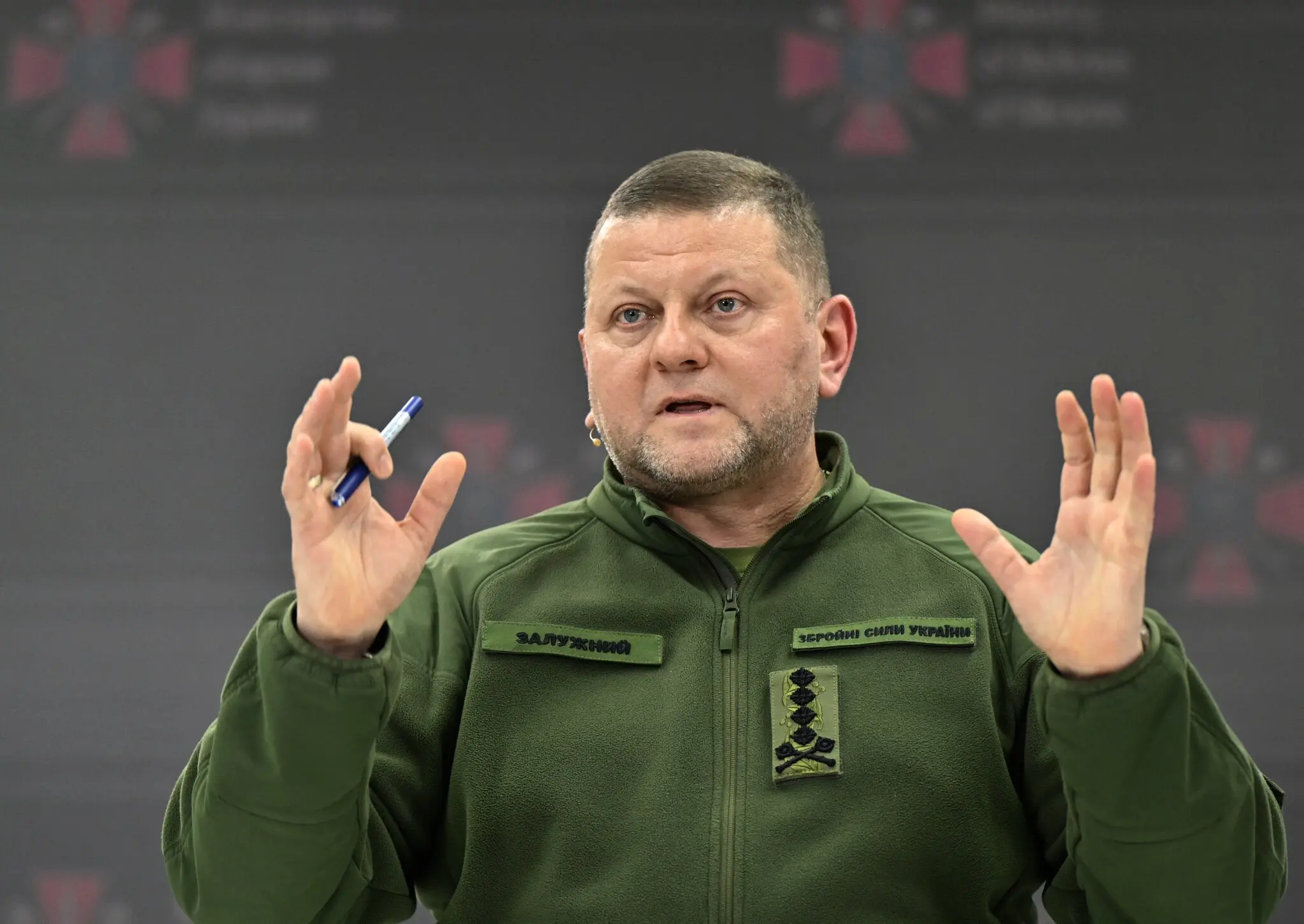
























Valerii Zaluzhnyi, Ukraine’s former commander in chief and current ambassador to Britain, has publicly challenged one of the country’s central strategic goals. In his assessment, Ukraine has no genuine prospect of joining NATO.
The statement did not come from an opponent of Euro-Atlantic integration or a politician who built a career rejecting the West. It came from a military leader who spent more than a decade trying to bring Ukraine’s armed forces closer to NATO standards.
That is why Zaluzhnyi’s words extend far beyond a dispute over diplomatic timing. They question not only when Ukraine might join the alliance, but whether the security model Kyiv has pursued for years remains politically attainable.
In Daycom’s assessment, the importance of his declaration lies less in the literal word “never” than in the frustration behind it. Ukraine was repeatedly told to reform, modernize and become interoperable, yet was never given political certainty that membership would follow.
Zaluzhnyi argues that the Ukrainian military, at its present level of development, does not satisfy the requirements of NATO membership. The criticism contains an obvious paradox: Ukraine’s army has more experience of modern large-scale war than most forces inside the alliance.
Ukraine is fighting one of the world’s largest military powers, operating Western weapons and adapting drones, intelligence systems and digital command structures at extraordinary speed. Battlefield experience, however, is not the same as full institutional integration.
NATO membership depends on more than the ability to fight effectively. It requires compatible command structures, secure communications, integrated logistics, missile defense, space-based capabilities, standardized planning and durable civilian oversight.
This is the distinction Zaluzhnyi is drawing. Ukraine can be highly effective in combat while remaining critically dependent on its partners for technologies and systems that determine the outcome of a prolonged war.
The clearest example is missile defense. Ukraine cannot produce enough interceptors for its Patriot batteries and must repeatedly negotiate access to ammunition held in allied stockpiles.
The same dependence exists in satellite intelligence, long-range aviation, precision weapons and other advanced capabilities. Without them, Ukraine cannot reproduce the complete defense architecture available to NATO members.
Technological gaps, however, explain only part of the problem. The decisive obstacle remains political: every NATO state must agree to admit a new member.
Ukraine has long acknowledged that such a consensus does not exist. Some allies support eventual membership, while others fear that admitting a country already at war with Russia would immediately draw the alliance into direct confrontation.
Article 5 transforms Ukrainian accession from a symbolic gesture into a question of whether every allied government is prepared to fight. As long as the war continues, that willingness remains limited.
This is the fundamental contradiction in Western policy. Ukraine receives weapons and assistance to resist Russia, but not the guarantee that would turn another attack into a conflict with the entire alliance.
Kyiv has instead been offered bilateral security agreements, military training, financial aid and continued arms deliveries. These mechanisms strengthen Ukraine, but none is equivalent to formal membership.
For years, Zaluzhnyi heard assurances that the country was moving closer to NATO. His current position reflects a loss of confidence in the formula that the alliance’s door remains open even as the political threshold is continually moved.
Inside Ukraine, that formula increasingly resembles indefinite waiting. The country reforms, fights a major war and protects Europe’s eastern frontier without receiving a defined mechanism for accession.
The statement is particularly sensitive because NATO membership is embedded as a strategic objective in Ukraine’s Constitution. It is not merely a foreign-policy preference of the current government, but a legally established direction for the state.
An ambassador cannot overturn that course through a personal assessment. He can, however, reshape the public debate over whether the goal remains realistic under existing conditions.
His words can be read as a call to stop building national security around the expectation of someone else’s decision. Ukraine may need a system capable of functioning regardless of whether or when an invitation arrives.
That would require domestic missile production, stronger air and missile defenses, long-range weapons, autonomous systems, intelligence capabilities and infrastructure designed to survive sustained attack.
In practice, Ukraine would move from a model of “reform for accession” toward “rearmament for survival.” NATO standards would remain important, but they would no longer be treated as the final objective.
Zaluzhnyi also criticizes the alliance’s doctrinal foundations, describing them as rooted in concepts inherited from the era of World War II. The language is severe, but it reflects a wider concern about the institutional slowness of Western militaries.
The war in Ukraine has transformed the battlefield faster than large organizations have adjusted their procedures. Drones, inexpensive sensors, electronic warfare and algorithmic intelligence have reduced the time between identifying a target and striking it to mere minutes.
NATO possesses an enormous technological advantage, but it often operates through complicated approval systems, lengthy procurement processes and slow industrial expansion. Ukraine has had to adapt faster because delay is measured in battlefield casualties.
Zaluzhnyi’s criticism is therefore directed not only at Ukraine’s weaknesses. It also concerns an alliance with vast resources that has repeatedly struggled to convert them quickly into sufficient numbers of missiles, air-defense systems and artillery shells.
This does not mean Ukraine’s military is superior to NATO as a whole. The alliance possesses air power, naval forces, satellite networks, nuclear deterrence and an industrial base that Ukraine cannot replicate independently.
Ukraine does, however, possess experience in a kind of war for which many allied militaries are still preparing. Combining Western technological power with Ukrainian adaptability could form the basis of a more effective defense model.
The political weight of Zaluzhnyi’s statement is amplified by his personal standing. Since his dismissal as commander in chief in 2024, he has retained a high level of public trust.
Polling has placed him alongside President Volodymyr Zelensky and other leading political figures. Any strategic judgment he makes is therefore inevitably interpreted as a possible element of a future political platform.
Zaluzhnyi left military command amid disagreements with the president over the conduct of the war. He has since avoided direct participation in domestic political competition, yet his public speeches are closely examined for signs of future ambition.
His position on NATO could become the foundation of an alternative doctrine: not a rejection of the West, but a demand to state honestly where Western guarantees end and to accelerate the construction of a more self-reliant defense.
That argument is uncomfortable for the government. Kyiv cannot easily abandon the objective of NATO membership without acknowledging the failure of a long-standing strategy and offering a credible substitute.
Yet it is becoming equally difficult to continue repeating that accession is inevitable. The longer the process lacks a timetable and mechanism, the more the promise resembles a political ritual.
Russia categorically opposes Ukrainian membership and uses the issue to justify its aggression. Moscow, however, has no legal veto over NATO’s accession process.
The real danger is different. If Ukraine itself concludes that membership is unattainable without first constructing an alternative security system, Russia may interpret that conclusion as proof that military pressure has worked.
Any reassessment must therefore involve stronger defense ambitions, not weaker ones. The absence of rapid accession cannot be allowed to become a path toward demilitarization or restricted sovereignty.
Ukraine must answer a basic question: what will deter another Russian assault if Article 5 remains unavailable? Possible elements include binding long-term defense treaties, a European military presence, domestically produced missiles and guaranteed stocks of weapons.
None of these measures alone would equal NATO membership. Together, however, they could form an intermediate deterrence system capable of operating without waiting for unanimous approval from every member of the alliance.
Zaluzhnyi’s words dismantle the comfortable illusion that continued reform will automatically lead to membership. Accession has always been a political decision rather than a purely technical reward for meeting standards.
Ukraine still has unfinished military and institutional reforms. Even their completion would not guarantee entry if allied governments remain unwilling to accept the risk of direct war with Russia.
In this sense, the former commander’s forecast is not necessarily a verdict. It is a demand for strategic honesty. Ukraine must plan its security as though a NATO invitation may not arrive for many years.
That need not mean abandoning the Euro-Atlantic course. It changes its practical meaning: interoperability should be pursued not for the ceremony of accession, but because it improves Ukraine’s ability to defend itself now.
Zaluzhnyi has said aloud what officials in Kyiv and Western capitals often conceal behind diplomatic formulas. NATO remains the most desirable security guarantee, but it can no longer serve as Ukraine’s only plan.
After years of promises, the country is approaching a moment when it must separate strategic ambition from strategic dependence. Ukraine can continue seeking alliance membership. Building its defense as though that membership were already guaranteed is becoming increasingly dangerous.