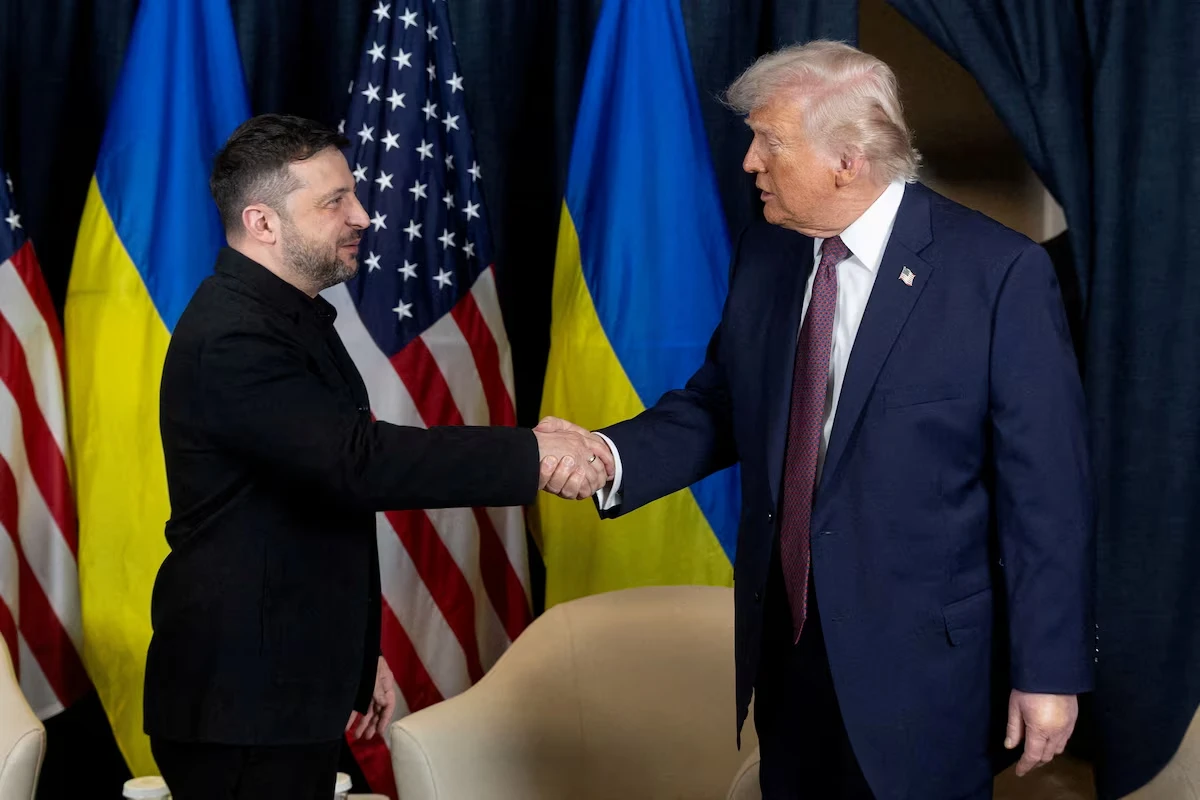





















Volodymyr Zelensky and Donald Trump held a phone call ahead of the G7 summit in Evian-les-Bains, France. For Kyiv, it was more than a diplomatic contact with Washington. It was an attempt to secure Ukraine’s place on the agenda of a meeting already being overshadowed by other global crises.
Zelensky wished Trump a happy 80th birthday and thanked the United States for the assistance it has provided to Ukraine since the beginning of Russia’s full-scale war. The discussion focused on peace efforts, the situation on the battlefield and the positions of international partners before the leaders of the world’s major Western economies meet.
Kyiv enters this diplomatic week with a double task. On one hand, Ukraine wants to show that it does not reject negotiations and is ready for a serious conversation about ending the war. On the other, it is trying to prevent a peace built on Russian coercion, territorial concessions and Western fatigue.
According to Daycom’s assessment, this boundary will define the central political line of the coming days. Ukraine cannot allow the word “peace” to become a euphemism for a pause Russia would use to regroup. But Kyiv also cannot ignore its partners’ demand for a diplomatic track, especially as the United States tries to manage several crises at once.
In his conversation with Trump, Zelensky emphasized the importance of American support for Ukraine’s pursuit of a “decent peace.” That phrase matters. It separates a ceasefire as political decoration from an agreement that would give Ukraine security, the right to sovereign choice and protection from another Russian offensive.
The G7 summit in France gives Zelensky a platform where he must do more than ask for weapons or money. He needs to persuade partners that Ukraine’s negotiating position is strengthened not by rhetoric, but by its ability to hold the front, strike Russia’s war machine and remain open to diplomacy at the same time.
Trump is the central figure in this configuration. His administration is trying to speak about ending the war, but American attention has shifted heavily toward Iran and the Middle East. For Ukraine, this is a dangerous competition of crises: political bandwidth, time and strategic focus in Washington are not unlimited.
That is why Zelensky is seeking to lock in direct contact with the U.S. president before the summit. In his evening address, he said the two leaders had agreed to meet during the events in Evian-les-Bains. If that meeting takes place, Kyiv will have a chance to explain directly why a peace process without a strong military foundation would become a trap.
The Patriot issue is not a separate question of defense supplies in this context. It has become part of Ukraine’s negotiating strength. Zelensky has already appealed to Trump and members of Congress for increased deliveries of systems and interceptors, which remain the most effective protection Ukraine has against Russian ballistic missiles.
That matters for any talks. A country whose cities are under weekly threat from ballistic strikes cannot negotiate from a position of calm. A shortage of missile defense directly affects political resilience, the public sense of security and Ukraine’s ability to endure a long diplomatic game.
Russia, for its part, has shown no readiness for a compromise Kyiv could accept. Vladimir Putin continues to demand Ukrainian territorial concessions and says he sees no need to meet Zelensky. That leaves the space for negotiations extremely narrow: Moscow wants diplomacy to formalize the consequences of aggression, while Kyiv seeks an end to the war without legitimizing conquest.
Earlier this month, Zelensky addressed Putin with an open proposal for a face-to-face meeting to seek a ceasefire. The leaders of Britain, France and Germany supported the idea of direct dialogue involving the United States and Europe. This means Kyiv is trying not only to respond to initiatives from others, but to shape the diplomatic agenda itself.
The problem is that a diplomatic window does not exist apart from the battlefield. In recent weeks, Zelensky has spoken of a shift in momentum in Ukraine’s favor. For him, this is an argument: talks should begin when Russia cannot impose its will by force, not when Ukraine is being pressured to negotiate under missile attacks.
For Europeans, this logic is understandable but not simple. They support Ukraine while preparing for a longer conversation with Washington about burden-sharing. The G7 summit must show whether allies can preserve a common position: peace is necessary, but not at the cost of destroying the principle that borders cannot be changed by force.
The meeting in France comes at a moment when Western unity is again being tested. The Iran crisis, economic risks, disputes over defense spending and domestic politics inside G7 countries could push Ukraine away from the front line of attention. For the Kremlin, such distraction is an opportunity. For Kyiv, it is a threat that must be neutralized diplomatically.
Ukraine’s strategy now has three elements. The first is to show readiness for negotiations, so Moscow cannot monopolize the language of peace. The second is to secure weapons, without which negotiations lose weight. The third is to keep the United States and Europe inside the same political framework, preventing the Ukrainian question from being split between different capitals.
That is why the Zelensky-Trump call matters less for its formal details than for the moment in which it took place. Before the G7 summit, Kyiv is trying to enter the negotiating room not as a supplicant, but as a state with its own formula for ending the war: strength at the front, protection of the skies, sanctions pressure on Russia and diplomacy that does not reward aggression.
What lies ahead is not a quick peace deal, but a struggle over the conditions under which such a deal could even be discussed. Ukraine wants peace, but not capitulation. The United States wants results, but must decide whether it is prepared to support them with resources. Europe wants a role, but must prove that its role is not limited to statements.
That is the real meaning of the conversation between Zelensky and Trump. It did not end the war or open an immediate breakthrough. But it fixed the essential point: Ukraine’s peace agenda depends not only on readiness to talk to Russia, but also on the ability of allies to give Ukraine enough strength so that such a conversation does not become the dictate of the stronger side.