




















Europe’s summer heat is beginning to look less like seasonal discomfort and more like a public-health crisis. During a single week in late June, roughly 16,000 more people died across 23 countries than would normally be expected for that time of year — an extraordinary mortality spike for summer.
The sharpest increase did not occur where temperatures reached the highest absolute levels. Spain and Italy endured days above 40 degrees Celsius, yet the largest excess-death totals were concentrated in France, Belgium and Germany, where extreme heat remains less familiar.
That distinction is crucial. Parts of northwestern Europe were many degrees above their usual late-June climate. Paris reached roughly 41 degrees Celsius on June 24, while Liège approached 38 two days later. For cities, homes and health systems designed around cooler summers, the shock proved deadly.
As Daycom has previously assessed, the central lesson of this heat wave is that danger is determined not only by the temperature itself. What matters just as much is how far conditions move beyond what people, buildings, hospitals and urban systems are built to withstand.
Florence reached around 40 degrees Celsius in late June.
Seville climbed above 40.
Yet excess mortality there remained comparatively low.
That does not mean extreme heat is no longer dangerous in southern Europe. It means societies that have lived with severe summer temperatures for generations have developed ways of coping with them.
Homes have shutters.
Streets provide more shade.
Daily schedules are more often adjusted around the hottest hours.
People are more accustomed to recognizing when exposure becomes dangerous.
Health systems have more experience with heat stress.
Behavior itself becomes part of climate adaptation.
Northern Europe developed under a different set of assumptions.
Homes were designed primarily to retain warmth during winter rather than release it during summer. Large windows, heavy insulation, limited ventilation and little air-conditioning can all be advantages during a cold season and liabilities during a prolonged heat wave.
Nighttime temperatures are often the decisive factor.
The human body can tolerate severe daytime heat much better if it has the chance to cool down overnight. When apartments remain overheated around the clock, the cardiovascular system loses that recovery period.
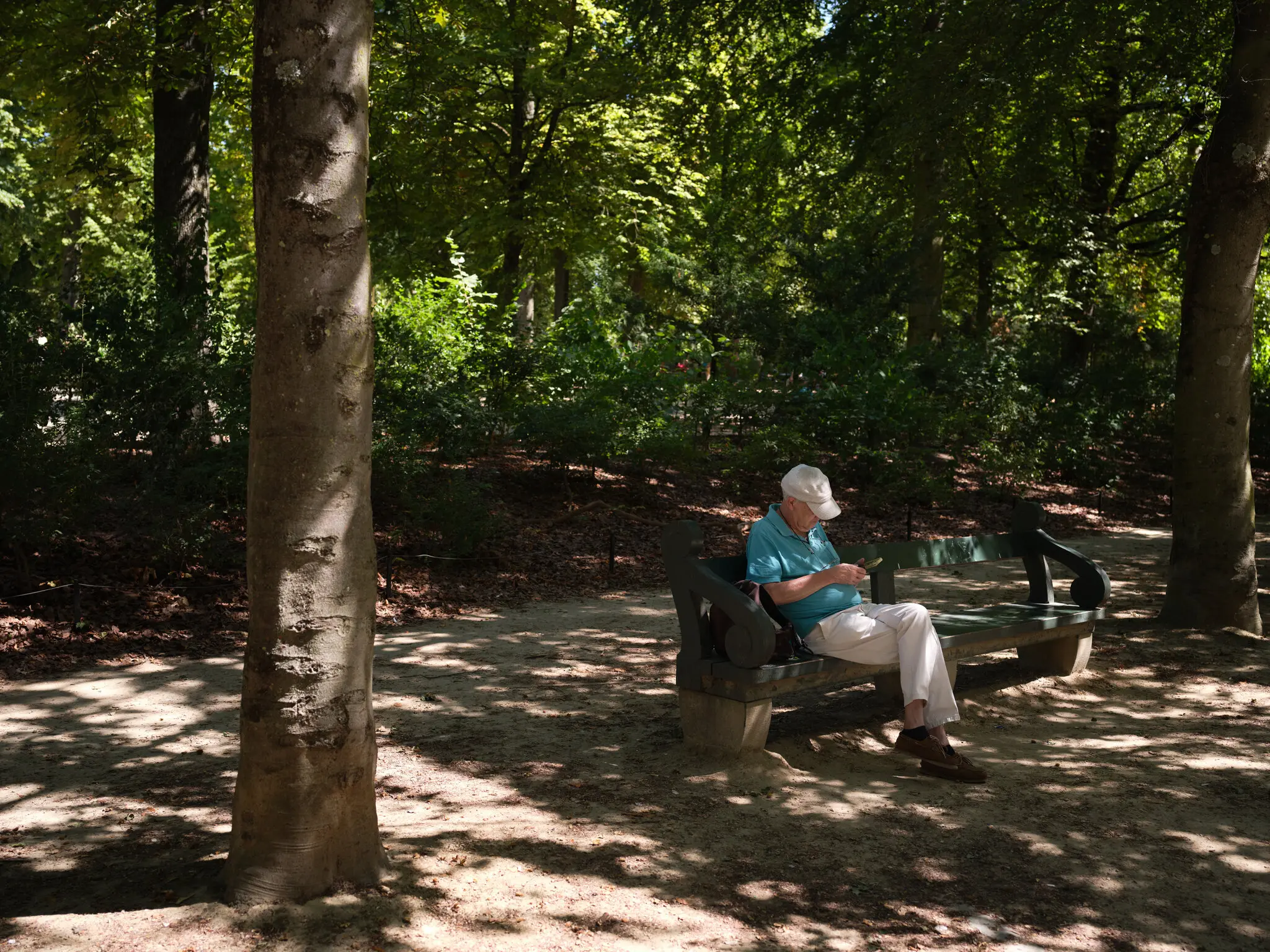
Older people face the greatest danger.
And heat rarely appears as the obvious cause of death.
Medical records may list heart attacks, strokes, kidney failure, dehydration or complications from chronic illness.
That is why counting deaths directly attributed to heat is extremely difficult.
Researchers instead look at excess mortality.
The measure compares the number of people who actually died with the number statistically expected during the same period based on historical patterns.
If 100,000 people would normally die during a given week and 116,000 die instead, the difference becomes evidence that something exceptional is affecting the population.
Historically, Europe’s biggest mortality spikes occur in winter.
Influenza, COVID-19 and other respiratory illnesses tend to drive deaths upward during colder months.
But this year, one week in June produced more excess deaths than any week of the previous winter.
For Europe’s health systems, that is an unsettling shift.
Summer is becoming a second season of mass mortality.
And it requires a very different kind of preparedness.
During an epidemic, governments can vaccinate, stockpile medicines and expand hospital capacity.
Heat presents a problem that cannot be solved inside hospitals alone.
A dangerous apartment remains dangerous even if the hospital system functions perfectly.
A treeless neighborhood does not cool down because a health ministry issues an alert.
A school, nursing home or social-housing complex without cooling does not become safe at 40 degrees simply because an emergency plan exists.
That is why climate adaptation is increasingly becoming infrastructure policy rather than merely environmental policy.
Europe will have to redesign housing.
And not only new housing.
The larger problem is the millions of existing apartments and buildings that were considered entirely suitable only a decade or two ago.
Air-conditioning is the most obvious response, but it creates a new set of contradictions.
Mass adoption sharply increases electricity demand precisely during the hottest hours of the day.
Power systems historically designed around winter demand peaks must now prepare for summer peaks as well.
The hotter the day, the more households switch on cooling at the same time.
If generation or the grid fails, the worst possible scenario emerges: power cuts precisely when vulnerable people need cooling most.
Adaptation therefore cannot mean installing millions of air conditioners and stopping there.
Cities need to change physically.
More trees.
More shaded streets.
Lighter-colored roofs.
Better natural ventilation.
External shutters.
Fewer surfaces that absorb and radiate solar heat.
Retrofitted public buildings.
These measures sound mundane compared with global climate summits.
But they directly determine how many people survive the next extreme-heat event.
Europe’s deeper problem is that climate risk is moving faster than infrastructure.
A building may stand for a century.
A drainage system for decades.
Urban trees need years to mature.
Power grids can take even longer to rebuild.
Temperature records can fall from one summer to the next.
That creates a growing mismatch between the speed of warming and the speed of political adaptation.
Western Europe ended June with the highest temperatures on record.
That does not mean every future summer will be hotter in every country.
Climate remains variable.
But the baseline from which heat waves begin is rising.
Events once treated as exceptional are becoming more frequent.
Frequency changes the economics of adaptation.
If a 40-degree day happens once every 50 years, rebuilding housing stock can seem excessive.
If it happens several times a decade, failing to adapt becomes more expensive than the renovation itself.
Europe has faced this lesson before.
The 2003 heat wave killed tens of thousands and was one of the first moments when the continent fully confronted the lethal potential of extreme temperatures.
In 2022, another historic heat event produced more than 16,000 excess deaths in a single July week.
That time, southern Europe suffered most.
Parts of Spain reached roughly 46 degrees Celsius.
The 2026 spike reveals a different pattern.
This time, the decisive factor was not simply the highest temperature, but the combination of severe heat and low preparedness.
That dramatically widens the map of future climate risk.
Vulnerability no longer aligns neatly with the map of Europe’s hottest countries.
Stockholm may be more vulnerable at 35 degrees than Seville at 40.
Paris may suffer more at 39 than Athens at 41.
The reason is the adaptation threshold.
People adapt physiologically.
Societies adapt culturally.
Cities adapt architecturally.
Health systems adapt institutionally.
When temperatures suddenly move far beyond the familiar range, all of those defenses can fail at once.
That is what late June exposed.
Governments therefore need to rethink what a heat warning actually means.
It is not enough to announce that tomorrow will reach 38 degrees.
Authorities need to know where people over 75 live.
Which of them live alone.
Which buildings lack effective cooling.
Which nursing homes have air-conditioned rooms.
Where public cooling centers are located.
Who will check on an elderly person during the fourth consecutive tropical night.
Climate policy begins to merge with social care.
Large cities face a particularly severe problem.
Asphalt, concrete and dark roofs absorb heat during the day and release it at night.
Inside an urban heat island, temperatures can remain significantly higher than in surrounding areas long after sunset.
For someone living on the top floor of an old Paris apartment building, the difference between an official outdoor temperature of 35 degrees and the actual temperature inside the home can become medically decisive.
Heat is therefore also a problem of inequality.
A wealthy household can install air-conditioning, leave the city or work remotely.
An elderly person on a low income in a small apartment often cannot.
A construction worker, courier, driver or warehouse employee cannot simply move the working day into an air-conditioned room.
As heat intensifies, climate risk becomes increasingly distributed by income, age and occupation.
That is why the figure of 16,000 deaths is not simply a measure of temperature.
It is a measure of social preparedness.
Europe already has the technology, wealth and health infrastructure to prevent a significant share of these deaths.
The problem is that the continent was built for a different climate.
Its homes were designed for cold winters.
Its power systems for winter peaks.
Its cities for moderate summers.
Its social services for seasonal winter crises.
That entire architecture is beginning to lag behind reality.
And that may be the most important lesson from the June heat wave.
Climate change does not always arrive as a catastrophic flood or wildfire that cannot be ignored.
Sometimes it looks like an ordinary sunny day.
Then another.
Then a night when the apartment never cools.
And a week later, mortality statistics are 16,000 deaths above normal.
That quietness is what makes extreme heat so dangerous.
It does not destroy a city in a minute.
It gradually overloads the human body, the apartment, the hospital, the power grid and the social-care system.
Southern Europe has already learned many of the habits needed to live in that climate.
Northern Europe will have to learn them quickly.
After the summer of 2026, the question is no longer whether another major heat wave will come.
The question is how many European cities will be ready before it does.