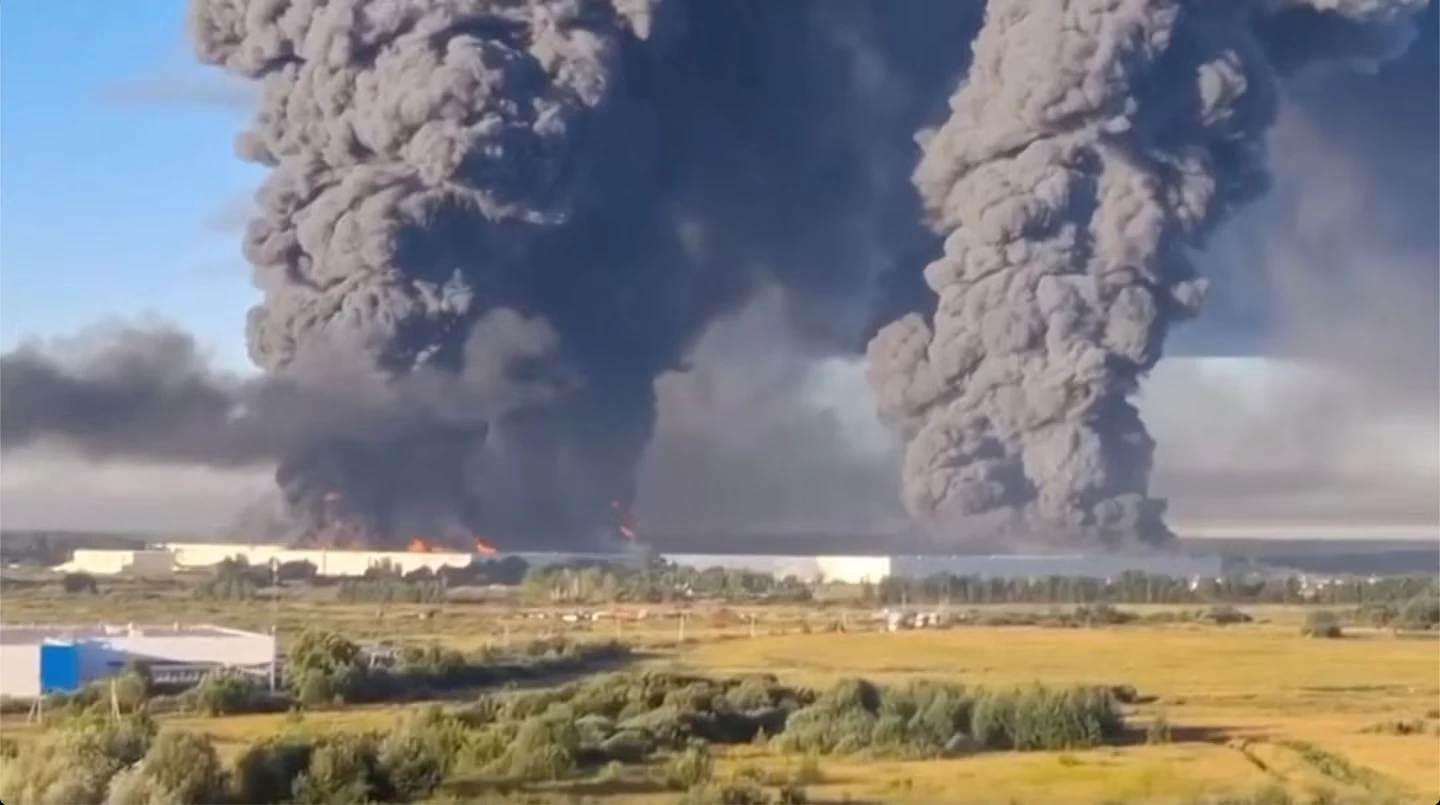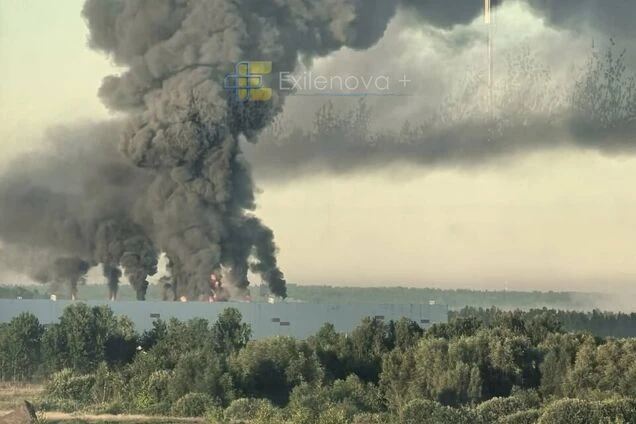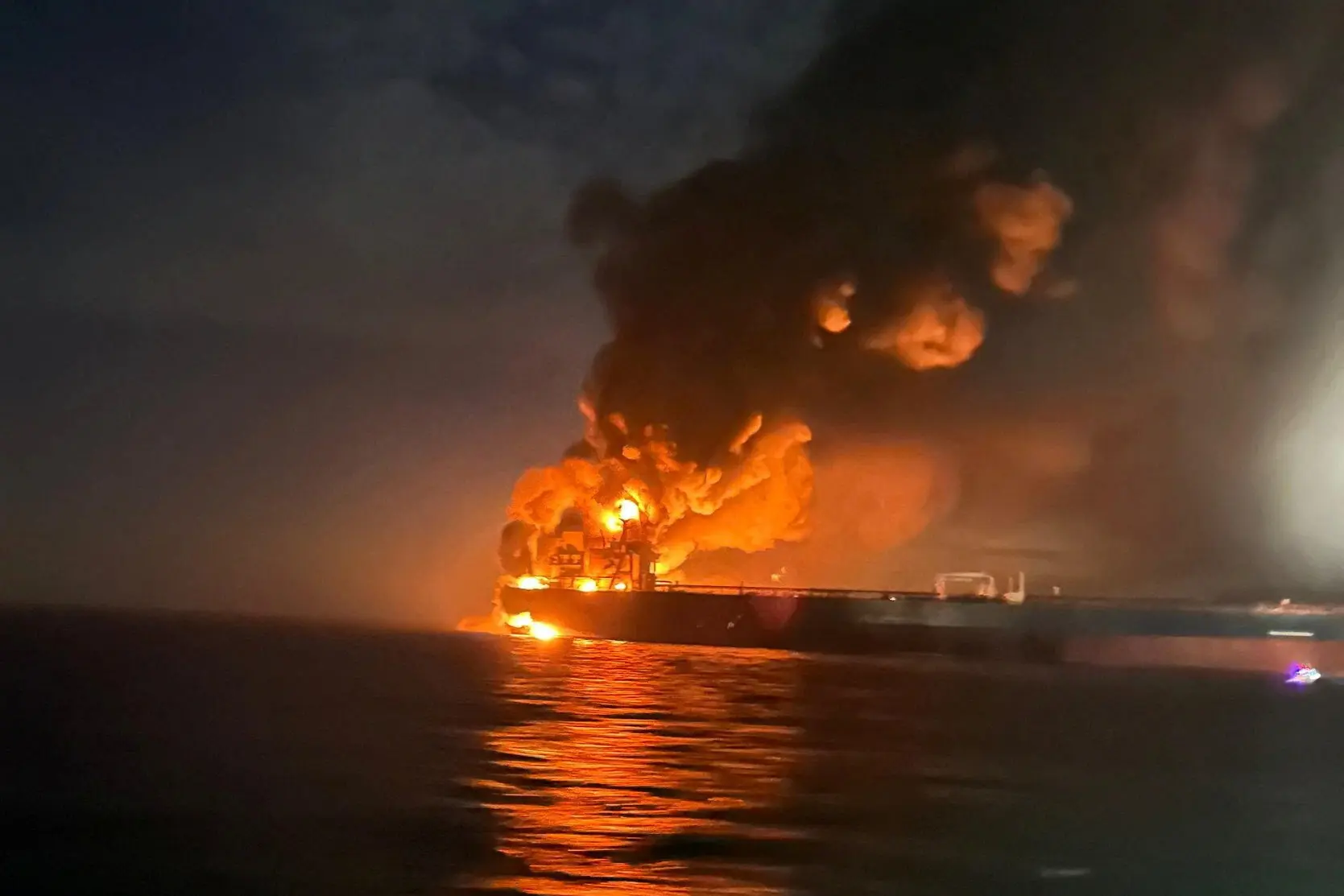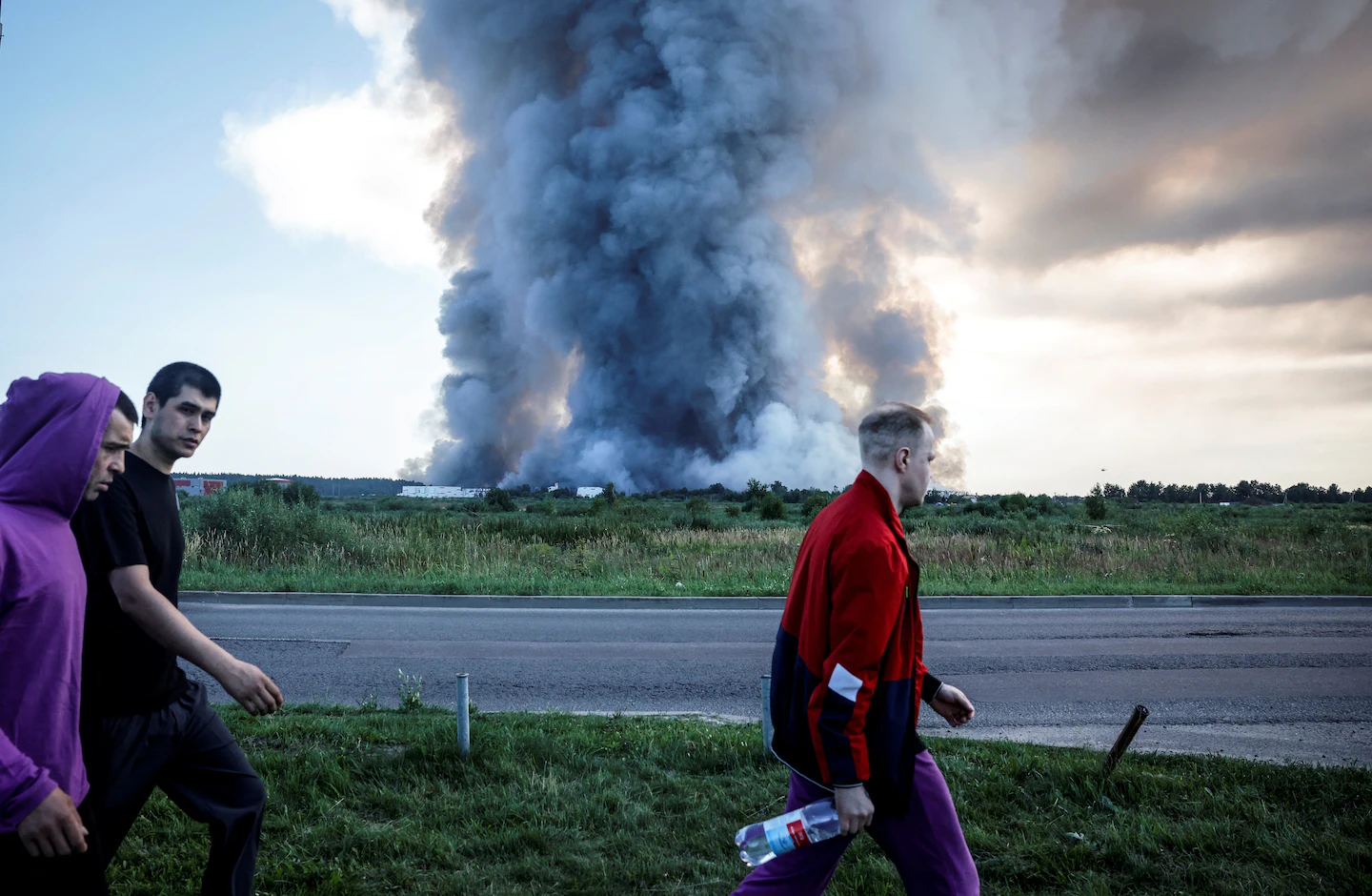





















The fire at the Wildberries logistics complex in Elektrostal burned for two days. Smoke above one of Russia’s largest e-commerce warehouses was visible in satellite imagery, while footage from the site showed buildings almost entirely destroyed. Another major company facility burned in Kotovsk, in the Tambov region.
At least eight people were killed and more than 80 were injured. The next wave of attacks reached the Moscow region, where drones ignited fires at a logistics site near Domodedovo, an oil depot and a residential building. Russian authorities said hundreds of unmanned aircraft had been directed toward the capital and surrounding areas.
The scale of the destruction turned the attack on Wildberries from another episode in the air war into an event of national significance. For Russia, the company is more than an online retailer. It is part of everyday life for millions of people, supplying clothing, electronics, household goods and equipment.
In Daycom’s assessment, the significance of the strikes extends beyond the loss of warehouse capacity. They damaged another part of the Kremlin’s unspoken bargain with society: the state wages war, while most citizens preserve a familiar way of life and avoid asking too many questions.
Russia’s Wartime Amazon
Wildberries began as an online clothing retailer and grew into Russia’s largest marketplace. Its platform connects manufacturers, merchants, couriers, warehouse employees and millions of consumers across dozens of regions.
The Elektrostal complex was one of the main distribution hubs serving Moscow and the surrounding area. It covered roughly 250,000 square metres. The Kotovsk warehouse added another 108,000 square metres and handled a substantial share of deliveries to southern Russia.
Early estimates suggested that the two attacks alone may have eliminated about seven percent of Wildberries’ total logistics capacity. Rebuilding costs were placed in the hundreds of millions of dollars, before accounting for destroyed inventory, equipment, lost revenue and possible compensation claims.
That is a serious blow even for a company whose annual profit is measured in billions. But the deeper vulnerability lies not in the corporate balance sheet. It lies in the number of small businesses that depend on the platform’s infrastructure.
For thousands of sellers, the warehouses were not simply storage sites. They provided access to customers in Moscow, rapid delivery, automated payments and the ability to operate without a physical retail network. The destruction of inventory meant, for many, the loss of nearly all working capital.
A Dual-Use Target
Ukraine said the warehouses had stored components used in drone production and navigation systems, including sanctioned goods. That argument places Wildberries in the contested space between civilian commerce and military logistics.
The marketplace does sell body armor, radios, electronic warfare equipment, fiber-optic cable for FPV drones, electronic components and other goods that can be used at the front. A significant share of Russian military supply is sustained by volunteers, private foundations and soldiers’ families purchasing equipment through ordinary commercial platforms.
Modern warfare has blurred the boundary between military and civilian logistics. The same warehouse may serve sellers of cosmetics, household appliances, radios and drone parts. The same carrier may deliver children’s clothing in the morning and equipment for a military unit in the evening.
That dual character makes such sites strategically attractive and politically dangerous targets. Destroying a logistics hub may interrupt the flow of military-related goods, but it also inflicts direct losses on civilian workers and entrepreneurs.
The deaths of eight people and the injuries of dozens cannot be treated as a secondary detail. The deeper Ukraine moves the war into Russia’s rear, the harder it becomes to balance military effect, international law and the political cost of civilian casualties.
A War That Can No Longer Be Hidden
For years, the Kremlin tried to insulate most Russians from the direct consequences of the invasion. The war was supposed to remain the concern of professional soldiers, mobilized men from poorer regions, defense factories and television propaganda.
Moscow and other major cities were expected to maintain an almost ordinary rhythm. Restaurants stayed open, deliveries arrived on time, shopping centers remained busy and attacks on Ukraine were experienced as distant events.
The strike on Wildberries narrowed that distance. When a huge column of smoke rises above a brand recognized by millions, war enters daily life more forcefully than any official report about a damaged military facility.
A customer sees a delayed order. A merchant loses stock. A warehouse worker realizes that a civilian job has become a potential target. Fear spreads not through political speeches, but through personal experience.
That is the central psychological effect of the attacks. They call into question the state’s ability to protect not only its borders, but also the economic core of the country. Russia’s territorial depth, long regarded as a strategic advantage, no longer guarantees safety.
The Economics of Forced Dispersion
Large warehouses are efficient because they concentrate goods, labor, transport and digital management in one location. The same concentration makes them highly vulnerable to long-range weapons.
After repeated attacks, Russian companies will be forced to rethink logistics. They may distribute inventory across smaller sites, build reserve capacity, create duplicate routes and move critical hubs farther from major cities and military facilities.
All of this increases resilience but reduces efficiency. Smaller warehouses cost more to operate, require more staff and transport, complicate inventory control and lengthen delivery times.
Direct losses are only part of the price. Insurance, security, surveillance systems, fire protection and forced shutdowns during air alerts all add costs. Even a drone that fails to reach its target can halt operations, trigger evacuations and disrupt transport schedules.
In this way, the long-range campaign imposes a permanent vulnerability tax on the Russian economy. Businesses are compelled to invest not in growth, but in protection from a war the state promised to keep far from the country’s largest commercial centers.
Sellers Caught Between War and the Corporation
The sharpest domestic dispute concerns compensation. Thousands of merchants lost goods stored inside Wildberries facilities and began demanding reimbursement.
Shortly before the attack, however, the company changed its rules for sellers, exempting itself from liability for losses caused by force majeure. The category explicitly included drone strikes, weapons use and damage involving military equipment.
Legally, that may allow Wildberries to avoid full compensation. Politically, the position could become explosive. Small businesses are already under pressure from higher taxes, expensive credit, labor shortages and weaker consumer demand.
For entrepreneurs, the fire destroyed more than merchandise. It consumed months of work, borrowed money, raw materials and expected income. They now find themselves trapped between a war they cannot control, a state that failed to protect them and a platform seeking to limit its own liability.
Wildberries promised support for the families of those killed and seriously injured, along with temporary financial relief for sellers. But loans, debt deferrals and faster withdrawals cannot replace inventory that has disappeared.
The company must now choose between legal savings and reputational damage. Refusing broad compensation could turn affected merchants into a new source of public anger.
A Political Risk for the Kremlin
The attacks came ahead of a parliamentary campaign scheduled for the autumn. The result itself is unlikely to threaten the Kremlin, but the campaign still requires the appearance of stability and control.
Warehouse fires, airport disruptions, attacks on oil depots and strikes in the Moscow region undermine that image. They show that the state cannot fully protect even the country’s central regions.
The Kremlin has responded in familiar terms, describing the attacks as terrorism, emphasizing civilian victims and presenting Russia as the target of external aggression. Such rhetoric may mobilize part of the population, but it does not solve the practical problem of defense.
Russia can reinforce air defenses around Moscow, industrial zones and major logistics centers. Yet every system moved into the rear is one less system available to protect an airfield, military base or section of the front.
Ukraine’s strategy exploits that dilemma. The number of potential targets across Russia far exceeds the available air defenses. It is impossible to protect an oil refinery, warehouse, port, railway junction, residential district and military facility with equal reliability.
A Spiral of Retaliation
The attack on Wildberries formed part of a rapid exchange of strikes. Russia followed with one of its heaviest missile attacks on Kyiv, using dozens of ballistic and hypersonic weapons against logistics sites and urban infrastructure.
Among the targets were a distribution center and a Nova Poshta sorting terminal. Moscow has long used against the Ukrainian delivery company the same argument Kyiv now applies to Russian marketplaces: that a civilian logistics network also supports military supply.
A self-sustaining spiral emerges. Ukraine strikes oil refineries, and Russia attacks energy infrastructure. Ukraine hits logistics centers, and Russia strikes postal terminals. Each side describes its own actions as military necessity and those of the enemy as terrorism.
The most dangerous feature of this logic is the constant expansion of what counts as an acceptable target. Facilities once viewed as civilian are gradually absorbed into the war economy and included in the cycle of reciprocal attacks.
For Ukraine, the danger is especially acute. Russia possesses a much larger arsenal of ballistic missiles and can answer drone strikes with far more destructive attacks on densely populated cities. Every Ukrainian success deep inside Russia may be followed by retaliation that Ukrainian air defenses cannot fully stop.
Does It Change the War?
Strikes on Wildberries will not collapse the Russian economy or force the Kremlin into immediate peace talks. Russia has large reserves, a centralized financial system and the ability to transfer losses onto companies and citizens.
But the attacks gradually change the cost of the war. They force the state and private sector to spend more on defense, repairs and backup systems. They weaken trust in the authorities, disrupt established economic relationships and make the war personal for people who had previously watched it from a distance.
Ukraine’s most important achievement is the erosion of geographic asymmetry. Russia can strike almost anywhere in Ukraine, but fewer Russian regions can now consider themselves beyond reach.
Strategic success, however, depends on disciplined target selection. A fire that destroys an important node in military supply may justify considerable risk. A strike that kills civilians while producing mainly commercial damage may create more political costs for Ukraine than military gains.
Wildberries has become a symbol of the war’s new phase not because it sells more goods than any other company, but because it shows how deeply the conflict has entered the economy of everyday life.
What burned was not only warehouse space and inventory. Part of the Russian belief that war could continue for years without reaching workplaces, family budgets and routine purchases burned with it.
That is what makes the attack strategically important for Ukraine and politically dangerous for the Kremlin. Yet the deaths of workers reveal the other side of the same strategy: the wider the war zone becomes, the harder it is to distinguish pressure on the state from harm inflicted on people trapped inside its economic machinery.