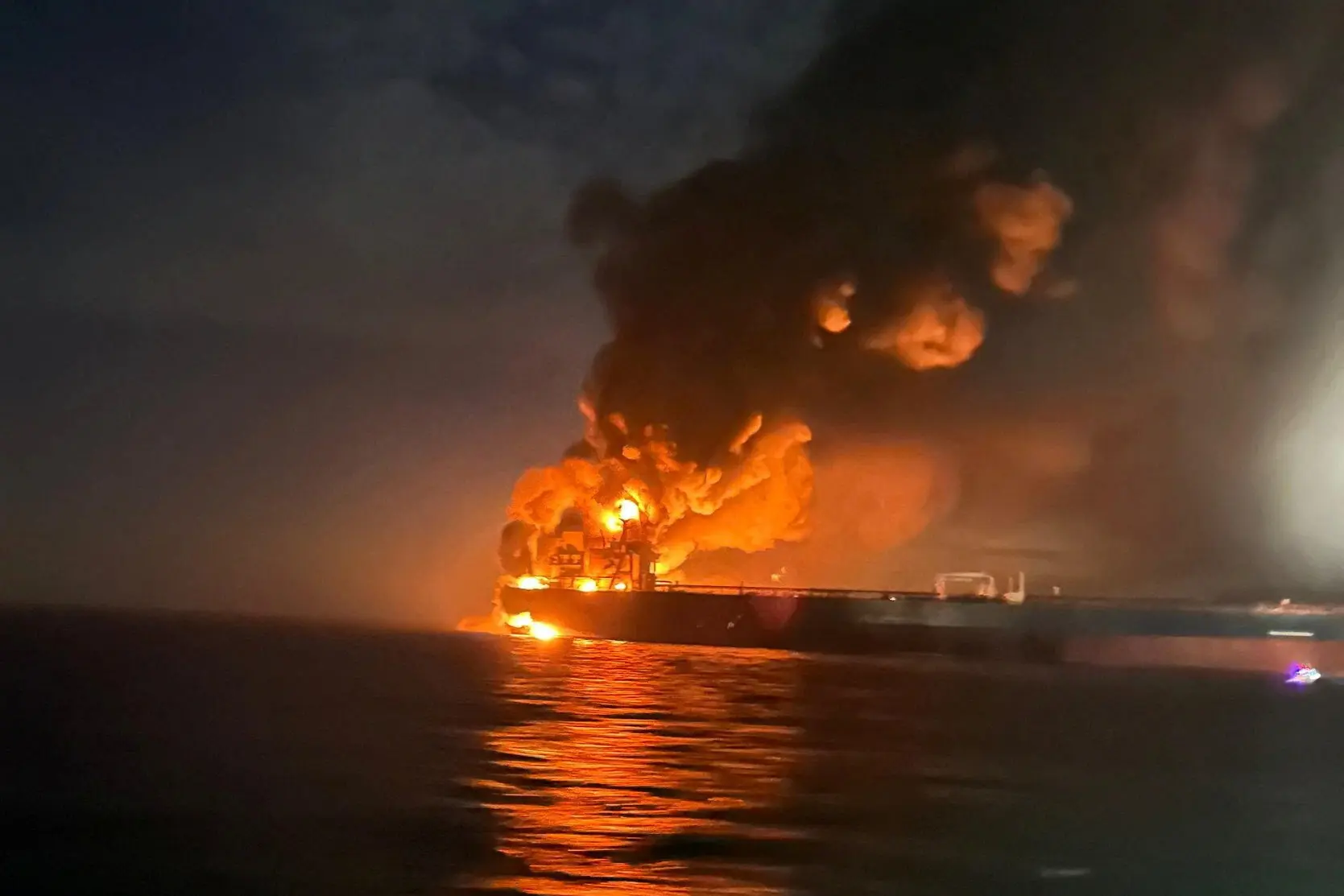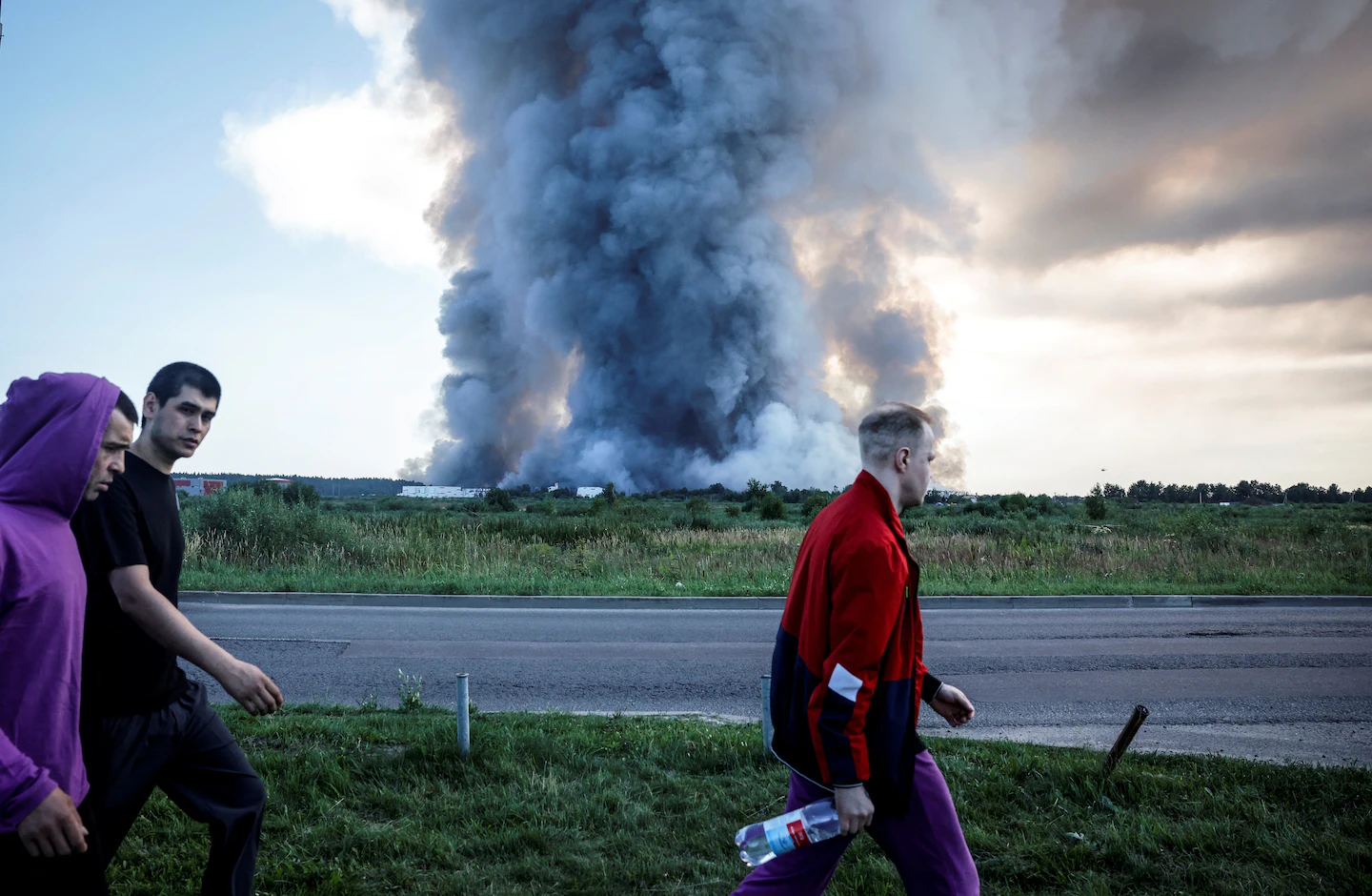
























A dense column of smoke rose above a Wildberries warehouse complex in Krasnodar as more than a hundred emergency workers and a helicopter were deployed to contain the fire. Almost simultaneously, other company facilities were hit in Nevinnomyssk, while drone debris struck an industrial site in Armavir.
Russian authorities reported one worker killed and ten people wounded in the Krasnodar region. Several days earlier, another attack on Wildberries facilities had killed eight employees, caused major fires and disrupted parts of the company’s logistics network.
Ukraine has not publicly claimed responsibility. Yet the geography, repetition and choice of targets point to a widening campaign of long-range drone strikes intended to move the economic cost of war deeper into the Russian rear.
In Daycom’s assessment, the attacks mark an important change. Ukraine’s drone campaign is no longer focused only on oil depots, airfields, factories or railway junctions. It is increasingly reaching civilian logistics systems that support the daily life of Russian cities and the stability of the consumer economy.
Why Wildberries Matters
Wildberries is no longer simply an online retailer. It has grown from a small clothing business into Russia’s largest marketplace, linking thousands of sellers to a vast network of warehouses, sorting centers, pickup points and road transport routes.
Its logistics hubs are part of a much larger digital commerce system. Goods, packaging, transport, software, labor and financial flows all converge in these facilities. When one major center is disabled, the effects extend beyond the company itself to merchants, contractors, carriers and regional delivery networks.
Russian online sales rose by 28 percent in 2025, reaching 11.5 trillion rubles. Transactions conducted through digital platforms amounted to roughly 8.5 percent of the country’s gross domestic product. Marketplaces have therefore become a central component of the Russian economy.
That gives Wildberries warehouses significance far beyond retail. They help move goods rapidly across enormous distances, sustain employment and preserve the appearance of normal life despite the war.
A strike on such a facility will not collapse the Russian economy. It does, however, demonstrate that the infrastructure of ordinary consumption is no longer beyond reach.
A War Over the Sense of Safety
During the first years of the full-scale invasion, many Russians experienced the war mainly through television reports, mobilization, inflation or the death of relatives serving in the military. For residents of large cities, the conflict often remained psychologically distant.
Long-range strikes are narrowing that distance.
A warehouse fire, a delayed delivery, an apartment damaged by falling debris or a temporarily closed airport makes the war visible in everyday life. It arrives not through a battlefield bulletin, but through work, transport and consumption.
That is the psychological force of attacks on civilian economic infrastructure. Their effect may lie less in destroying one warehouse than in creating persistent uncertainty: which facility will be next, how secure is the rear and can the state still guarantee protection?
For the Kremlin, this is a sensitive challenge. Russia’s wartime stability rests partly on an implicit bargain: most citizens remain politically passive while the state preserves a familiar standard of daily life. The more frequently the war interrupts that routine, the more expensive the illusion of control becomes.
From Military Targets to Economic Networks
Ukraine’s early strikes deep inside Russia were concentrated mostly on clearly military targets: airfields, ammunition depots, command posts, air defense systems and defense plants.
The target list later expanded to include oil refineries, fuel storage sites, energy facilities, railway stations and ports. The logic was direct: reduce the resources sustaining the Russian military and financing the state budget.
Attacks on warehouses belonging to a major marketplace represent the next step. These facilities formally belong to the civilian economy, but they depend on the same transport, fuel, storage capacity, digital systems and workforce required by a state fighting a long war.
In a modern economy, the boundary between civilian and military logistics is often blurred. The same truck may carry household goods, uniforms, electronics or technical equipment. A warehouse district may serve private business while also sitting beside industrial, transport or military infrastructure.
That does not mean every civilian warehouse automatically becomes a legitimate military target. On the contrary, the deaths and injuries of workers create serious moral, legal and political risks for Ukraine.
The farther the long-range campaign moves from unmistakably military infrastructure, the greater the cost of error.
The Risk to Civilians
Eight employees were killed in the earlier attacks on Wildberries facilities. The latest strikes caused another death and multiple injuries. Those figures make it impossible to separate the question of strategic effectiveness from the issue of civilian harm.
Large warehouses operate around the clock and may contain hundreds of workers at any given time. Even a precise strike can trigger a vast fire, structural collapse or the rapid spread of flames through storage areas.
The danger also rises when Russian air defenses intercept drones over populated areas. In Krasnodar, falling debris damaged two apartment buildings. No one was injured, but the incident showed how difficult it is to control the consequences once an unmanned aircraft enters a dense urban environment.
For Ukraine, this creates a strategic dilemma. A long-range campaign must increase pressure on the Russian state without undermining international support or allowing the Kremlin to portray the attacks as a deliberate war on ordinary workers.
Russian officials and company executives are already trying to shift attention from the function of the targeted facilities to the suffering of those employed there. Emotional statements about people who were merely doing their jobs form part of that information strategy.
The reaction is predictable, but it should not be dismissed. Ukraine must preserve a clear military rationale for its long-range strikes and avoid operations in which the possible economic gain is disproportionate to the risk imposed on civilians.
Can Russian Logistics Be Disrupted?
Wildberries operates a vast and distributed network. Damage to several warehouses will not stop the company. Cargo can be rerouted, operations transferred to other sites and workers reassigned.
But resilience does not mean the absence of cost.
Rerouting shipments increases transport distances, puts pressure on other distribution centers and raises insurance expenses. The company must strengthen security, revise schedules, alter routes and invest in protective measures.
If attacks continue, the economic damage accumulates. The cost includes not only burned inventory or damaged buildings, but also downtime, compensation payments, lost data, broken contracts, transport shortages and declining employee confidence.
One of the most important effects may be on future infrastructure planning. Businesses may begin avoiding large centralized warehouses, shifting instead toward smaller sites and dispersed inventories.
That improves survivability but reduces efficiency — the very advantage on which modern e-commerce depends.
In this way, a drone campaign can make the Russian economy more expensive, slower and less predictable. It does not produce an immediate strategic breakthrough, but it gradually raises the price of sustaining the war.
The Geography of the New Pressure
Krasnodar, Nevinnomyssk and Armavir are all located in southern Russia, a region important for transport, industry, agriculture and the supply of occupied Ukrainian territories.
The Krasnodar region is one of the main logistics corridors linking central Russia, the Caucasus, Black Sea ports and routes toward Crimea. Repeated disruption of warehouses, railways or highways there places additional pressure on the wider transport network.
At the same time, strikes in both the Moscow region and southern Russia show that the campaign is not confined to a single axis. One possible objective is to stretch Russian air defenses between the capital, military bases, industrial sites, ports and major cities.
It is impossible to protect every target at once.
Every air defense battery moved toward a warehouse district or energy facility is one less system available to defend an airfield, military base or front-line sector. Even a drone that fails to reach its target may force Russia to expend expensive interceptors and alter the deployment of its defenses.
A Strategy of Accumulated Pressure
Long-range strikes alone cannot force the Kremlin to end the war. Russia’s economy remains large, the state controls key resources and an authoritarian system can transfer losses to businesses and citizens for longer than many democratic societies can tolerate.
Yet such attacks change the underlying calculation.
They deprive Russia of the ability to treat territorial depth as an unconditional advantage. Factories, warehouses and transport hubs hundreds of kilometers from the front can no longer assume complete safety.
For Ukraine, this is also a way to compensate partly for shortages in aircraft, missiles and manpower. A relatively inexpensive drone may damage a facility whose construction and repair cost many times more.
The success of the strategy depends not on the number of dramatic explosions, but on the quality of target selection. The scale of the fire matters less than the wider effect: which transport chains were disrupted, how many resources will be required for recovery and what defenses Russia must divert.
Repeated attacks on Wildberries indicate that Ukraine’s drone campaign may be moving from isolated demonstrations of reach toward sustained pressure on specific economic networks.
This is no longer only a message about how far Ukrainian drones can fly. It is an attempt to force the Russian rear to reorganize continuously.
But the wider the campaign becomes, the more important target discipline will be. Strikes that cause significant civilian casualties without a clear strategic result may inflict more political damage on Ukraine than economic damage on Russia.
The fires at Wildberries warehouses reveal both sides of the new war. Drones allow Ukraine to reach deep into Russia’s economic space and erode the sense that the rear is untouchable. At the same time, they carry battlefield risk into places where thousands of civilians work.
The future of the long-range campaign will be determined by this tension. Its success will depend not only on how far a drone can travel, but on whether Ukraine can turn each strike into strategic pressure without surrendering its moral and political advantage.