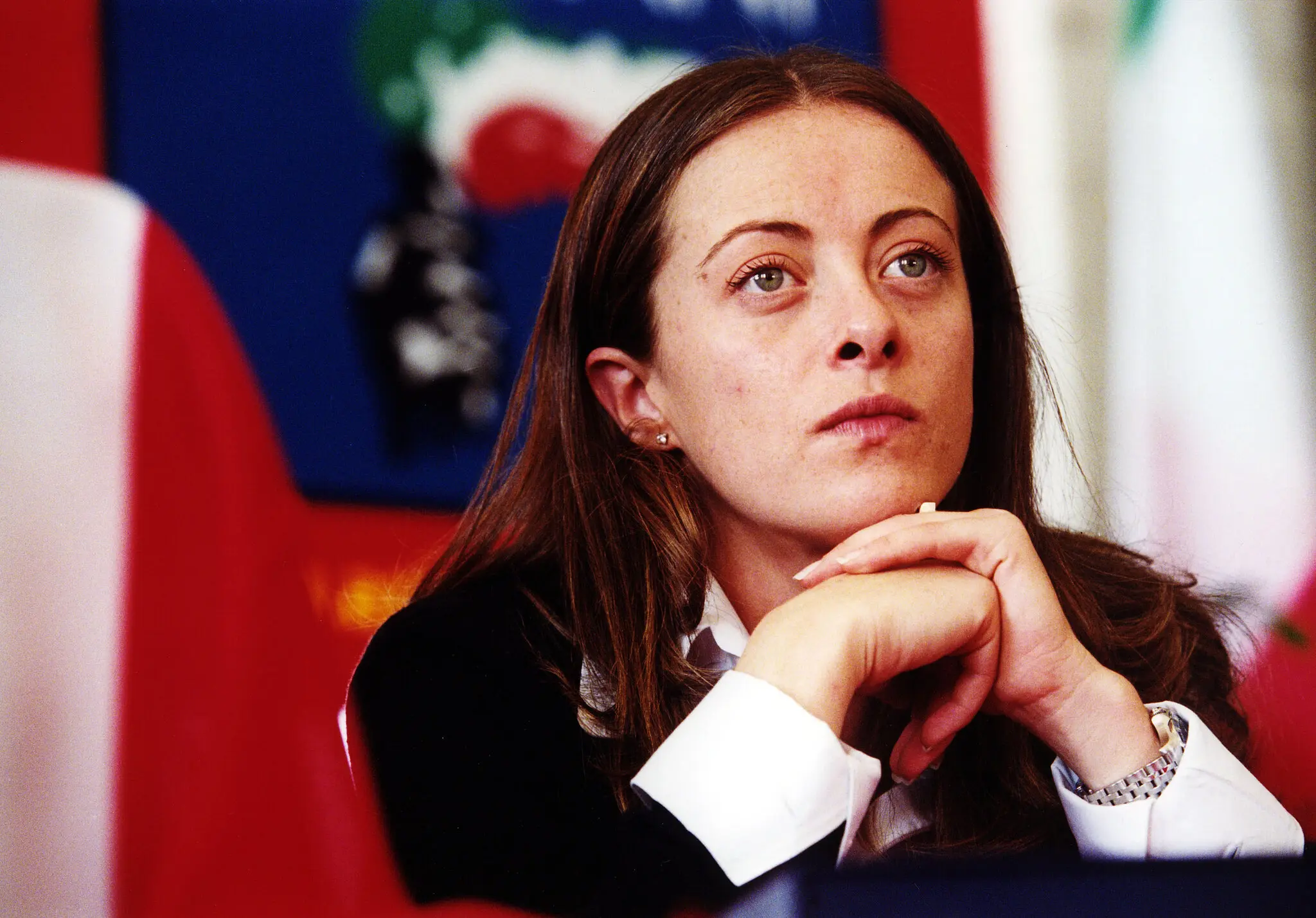






















Giorgia Meloni is approaching a milestone that would have seemed improbable when she entered Palazzo Chigi in October 2022. If her government remains in office through September 4, it will surpass the 1,412-day record of Silvio Berlusconi’s second cabinet and become the longest-serving government of republican Italy.
For a country whose postwar politics became synonymous with revolving-door governments, longevity carries unusual weight. Italy has had 68 governments across 19 legislatures since the republic was founded. Meloni has turned simple survival into part of her political argument: stability, in her telling, is itself evidence that Italy can govern differently.
But the real significance of the Giorgia Meloni record lies beyond the calendar. A politician whose formative years were spent on the post-fascist right now occupies a central place in European diplomacy, attends the West’s most consequential summits and leads one of the European Union’s largest economies without having abandoned her conservative political identity.
Her rise has therefore become a case study in something larger than Italian politics. Meloni did not reach the centre by becoming a conventional centrist. She brought much of her language about borders, national identity, family and cultural conservatism with her, while adapting the way those ideas are exercised inside institutions she once approached from the margins.
According to Daycom’s analysis of public records, economic data and recent political developments, that combination is essential to understanding her durability. Meloni has kept a parliamentary coalition together while remaining broadly compatible with NATO, the EU and financial markets — turning ideological sharpness and institutional predictability into complementary assets.
That balance helps explain why her political evolution matters elsewhere in Europe. The question is no longer simply whether a party with radical roots can win an election. Italy is testing whether such a movement can become sufficiently familiar, disciplined and durable that voters begin to treat it not as an exception to the system, but as one of its permanent governing choices.
Meloni herself frames her politics less as an exercise in moderation than as resistance to imposed limits. She speaks repeatedly about national pride and rejects the idea of an Italy that instinctively accepts a subordinate role. Her own career — from a teenage activist on the political fringe to prime minister — functions as the personal version of that national argument.
The appeal is easy to understand. Rather than offering supporters an abstract doctrine, Meloni presents a story about recovery of agency: Italy has been underestimated, conservative voters have been patronised, and institutions have too often defined which opinions are respectable before elections have had a chance to do so. Her biography gives that story a persuasive protagonist.
Yet the limits of ideological affinity have become increasingly visible in her relationship with Donald Trump. For years, the Italian leader seemed unusually well placed to deal with him: the two shared language on illegal immigration, political correctness and parts of the wider culture war. In 2026, that expectation has collided with a much more abrasive reality.
The rupture became public in June when Trump claimed Meloni had “begged” him for a photograph at a G7 summit. She said the story was fabricated and responded unusually forcefully, insisting that neither she nor Italy begs. The dispute developed into a broader diplomatic quarrel rather than disappearing as another piece of Trumpian theatre.
The tension did not quickly subside. In July, Trump publicly mocked Meloni again ahead of a NATO meeting, while senior Italian officials stressed that the strategic relationship with Washington had to survive disagreements between leaders. The episode exposed the distance that can open between shared cultural politics and the interests of allied states.
That distinction is increasingly important to Meloni’s international positioning. She can share parts of Trump’s worldview while rejecting the assumption that ideological sympathy requires deference. Her argument is now recognisably that of a traditional European head of government: personal relations matter, but national strategy and the cohesion of the West matter more.
The economy offers a more ambiguous test of her record. Italy’s labour market has delivered figures any government would advertise. Unemployment fell to a record-low 5 percent in May, while the employment rate reached 62.8 percent in the first quarter of 2026, its highest level on record after particularly strong gains over the previous two years.
Those numbers, however, coexist with structural weakness. Italy’s employment rate remains more than nine percentage points below the OECD average, with especially large gaps among women and younger workers. Stronger job creation has therefore improved the picture without eliminating the country’s longstanding problem of getting enough people into stable employment.
Wages are an even more difficult part of the government’s economic story. Real pay rose 1.3 percent year on year in the first quarter, but remained 6.1 percent below its level at the start of 2021. Among the major OECD economies, Italy still has the largest such shortfall, leaving many households with purchasing power yet to be recovered.
Growth has been steady rather than spectacular. Italy’s GDP expanded by 0.2 percent in the second quarter from the previous three months and by 1 percent from a year earlier. The figures suggest resilience, but not the kind of acceleration that would quickly resolve deep problems involving productivity, public debt and stagnant living standards.
This is why the economic dispute between Meloni and the centre-left cannot be settled with one headline statistic. The government can point to employment, financial stability and an economy that has avoided some darker predictions. Its critics can point to weak wage recovery, sluggish productivity and public services that remain under considerable strain.
For Meloni, however, political economics is also about comparison. She does not have to persuade Italians that the country has entered an economic golden age. She has to convince enough of them that her government has managed difficult conditions better than its opponents would have done — and that stability itself carries an economic value after decades of political churn.
Migration remains a clearer source of political advantage. In the first seven months of 2026, 16,567 people arrived in Italy by sea, compared with 36,545 over the same period a year earlier. July alone recorded 2,179 arrivals, according to figures reported from the UN refugee agency’s data.
Those figures do not prove that Rome’s policies alone caused the fall. Migration across the Mediterranean is shaped by conflict, weather, smuggling networks, agreements with departure countries and decisions taken elsewhere in Europe. Politically, however, the decline gives Meloni something valuable: a measurable result on one of the issues most closely associated with her rise.
Her cultural politics work differently. Meloni has repeatedly distanced herself from much of contemporary feminist language, arguing that equality should be measured by whether a woman can exercise power rather than by quotas or linguistic conventions. Her own premiership allows her to make that case from a position few of her predecessors could have occupied.
There is a useful political paradox in this. Italy’s first woman prime minister is also one of Europe’s most prominent critics of progressive gender politics. She can present her career as evidence that a barrier has been broken while challenging the movements and vocabulary historically associated with breaking such barriers. For supporters, the contradiction is part of the appeal.
For opponents, it points to a larger problem with the Meloni model: representation at the top does not necessarily imply structural change beneath it. Italy still has one of the lowest employment rates in the OECD, with women particularly underrepresented in the labour market. Symbolic individual success and broader economic equality remain separate questions.
Meloni’s importance is magnified because similar political pressures are intensifying elsewhere. In Germany, the AfD reached a record 28 percent in the August ARD-DeutschlandTrend, seven points ahead of the CDU/CSU bloc at 21 percent. It is only an opinion poll, not an election result, but it illustrates how far the balance has shifted since the 2025 federal vote.
France presents another version of the same test. Marine Le Pen has said she intends to run for president in 2027 after an appeals court reduced the period during which she was barred from seeking office. She remains a leading contender, while the National Rally has become the largest single party in France’s fragmented National Assembly.
For parties such as these, Meloni offers a potentially powerful lesson. The route to lasting influence need not involve perpetual confrontation with Brussels, withdrawal from alliances or constant institutional crisis. A radical-right party can retain a hard line on identity and migration while cultivating fiscal caution, diplomatic reliability and competence in government.
That is considerably harder for mainstream opponents to confront than an openly anti-system movement. Warnings about extremist origins lose some of their immediate force when voters have watched the same politician negotiate EU budgets, attend NATO summits and manage a coalition for nearly four years without the democratic system collapsing around her.
Time itself becomes a mechanism of normalisation. The longer a once-marginal political force operates inside ordinary institutions, the more its presence changes the definition of what counts as ordinary. Positions that were once framed as incursions from the fringe can, through repetition and electoral success, become part of the vocabulary around which everyone else must organise.
That does not make Meloni invulnerable. Italian voters rejected her flagship judicial overhaul in a March referendum, with roughly 54 percent voting against it. The defeat punctured the image of uninterrupted political momentum and demonstrated that the prime minister can lose a national confrontation even while retaining control of parliament.
Her coalition has also shown signs of strain over electoral reform. A key parliamentary vote was lost in July after members of the governing majority apparently broke ranks, although the lower house subsequently approved the broader reform package. The episode was a reminder that political longevity and complete internal discipline are not the same thing.
The approaching September record therefore marks a transition rather than a culmination. Meloni has largely answered the question of whether a leader with her political roots can provide stable government in Italy. The harder question is whether stability has produced enough material improvement for voters who care less about political history than about wages, housing and opportunity.
By the time Italians next vote nationally, endurance alone will no longer be sufficient evidence. A government that has lasted almost a full term inherits ownership of the country it governs. Weak productivity, demographic decline, the prospects of younger Italians and the quality of public services become progressively harder to attribute to previous administrations.
That is what makes the Giorgia Meloni story larger than a record measured in days. Italy is showing Europe how a political movement can travel from the edge of the postwar order to its institutional centre without entirely surrendering the identity that once kept it outside. The transformation runs in both directions: the movement changes, but so does the centre around it.
Europe’s next political argument, then, is no longer chiefly about whether the populist right can win power. In several countries, that possibility is already embedded in electoral politics. The more consequential question is what happens when movements once defined by their opposition to the establishment learn how to inhabit it — and remain there long enough to redefine what the establishment is.