






















Kostiantynivka has again become a place where geography matters almost as much as artillery. The city on the southern edge of Ukraine’s “fortress belt” no longer looks like a rear defensive hub: fighting is closing in on its outskirts, and the front line is beginning to seep into the urban fabric.
Russian units are not moving here in a sweeping breakthrough. They are advancing in small groups, probing weak seams, trying to anchor themselves in residential areas and turn basements into temporary positions. This tactic makes the front less visible, but no less dangerous.
Kostiantynivka is the first major support point in a line that leads north toward Druzhkivka, Kramatorsk and Sloviansk. For Ukraine, these are not merely cities in Donetsk region. They are the defensive frame that has held back Russia’s advance through the industrial heart of Donbas for years.
According to Daycom’s earlier analysis, this is where Russia’s campaign enters its most difficult phase: capturing tree lines, streets or isolated blocks no longer delivers quick operational results, but it steadily raises the cost of Ukraine’s defense.
Moscow wants to turn Kostiantynivka into a launchpad for a push north. If the city falls, Russian forces will gain a closer approach to Druzhkivka and increase pressure on the supply routes of Kramatorsk and Sloviansk. But that would not mean an automatic collapse of the front.
Ukraine’s defense does not rest only on concrete, trenches and firing positions. Its durability depends on rotations, ammunition, casualty evacuation, drone operations and the ability to keep roads functioning even after they have become a “kill zone” for almost any vehicle.
The road north from Kostiantynivka is increasingly exposed to artillery, FPV drones and guided bombs. Strands of fiber-optic cable stretch above anti-drone netting, used by operators to guide attack drones toward their targets.
Under these conditions, logistics is changing shape. Where trucks once moved, ground robots now carry water, food and ammunition. Soldiers cross the most dangerous stretches on foot or on light vehicles, because conventional evacuation is often no longer possible.
Civilian life in Kostiantynivka has almost shut down. Before the full-scale war, the city was home to about 70,000 people. Now only a few thousand remain. For those who have not left, the war is no longer approaching. It is already at the door.
Druzhkivka, farther north, is entering the same psychological space. Evacuation there no longer looks like a precaution. It is becoming the last chance to leave before the road loses its remaining predictability.
Russia’s main advantage remains the same: manpower. It can afford small assault groups, constant probing attacks and operations that often appear wasteful in military terms but, over time, put pressure on Ukrainian reserves.
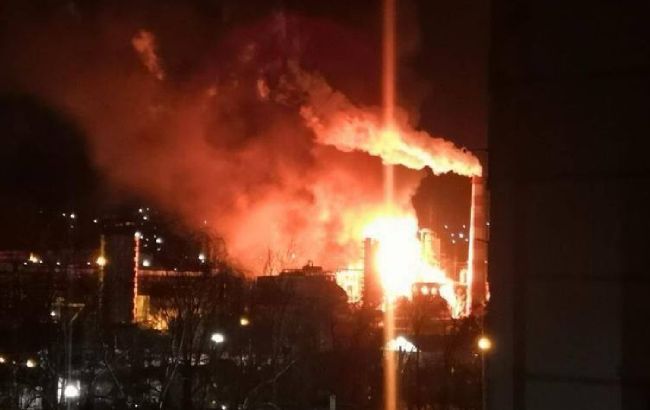
Yet Russia’s war machine is no longer moving without friction. Ukrainian strikes on logistics, oil infrastructure and supply routes to occupied Crimea are weakening Moscow’s ability to sustain a long campaign across the entire front.
That is why Kostiantynivka reveals the dual nature of the war now. Tactically, Russia is advancing. Operationally, it is paying an ever higher price for every meter. Strategically, it is trying to prove that it can still impose the tempo.
For Ukraine, the dilemma grows harsher each week. Holding the city preserves the integrity of the Donbas defensive belt, but demands more resources. Pulling back could save lives, but it would open a new line of pressure on the northern cities.
The Kremlin presents the situation as proof that the seizure of Donbas is inevitable. In reality, Kostiantynivka shows the limits of Russian power as much as its persistence: Russia can still squeeze the front, but it has not shown that it can quickly turn local gains into a broad breakthrough.
The battle for the city is unlikely to have a sharp ending. It is more likely to continue as an exhausting sequence of infiltrations, clearances, strikes on roads and fights for individual neighborhoods. This is how Russia has taken other eastern cities: slowly, expensively and through the destruction of urban space.
Kostiantynivka matters not only as a point on the map. It has become a test of whether Ukraine can hold the industrial Donbas under a new form of warfare, where the sky is crowded with drones, roads are remotely mined and the rear almost disappears.
If the city holds, it will slow Russia’s plan to move toward Druzhkivka, Kramatorsk and Sloviansk. If it falls, Ukraine will lose the southern lock of the “fortress belt,” but Russia will gain not a finished victory, only the next exhausting stage of the same war.
What is being decided in Kostiantynivka now is not the fate of the entire front, but the pace of the next campaign. That is why the battle matters: it will show whether Russia can still build momentum, and whether Ukraine can force that momentum to stall before it becomes a breakthrough.