






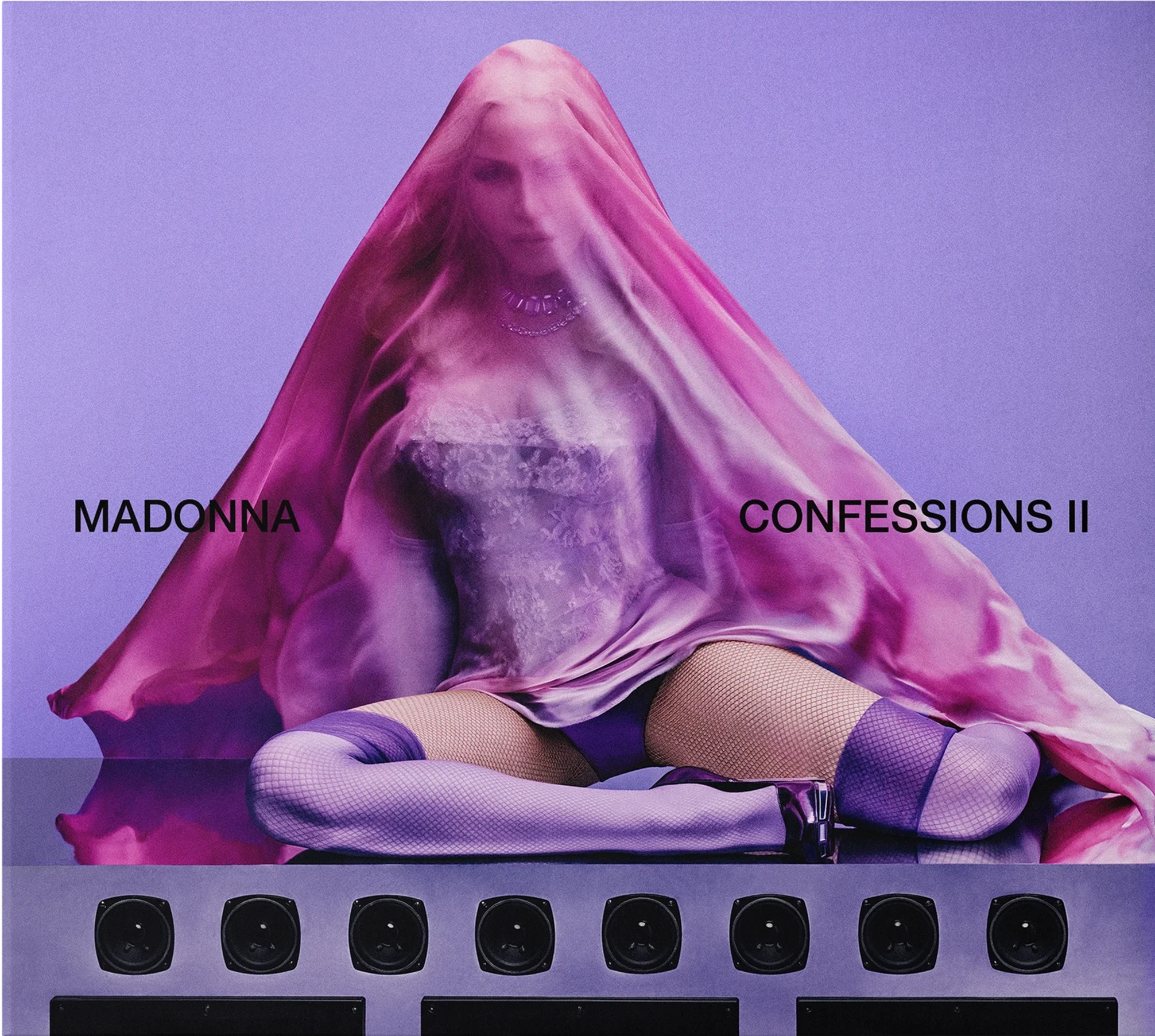
















For most of her career, Madonna treated her own history almost like dangerous cargo: something she could quote, tease or reinvent, but rarely allow to dictate the present. In 2026, that instinct has shifted. On “Confessions II,” she turns toward the past with unusual openness — and sounds freer for it than she has in years.
Released on July 3, the album consciously continues the story of 2005’s “Confessions on a Dance Floor.” Madonna reunites with Stuart Price, while the record is shaped as an almost continuous club sequence. The nostalgia is not merely decorative. It is a way back into the cultural environment from which her pop identity originally emerged.
Jean-Michel Basquiat, Keith Haring, Kenny Scharf, Fab Five Freddy, Maripol, David Byrne, Nile Rodgers and the Rock Steady Crew all pass through the song’s imagined nightlife. The effect is less a roll call of cultural capital than a map of the city that formed her before she became one of pop music’s defining global stars.
According to Daycom’s analysis, “Danceteria” is the strongest example among these new songs of the difference between nostalgia and creative memory. Madonna is not trying to become the young clubgoer she once was. She is using that period as material, returning to the environment where her understanding of pop freedom was first constructed.
That matters for an artist whose career has been built around perpetual reinvention. Some of Madonna’s later work occasionally carried the strain of someone determined to prove she knew every new producer, every current sound and every emerging star. “Confessions II” reverses the equation. For once, she is not chasing anyone.
Paradoxically, accepting her own history makes the music feel more contemporary. “Danceteria” contains echoes of “Vogue,” familiar club drama and gestures drawn from several eras of Madonna’s career, but it never becomes a catalogue of self-reference. Its real source of energy is the nightclub itself as a social space of possibility.
“Confessions II” makes no attempt to hide its relationship with the album that preceded it two decades ago. Its structure again treats the dance floor not as a sequence of isolated singles but as a continuous environment. That is a risky proposition for any sequel to a beloved record, yet Madonna mostly avoids turning it into her own tribute act.
At the opposite end of the spectrum are Mary in the Junkyard. Their debut full-length, “Role Model Hermit,” also arrived on July 3, but instead of pop archaeology it offers twitchy British guitar music in which rhythms tilt unexpectedly and melodies sit somewhere between fragility, unease and fairy-tale strangeness.
“Blood” captures the trio’s appeal particularly well. Clari Freeman-Taylor’s guitar does not simply propel the song forward; it keeps destabilising it, pulling the track between indie rock, art punk and something more spectral. The music does not demand immediate comprehension. Its details become more rewarding the longer the listener stays with them.
Mary in the Junkyard represent a particularly interesting corner of the current British guitar scene because they have little interest in simply reviving a specific decade. They take familiar alternative-rock vocabulary and bend it just far enough that melody remains intact while predictability disappears.
Ciara chooses a much more direct emotional language on “Yes.” The song arrived around the tenth anniversary of her marriage to Russell Wilson and works almost as a musical anniversary card: a light, polished pop-R&B declaration about a relationship that has lasted well beyond its honeymoon period.
What saves “Yes” from becoming overly sentimental is its lack of ceremony. Ciara does not frame a decade of marriage as an epic ballad about sacrifice and survival. She sings with the energy of someone who still wants to say yes. For an artist whose strongest performances have always been rhythmic and physical, that lightness suits her.

Billy Strings brings a very different tension. “Burn the Other End” previews his forthcoming album “So Much for Goodbyes,” due August 28, and again demonstrates why bluegrass has never functioned as a genre boundary for him. It is a foundation from which he can move into psychedelia, rock and long-form improvisation.
The song begins with a mood of exhaustion, stubbornness and gathering unease. Strings’ virtuosity never overwhelms the composition. Speed and technical complexity are not there merely to advertise skill; they gradually intensify the song’s pressure, making the arrangement feel as though it is tightening around the listener.
Live, the track seems almost designed to stretch into one of Strings’ extended jams. That is central to his musical identity: the studio recording often feels like only one possible version of the song. It establishes the narrative and temperature, while leaving enough open space for the composition to mutate completely onstage.
Smirk brings the collection back toward punk with “Cheap Greed,” but without the romance of youthful self-destruction. Nick Vicario’s new album “Speculative Fiction” is broader and more reflective than some earlier Smirk material, written from the distance of adulthood, family life and a more sober understanding of his own past.
“Cheap Greed” retains the project’s abrasive impulse, directing it toward consumer cruelty and social inequality. The most effective moment comes with a sudden mid-song tempo shift. Instead of simply accelerating the argument, Vicario appears to rebuild the song from within, as if the track itself has lost patience with its original shape.
That makes “Speculative Fiction” interesting beyond its punk mechanics. Vicario refuses the idea that growing older automatically means abandoning confrontation. Marriage, parenthood and personal change enter the material without softening it into comfortable acceptance. Maturity here becomes another source of friction.
The most fragile story in this group belongs to Empress Of, the recording name of Lorely Rodriguez. Her forthcoming album “Dream House,” due September 18, is deeply connected to the aftermath of the Altadena fires that destroyed her home. Even material written earlier acquired a different emotional gravity after that loss.
Against that background, the title “Dream House” stops sounding like an abstract pop metaphor. Rodriguez is working with the image of home after the literal place has disappeared. “Wild Storm” does not attempt to sonically reproduce catastrophe. Its falsetto and airy electronics instead create a strange sense of elevation above what cannot physically be restored.
That mismatch between subject and sound is what gives the track its strength. Pop often translates grief automatically into the language of the slow ballad. Empress Of chooses movement, air and weightlessness instead. She does not deny loss; she looks for a form in which life can continue after it, without rebuilding the past exactly as it was.
Taken together, these six songs form a surprisingly coherent picture. Madonna returns to the clubs of her youth. Smirk reassesses self-destructive years. Empress Of makes music in the aftermath of losing a home. Ciara marks ten years of marriage. Billy Strings turns weariness into forward momentum.
Even Mary in the Junkyard, the youngest act here and the least burdened by a long personal catalogue, are essentially asking the same question: what do you do with a familiar musical language when simply repeating it is no longer enough? Their answer is to distort it. Madonna’s is almost the reverse — to stop running from where that language began.
That is why “Danceteria” remains the most compelling track of the group. Not because Madonna needs once again to prove that she is the queen of pop, but because for a few minutes she stops trying to prove anything at all. She walks back into an old New York club, looks around at the people who shaped her youth — and finds music there that is still moving forward.