




















A Romanian F-16 fighter jet has shot down a drone that entered the country’s airspace, marking the first such interception by the NATO member since Russia’s full-scale invasion of Ukraine. The aircraft was destroyed on July 24 near Padina in Buzău County.
Romanian radar systems first detected the drone about 20 kilometers east of Sulina on the Black Sea coast. Two Romanian F-16s and two Italian Eurofighter Typhoons stationed in the country were scrambled in response.
The pilot opened fire at about 11 a.m., once the drone was flying over an uninhabited area. Its fragments fell into a wheat field without causing injuries or damage. Romanian authorities are still investigating the aircraft’s origin and purpose.
According to Daycom’s earlier analysis, the significance of the incident extends beyond the successful interception. Romania has moved for the first time from tracking incursions and collecting wreckage to actively destroying a threat inside its sovereign airspace.
Military officials said the aircraft appeared to be a Shahed-type attack drone, the Iranian-designed system used extensively by Russia against Ukraine. The preliminary assessment was based on the pilots’ visual observations, while a final identification will depend on the examination of recovered fragments.
That caution carries considerable political weight. Confirming Russian origin would mean that a combat drone belonging to a state waging war against Ukraine penetrated deeply into NATO airspace before being destroyed by an allied fighter.
Romania has recorded repeated airspace violations during Russian attacks on Ukrainian ports along the Danube. Drones or their fragments have previously fallen near Romanian border communities, but Bucharest avoided direct engagement in an effort to prevent uncontrolled escalation.
That threshold has now shifted. After a growing series of incidents, restraint increasingly carried greater risks than interception. Each drone allowed to continue its flight raised the possibility that the next one could reach a populated area or critical infrastructure.
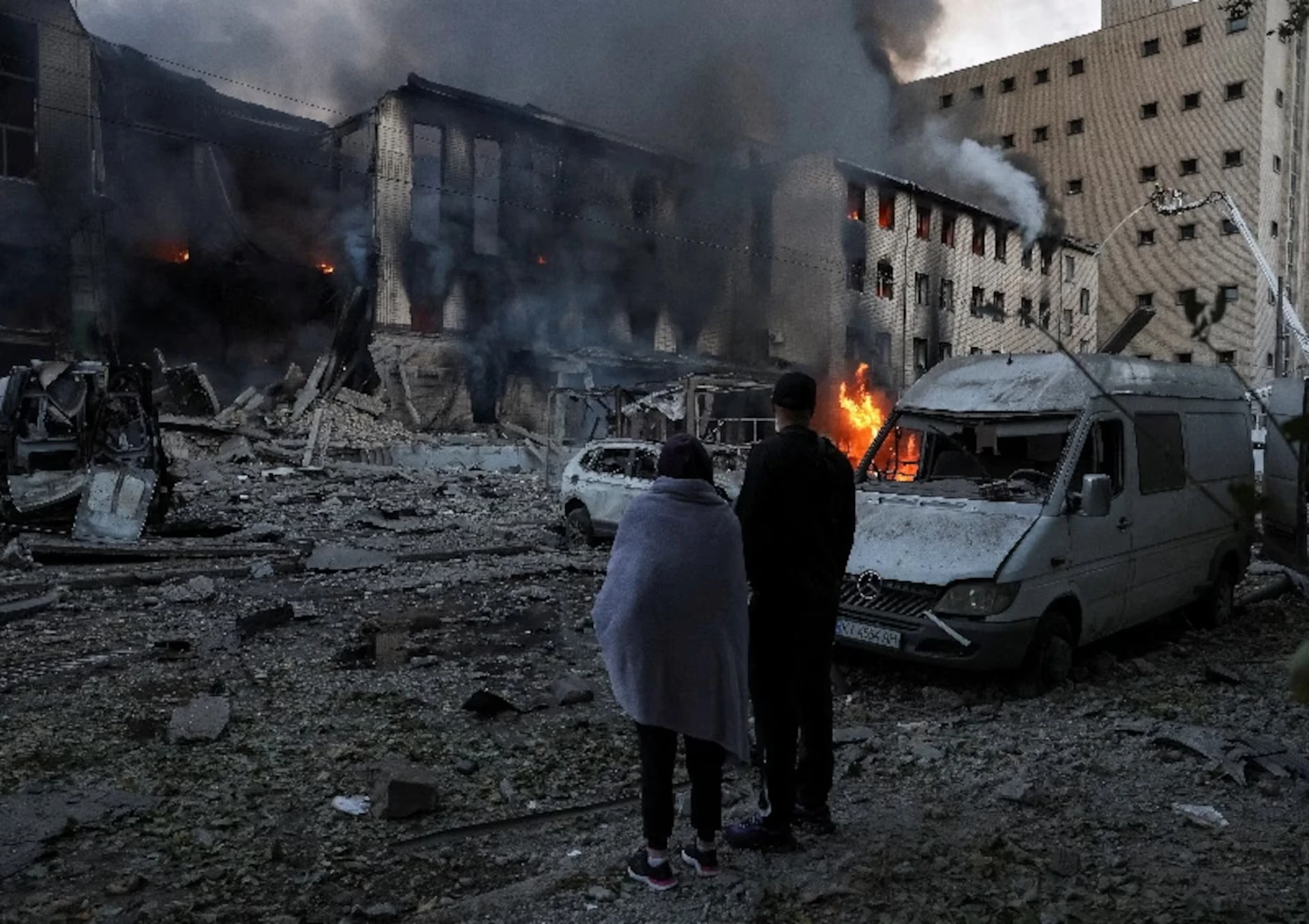
In late May, a drone struck an apartment building in Galați near the Ukrainian border, injuring two people. It was the first incident during the war in which an aerial threat from the Ukrainian direction hit a densely populated area in a NATO country and caused casualties.
After that episode, the explanation of an accidental border crossing was no longer sufficient. Even when a drone deviates because of electronic warfare, navigation failure or technical malfunction, a state must respond to its actual trajectory rather than its presumed original target.
Romania’s geography makes the problem especially acute. The country shares roughly 650 kilometers of border with Ukraine, controls a strategically important section of the Danube Delta and sits beside maritime routes that Russia has repeatedly tried to disrupt.
Russian attacks on the Odesa region have intensified around the harvest season. Ports, grain terminals, energy facilities and transport routes supporting Ukrainian exports through the Danube and the Black Sea have all come under pressure.
When Shahed drones target Izmail, Reni or other facilities close to Romania, the distance between an active war zone and NATO territory is measured not in strategic depth, but in minutes of flight. A navigation error can become an international security incident almost immediately.
The interception near Padina is particularly important because of how far the aircraft appears to have travelled. The drone did not simply cross the border for a few moments. It remained over Romanian territory long enough for fighters to pursue it and receive authorization to engage.
That raises questions about the structure of Romania’s ground-based air defenses. Scrambling an F-16 is effective but expensive when the target is a comparatively cheap drone. The aircraft, radar coverage and interceptor missile may together cost far more than the Shahed itself.
The imbalance does not eliminate the need to act. A drone that strikes an oil depot, power station, port or residential district can cause damage vastly exceeding the cost of interception.
For NATO, the incident is also a test of its rules of engagement. The alliance has strengthened air policing on its eastern flank while trying to distinguish between deliberate attack and accidental violation. Mass drone warfare is steadily eroding that distinction.
An unmanned aircraft does not need national markings to pose a threat. Its origin may remain uncertain until after it is destroyed, while the decision to engage must be made within seconds, based on speed, direction, flight profile and potential target.
Under such conditions, proven intent becomes less important than immediate risk. If an unidentified attack drone is moving deeper into national territory, military commanders cannot wait for a diplomatic investigation. They must neutralize the aircraft first and determine responsibility afterward.
The deployment of Italian Eurofighters shows that the defense of Romanian airspace has already become a multinational mission. NATO allies are not merely expressing political solidarity; they are integrating aircraft, radar networks, command centers and response procedures.
One successful interception, however, does not resolve the wider challenge. Russia can launch dozens of drones in a single night, varying their altitude and route to complicate detection. Fighter aircraft alone cannot secure the entire border.
Romania will need a layered air-defense system combining long-range radar and Patriot batteries with mobile fire teams, electronic-warfare systems, gun-based defenses and cheaper interceptors designed specifically for unmanned aircraft.
Coordination with Ukraine will be equally important. Rapid data-sharing on drone trajectories can provide Romanian forces with additional minutes to assess and respond. In modern air warfare, that warning time may determine whether a drone is destroyed over an empty field or reaches a city.
Moscow may try to portray the interception as evidence of aggressive NATO behavior. Legally, however, the central fact is the violation of sovereign airspace. Romania has the right to defend its territory whether the incursion was deliberate or accidental.
Bucharest is nevertheless likely to avoid rhetoric that could make the episode appear to be the beginning of direct war between Russia and NATO. That is why officials will wait for technical analysis before making definitive claims about the drone’s origin.
Such restraint does not mean a return to passivity. After the Romanian F-16 fired, the practical rules changed: an unidentified drone entering the country’s airspace and continuing inland can no longer assume it will be allowed to fly unchallenged.
The Padina incident does not automatically trigger NATO’s collective-defense mechanism. The alliance would first need to establish the source, nature and intent of the intrusion. But it brings NATO closer to a reality in which defending its borders requires the operational use of weapons.
Romania has now taken a step it avoided throughout the first years of the full-scale war. Rather than waiting for wreckage to fall on another home, it destroyed the threat in the air.
The incident has not changed the nature of the war, but it has changed NATO’s response to its proximity. The eastern flank is no longer merely a rear area for monitoring Russian attacks on Ukraine. It is a space where a navigational failure, a deliberate provocation or an uncontrolled Shahed can require a decision within minutes — and Romania has shown what that decision may now be.