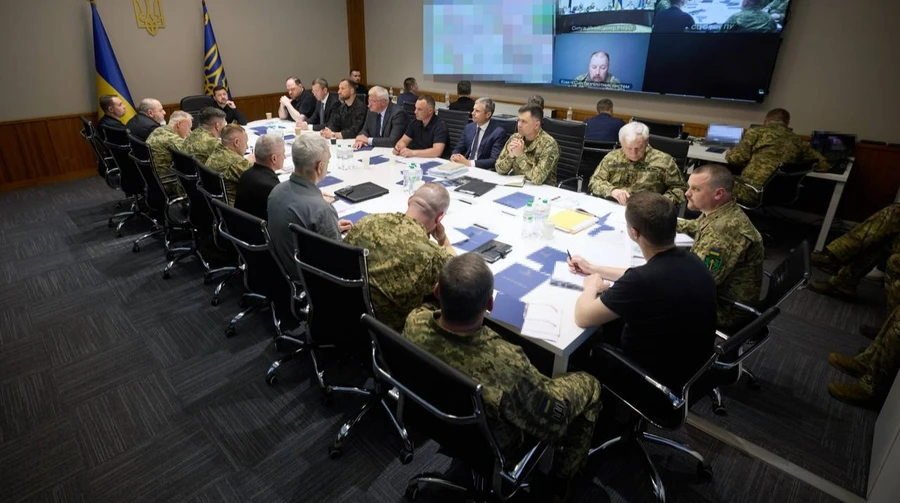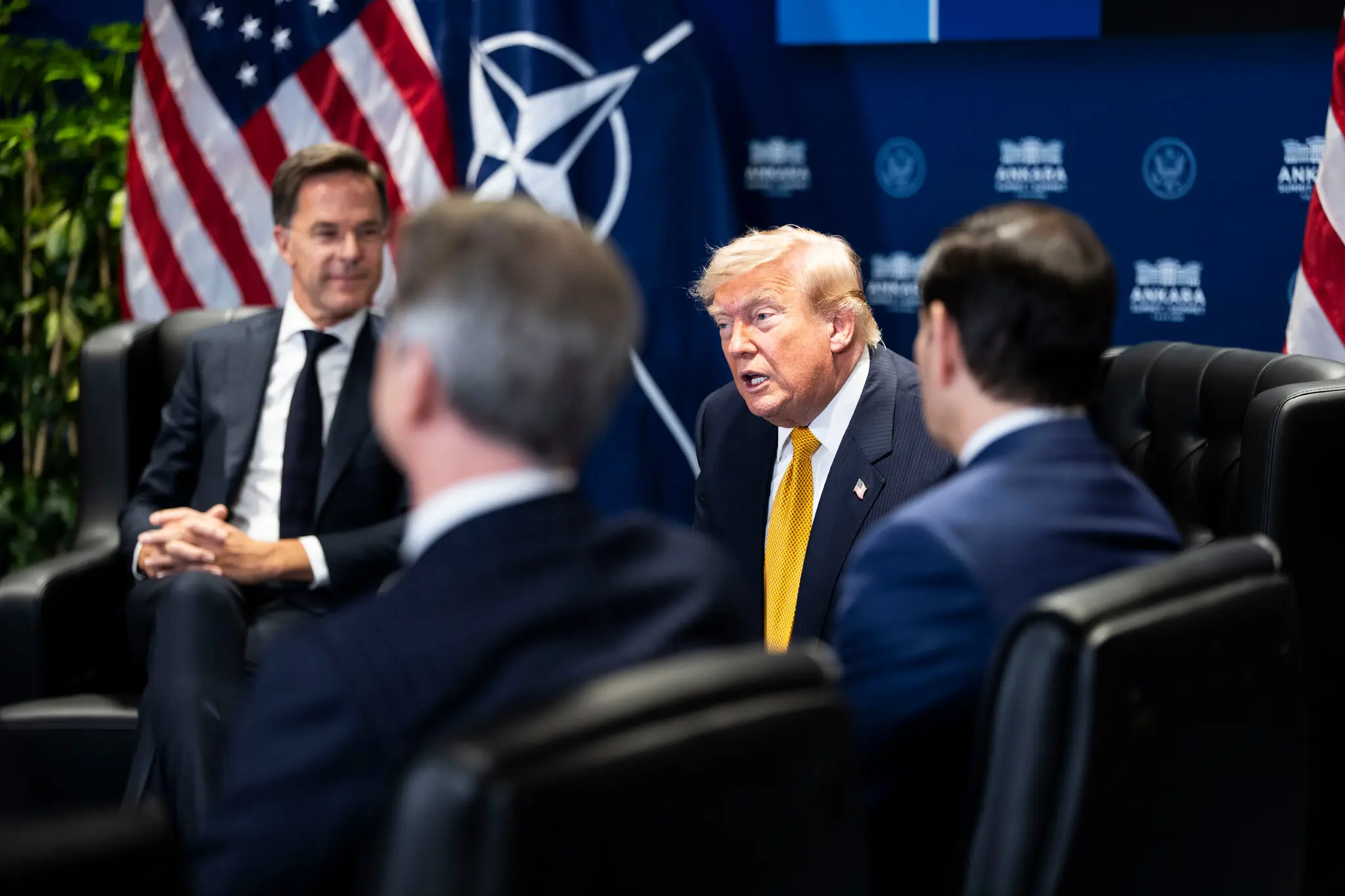

















Volodymyr Zelensky has begun a series of one-on-one meetings with Ukraine’s best-known commanders at a moment when discontent with the military leadership has moved from private offices into the streets. Officially, the president is discussing the front. Politically, the conversations increasingly resemble a search for a new command structure.
For several consecutive days, thousands of people gathered in Kyiv and other cities despite martial-law restrictions. They demanded the return of Mykhailo Fedorov to the Defence Ministry and the dismissal of Commander-in-Chief Oleksandr Syrskyi, whom they blame for obstructing reform.
The scale of the response no longer allows the government to portray the dispute as an ordinary personnel reshuffle. A survey found that 61 per cent of Ukrainians opposed Fedorov’s dismissal, while only 15 per cent supported it. In effect, the decision has become a public vote of no confidence in the president’s reasoning.
Daycom’s assessment is that Zelensky is conducting more than consultations with senior officers. He is trying to identify a commander capable of holding the front, calming the armed forces, continuing technological reform and maintaining a workable relationship with the political centre.
Six commanders whose careers were shaped by the war with Russia met the president separately. They included Mykhailo Drapatyi, Volodymyr Horbatiuk, Oleh Apostol, Andriy Biletskyi, Ihor Obolenskyi and Denys Prokopenko. Each represents a distinct combat tradition and a different model of leadership.
The meetings do not necessarily mean Syrskyi’s dismissal is imminent. Zelensky may be gathering assessments before a high-level defence meeting, preparing changes below the top level or searching for a balance between the commander-in-chief and the reformist camp. Yet the public nature of the consultations has turned them into an unofficial audition for the country’s highest military post.
Drapatyi is widely regarded as the most obvious contender. He has battlefield authority, support within parts of the officer corps and a reputation for speaking directly about institutional failures. His clashes with the existing command structure have reinforced his image as an alternative to Syrskyi’s system.
Horbatiuk represents a different kind of candidate: a staff professional with experience managing large formations. Apostol comes from the Air Assault Forces, while Biletskyi, Obolenskyi and Prokopenko command corps built around units with strong battlefield identities and distinct internal cultures.
This generation was shaped not by Soviet academies, but by the war that began in 2014. Its commanders are accustomed to permanent shortages, building their own technology teams, finding additional resources and changing tactics rapidly under pressure from Russian drones.
The protesters are trying to turn that generational difference into a political argument. Their demand is not primarily about Syrskyi’s age or even individual failed operations. It is directed at a culture in which information travels slowly upward, criticism is treated as disloyalty and promotions depend on proximity to headquarters.
Fedorov became the symbol of the opposite model. He argued that units should be assessed by battlefield performance, that resources should flow toward the most effective teams and that the path from technological development to frontline use should be shortened. His removal was seen as a victory for a closed hierarchy over measurable accountability.
Zelensky attempted to reduce the tension by offering Fedorov other roles related to military technology and innovation. But according to people close to the former minister, he is prepared to return only to the Defence Ministry. That position deprives the president of an easy compromise.
A separate technology office could preserve Fedorov’s place in government without removing Syrskyi. Yet without authority over procurement, budgets and personnel, such a role would risk becoming a public showcase with little real power. The current crisis arose from a struggle over authority, not job titles.
The head of the presidential office, Kyrylo Budanov, has called for calm, saying that public opinion has been heard and that work is underway. The message is intended to contain escalation, but it also creates an expectation of rapid results. Every day without a decision will now be interpreted as an attempt to outlast the protests.
Organisers have already issued an ultimatum: unless Syrskyi is removed and Fedorov restored by July 24, they will call for a general, indefinite protest. In a country at war, that prospect creates a risk that cannot be dismissed as ordinary political inconvenience.
Street pressure can accelerate necessary reform, but it cannot become a permanent mechanism for appointing military leaders. If a commander-in-chief is removed solely because of demonstrations, the successor will begin the job knowing that public mood can determine the length of the mandate.
Ignoring the protests, however, would not amount to defending civilian control. It would mean denying the scale of the trust crisis. The demonstrations are supported by veterans, active-duty soldiers, technology units and civilians who see military reform as a question of national survival.
Syrskyi is criticised for a Soviet-style command culture and operations with a high human cost. His defenders reply that he manages a front stretching more than 1,200 kilometres with fewer troops and resources than the enemy. Under such conditions, any commander will make decisions that produce casualties.
That argument is valid, but no longer sufficient. Critics are questioning not only the number of losses, but the process that produces them: the quality of intelligence, whether objectives reflect battlefield reality, whether commanders can alter plans and whether headquarters will halt an operation once its purpose has disappeared.
The greatest danger is that the dispute divides the armed forces into supposedly “technological” and “traditional” camps. Ukraine needs both. Drones cannot hold ground without infantry, while disciplined infantry cannot survive without reconnaissance, robotic logistics, electronic warfare and rapid decision-making.
The next commander-in-chief, whoever it may be, must therefore avoid delivering victory to one side over the other. The General Staff should define strategic objectives, while corps commands receive enough autonomy to determine how those objectives can be achieved under actual battlefield conditions.
A new system for evaluating commanders will be equally important. Movement on a map cannot remain the only measure of success. Assessments should include casualty ratios, preservation of personnel, speed of adaptation, drone effectiveness, training standards and the ability of units to recover after difficult battles.
Zelensky’s meetings with six commanders show that Ukraine has a reserve of credible military leaders. Strong generals, however, do not automatically create a stronger institution. Any of them would face the same bureaucratic interests, closed personnel networks and political interference.
The president must therefore announce not only a name, but the rules governing the next phase. Will the commander-in-chief be allowed to form a new team? Who will control technological transformation? How will resources be distributed among corps? What protections will exist for officers who refuse to submit false reports?
The crisis emerged just as Ukraine appeared to be regaining military initiative. Long-range strikes against Russian targets and the slowing of Moscow’s advances strengthened the belief that the technology-led model was working. Fedorov’s dismissal was therefore interpreted as a threat to gains already achieved.
Zelensky can still turn the protests into the beginning of institutional renewal. To do so, he must resist the temptation to offer a single personnel sacrifice—Syrskyi, Fedorov or both. Society is not merely demanding punishment. It is asking for proof that the armed forces can change faster than the war itself.
The president’s public meetings with commanders have opened a process that will be difficult to return to secrecy. The final decision will not be judged simply by who stays or leaves, but by whether Ukraine gains a command system in which professionalism outweighs loyalty and truth from the front reaches the highest office without distortion.