















The Oregon Coast does not promise white sand or warm water. It calls for flannel, a waterproof jacket and a willingness to accept a sky that may remain gray all day. Even in summer, temperatures often hover around 15 to 17 degrees Celsius, and only the hardiest visitors enter the Pacific without a wetsuit.
That severity is precisely what makes the journey compelling. Fog swallows lighthouses, sea stacks rise from the water like remnants of another geological age, and small towns move at a pace where restaurant waitlists are still written by hand on paper.
The northern coast is particularly well suited to a short trip from Portland. In two days, travelers can see Astoria, the mouth of the Columbia River, the skeleton of a ship on the beach, the forests of Cape Disappointment and Cannon Beach with its enormous Haystack Rock.
In Daycom’s assessment, the value of this route lies less in the number of attractions than in the change of rhythm. Here, travel does not compete with a phone for attention. The ocean, cold wind, wet timber and morning coffee above the river gradually push the digital noise aside.
The natural place to begin is Astoria, the oldest American settlement west of the Rocky Mountains. The city stands where the Columbia River meets the Pacific, and that geography shapes its character: maritime, windswept, slightly brooding and stubbornly independent.
The first landmark is the Astoria Column, rising roughly 38 metres above the hilltop. After climbing its 164 spiral steps, visitors are rewarded with sweeping views of the river, the ocean and the waterways converging around the city. From the top, people traditionally launch small wooden gliders sold in the gift shop.
The column’s exterior frieze presents a largely colonial account of regional history, centered on European explorers and the Lewis and Clark Expedition. Indigenous peoples who had lived here for centuries were long left almost entirely outside the official narrative.
The park is now beginning to correct that perspective. New interpretive material acknowledges York, the only Black member of the expedition and a man held in slavery, as well as the Native communities whose knowledge and assistance were essential to the newcomers’ survival.
From the column, descend toward the waterfront. The Astoria Riverwalk stretches for more than nine kilometres along the Columbia. Old wooden pilings rise from the water, remnants of piers and salmon canneries that once supported the local economy.
Parts of Astoria still stand literally above the river. The commercial center was built on wooden structures because of the marshy tidal flats and steep surrounding hills. A devastating fire in 1922 destroyed much of that district, but traces of its unusual construction remain.
Modern Astoria does not live entirely in the past. Its center is filled with independent bookstores, workshops, cafes and design shops selling waxed-canvas clothing, maritime literature, ceramics, candles and other objects unlikely to appear in a conventional shopping mall.
Dinner almost inevitably returns the traveler to the sea. Local restaurants build their menus around fresh fish, shellfish and crab. The best dishes make no attempt to disguise the ingredients’ origins: fish arrives in substantial pieces, broths remain simple and seasonality matters more than culinary theater.
Morning in Astoria is best spent on the pier. Cafes suspended above the water offer views of cargo ships moving slowly past the windows. From here, the Columbia reveals itself not as scenic background but as one of the major commercial arteries of the American West.
The road then crosses the Astoria–Megler Bridge into Washington State. The structure extends nearly seven kilometres across the river near the point where it enters the Pacific. Below lies the Columbia Bar, one of the most dangerous shipping passages on the North American coast.
Cape Disappointment fully earns its dramatic name. The trail to the viewpoint runs through old-growth rainforest beneath Sitka spruce and western hemlock. Fog does not obscure the landscape here; it completes it.
From the cliffs, visitors can see the lighthouse, rocky coves and the meeting point of river and ocean. In good weather, the descent to Deadman’s Cove is worth considering. In rain or strong wind, it is better avoided: slick slopes and fast-changing tides leave little room for carelessness.
Back in Oregon, Fort Clatsop offers another pause. A reconstruction of the wooden fort shows how the Lewis and Clark Expedition endured the winter of 1805–1806. The surrounding interpretation also makes clear that the party depended heavily on the knowledge and help of the Clatsop, Chinook and Nehalem peoples.
The next stop is Fort Stevens State Park. Once part of the coastal defense system, it now attracts most visitors because of the wreck of the Peter Iredale, which ran aground in 1906.
Its rusting steel frame still lies in the sand. More than a century of waves has consumed almost the entire ship, leaving only the ribs of the hull. At sunset, they become a dark silhouette around which children play and gulls circle.
The scene captures something essential about the Oregon Coast: catastrophe is gradually absorbed into the landscape. No one tries to restore the ship or remove it from the beach. The ocean is allowed to finish the work.
The drive south toward Cannon Beach passes between dense forest and open water. In places, the Pacific appears suddenly beyond a bend or through the trees. This is one of those routes where the drive itself becomes part of the destination.
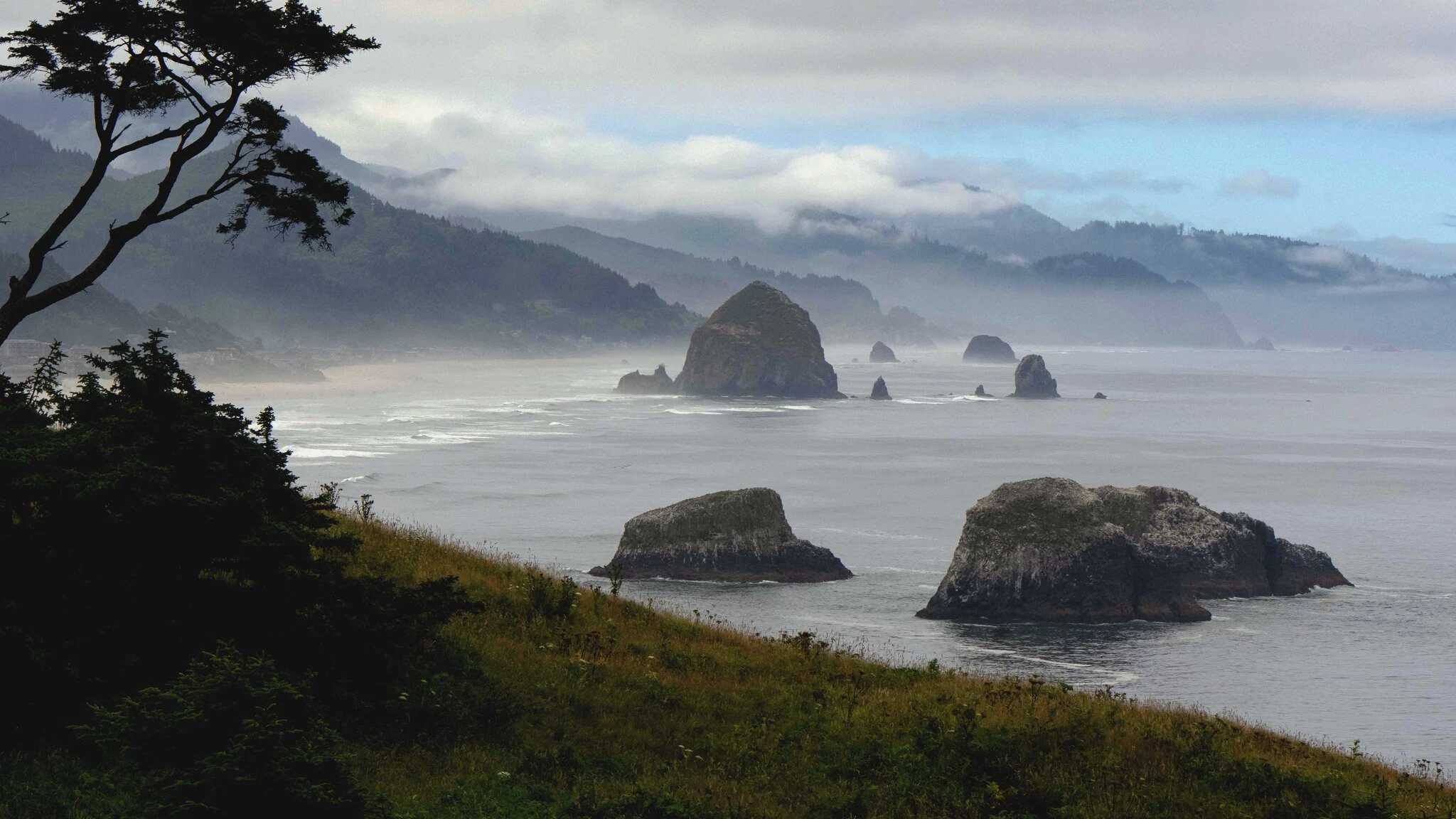
The most powerful stop is Ecola State Park. From the overlook, visitors can see Crescent Beach, offshore rock formations and Tillamook Rock Lighthouse. Built in the late nineteenth century on an exposed basalt outcrop, the lighthouse became notorious for the brutal conditions endured by its keepers.
It earned the nickname “Terrible Tilly.” The lighthouse is now closed to visitors, but its remoteness is part of its appeal. It stands in the ocean as a reminder of an age when navigation depended on people willing to live on bare rock in the path of storms.
Cannon Beach looks like a resort town but retains the restraint of a small coastal community. Galleries close early, restaurants do not stay open deep into the night, and the beach is almost always more important than the itinerary.
The town’s defining landmark is Haystack Rock, rising more than 70 metres from the sand. Formed roughly 17 million years ago, it has become one of the most recognizable sights on the coast, helped in part by its appearance in “The Goonies.”
The best time to approach is at low tide. As the water recedes, visitors can walk close to the base and see ochre sea stars, giant green anemones, mussels and dense colonies of barnacles. Their faint crackling creates the strange impression that the rock itself is breathing.
Exploring the intertidal zone requires discipline. Visitors should avoid stepping on marine life, removing creatures from the rocks or losing track of the tide. The water returns faster than expected, and some sections of beach can become traps.
From spring through late summer, the area around Haystack Rock also attracts black oystercatchers, pigeon guillemots and tufted puffins. The rock is therefore not simply a dramatic backdrop but a fragile ecosystem shaped by tides and by the behavior of the people who enter it.
Cannon Beach continues the maritime theme at the table. Crab, smoked salmon, scallops and local mushrooms offer a final meal that feels rooted in place rather than designed for tourists. Even dessert may take the form of an aquavit tasting, a reminder of the Scandinavian heritage carried by many early settlers.
Before returning to Portland, walk along Hemlock Street. Ceramic studios, small galleries and a candy shop offer a last glimpse of the town’s handmade culture. In the confectionery, saltwater taffy is still cut and wrapped in view of customers.
A car remains the best way to explore the coast. Portland is about two hours from Astoria, and the main stops are separated by manageable drives. Buses exist, but they remove the route’s greatest freedom: the ability to pull over at an unnamed beach when the fog suddenly lifts.
The tides impose their own schedule. They determine when Haystack Rock can be approached, when a cove is safe to enter and when tide pools can be explored. Here, the movement of the water matters more than museum opening hours or dinner reservations.
The weather also demands flexibility. A sunny forecast does not guarantee a clear day, and rain does not mean the trip has failed. On the contrary, cloud and mist give the forests, lighthouses and cliffs the atmosphere most travelers come to find.
The Oregon Coast makes little effort to be convenient. It is cold, windy and sometimes inhospitable. Visitors may get soaked, miss a viewpoint because of fog or reach a beach just as the tide begins to rise.
That unpredictability restores something travel often loses. The journey stops being a sequence of guaranteed experiences and becomes an encounter with a place that refuses to adjust itself to the visitor.
There is no need to hurry along Oregon’s northern coast. Two towns, a few forest trails, one shipwreck and a morning beside the Pacific are enough. The rest is supplied by fog, water and the sense that the world still moves more slowly here.