
























The Pentagon has opened early talks with Ford and General Motors about whether America’s auto industry can help the military obtain components, munitions-related parts, vehicles, and other hardware faster and at lower cost. The discussions are still preliminary and focused on parts and production capacity, not on complete weapons systems. But the meaning of the talks goes far beyond their current stage. The American war machine is running into a shortage not of ideas, but of scale.
The reason is straightforward. The war with Iran, combined with continued support for Ukraine, is draining stockpiles faster than the traditional defense sector can replenish them. This is no longer a matter of isolated delays or procurement bottlenecks. It is evidence that the existing model of military production struggles to function in conflicts where consumption is measured not over years, but in weeks.
That is why the Trump administration is not merely looking for new contractors. It is looking for a different manufacturing rhythm. For months, the White House has complained that the major defense primes build too slowly and charge too much, while the broader industrial base has lost the habit of thinking in volume. A long war does not require only exquisite systems. It also requires the ability to produce at speed, replenish at scale, and sustain multiple theaters at once.
As Daycom has argued before, the core American problem is not that the country has forgotten how to make weapons. It is that it has spent too long making them as highly specialized, low-volume, high-cost products. That model works well when the priority is technological prestige. It works far less well when the task is to refill empty stockpiles quickly and support a military burden spread across more than one conflict zone.
That is what makes the comparison with the “arsenal of democracy” both tempting and misleading. During World War II, Ford, GM, and other manufacturers did indeed retool for wartime output. But the success of that mobilization did not come from patriotism alone. It depended on the fact that military production was designed to fit existing factories, machinery, and mass-manufacturing skills. Industrial conversion worked because the state adapted military needs to civilian production realities, not because car plants were magically transformed by political will.
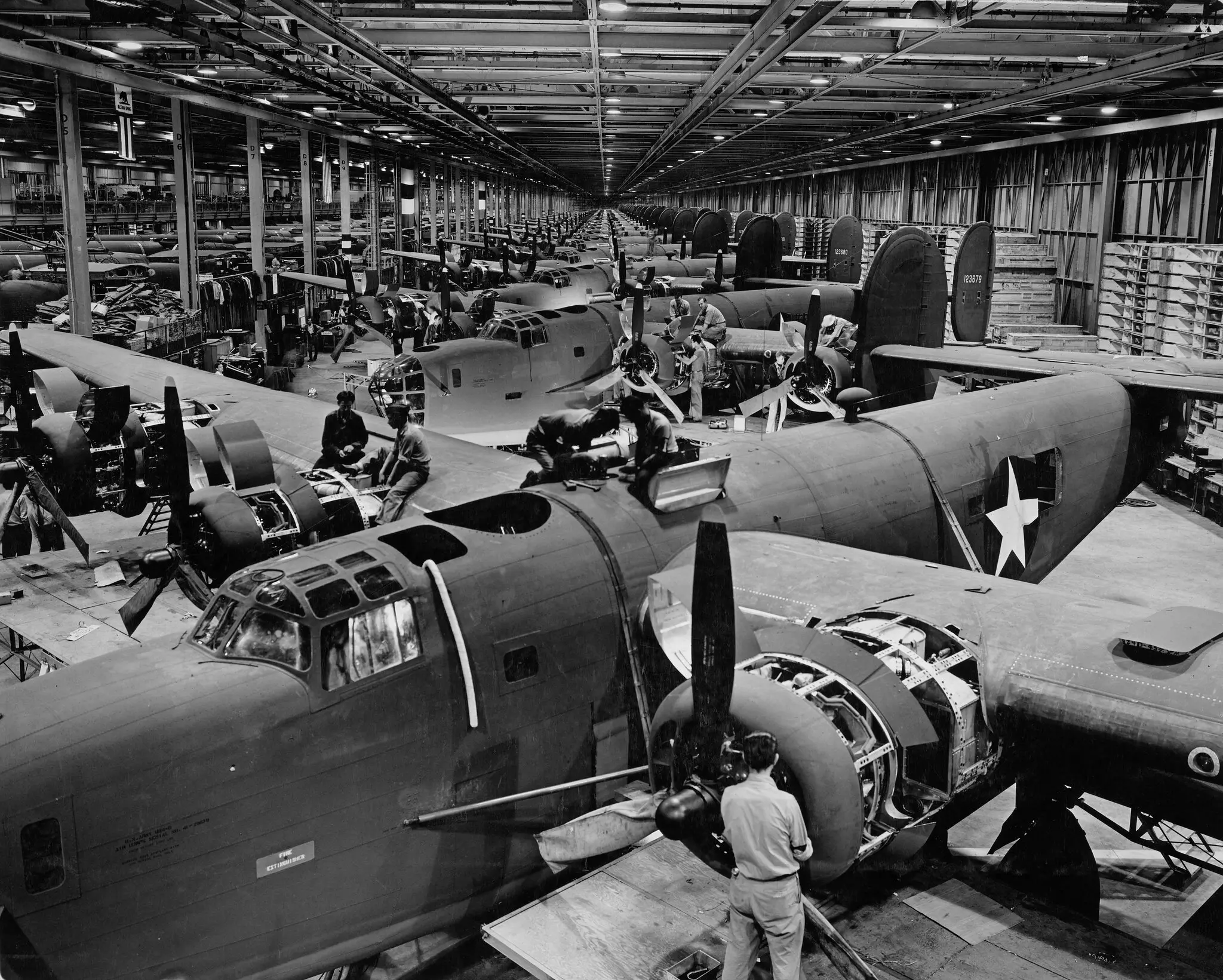 Завод «Віллоу-Ран», побудований компанією «Форд» у Мічигані, випустив тисячі військових літаків під час Другої світової війни — Архівні фотографії/Getty Images
The same question now returns in a more modern form. The issue is not simply whether Ford and GM can build something for the Pentagon. The deeper issue is whether the Pentagon can adjust its requirements to the logic of commercial manufacturing. If the military continues to demand highly customized, expensive, and difficult-to-scale solutions, then no partnership with civilian industry will produce the breakthrough Washington is hoping for. An auto plant cannot simply be declared part of the war machine. It has to be integrated into a new production philosophy.
In that sense, the turn toward Detroit is not an oddity. It is a forced act of rationalization. The automotive sector has exactly what the traditional defense world increasingly lacks: large-series production culture, cost-down engineering, disciplined supply chains, and the ability to produce high volumes of quality parts on tight schedules. For the Pentagon, that is not just an auxiliary advantage. It may be the clearest available answer to its own industrial inertia.
But this is also where the attractive narrative gives way to harder realities. Not every military component can be shifted onto commercial lines. Not every part can be replaced with an off-the-shelf equivalent. And many critical systems still depend on rare earths, advanced electronics, and fragile global supply chains that do not bend simply because Washington wants a faster wartime footing. Industrial urgency does not erase material dependence.
That is why these talks with Ford and GM should be read neither as symbolism nor as nostalgia. They are a sign that the United States is entering the industrial phase of modern war, where the decisive factor is not only the quality of a missile, but the speed with which a country can refill depleted arsenals. If this effort moves beyond conversation, its most important result may not be one contract or one component. It may be a new American formula for defense production — less elegant, perhaps, but far better suited to the brutal arithmetic of a long war.