

















The Strait of Hormuz has once again become a place where geopolitics moves faster than diplomacy. No sooner had there been a cautious signal of a partial reopening than Tehran effectively restored a regime of tight control. As a result, the world’s main energy corridor has entered a state that is already difficult to call open, yet still too early to call definitively closed. It is precisely this gray zone that now poses the greatest threat to the market.
Formally, both sides still leave room for political maneuver. In practice, however, Iran is directly linking freedom of passage through the strait to the lifting of the American blockade on ships departing Iranian ports. The United States, for its part, has shown no readiness to remove that pressure without a broader agreement. What emerges is a deadlock in which maritime navigation is no longer a technical matter of safety, but part of a bargaining process over power, prestige and the terms of ending the war.
Most important is the fact that Iran is no longer speaking the language of a quick compromise. Mohammad Bagher Ghalibaf has made it clear that a final agreement is still far away and that the military option has not been taken off the table. That means the current pause is not a transition toward stable peace. It is better understood as an interval between two phases of pressure, in which each side is trying to secure a more favorable position before it must once again decide whether diplomacy still functions or force will speak again.
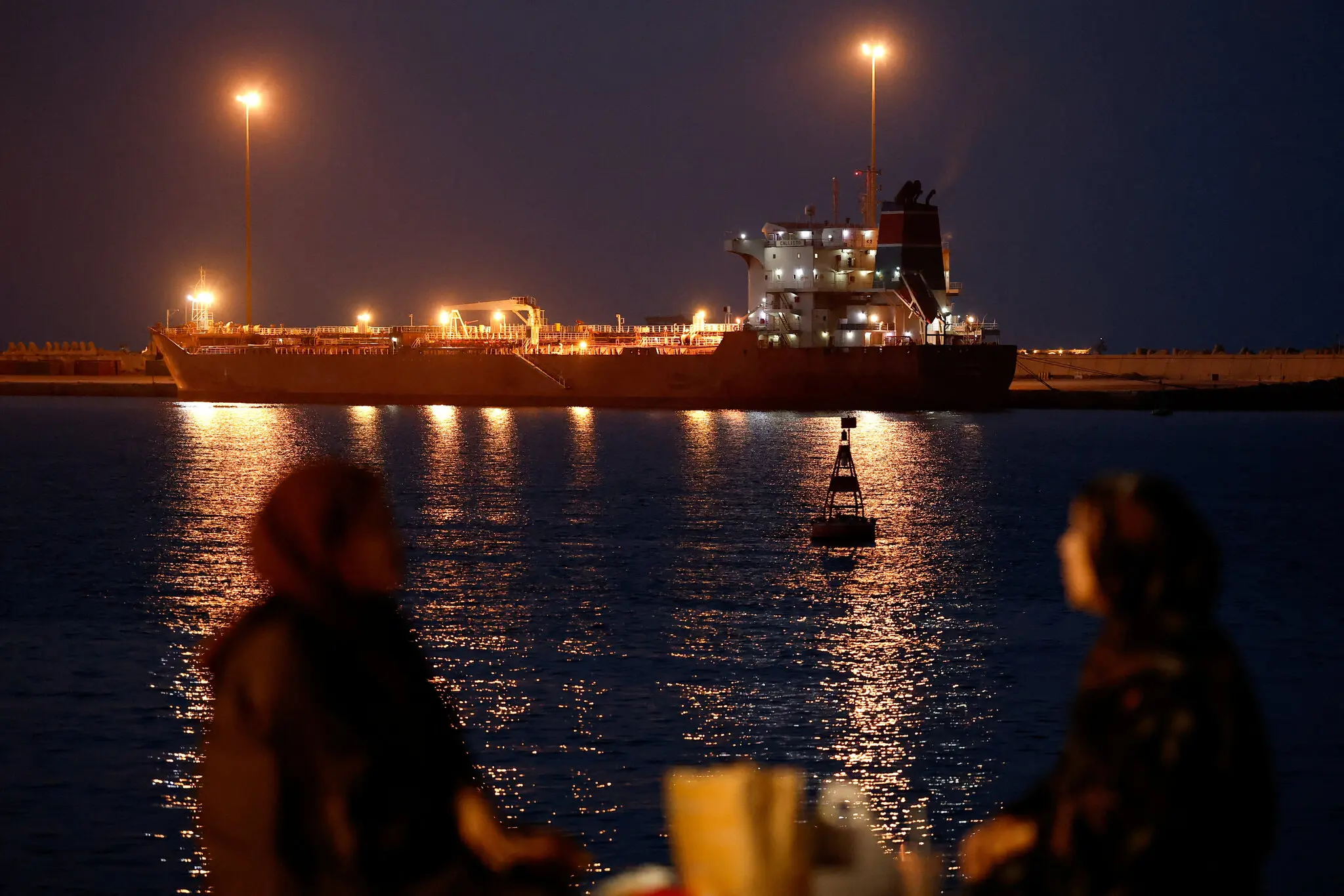
According to Daycom’s earlier analysis, the most dangerous maritime crises are born not at the moment of an officially declared closure, but at the moment when a route remains legally ambiguous while becoming operationally paralyzed. That is exactly what is now happening in the Strait of Hormuz. There is no universally recognized formal closure, yet the level of risk in the area remains critical, and commercial vessels are facing gunfire, unidentified projectiles, navigational disruption and the ever-present danger of miscalculation inside a war zone.
That is why the current state of the strait is best described as a de facto narrowing of navigational freedom rather than a classic full blockade in the strict legal sense. For insurers, shipowners and traders, the distinction is almost meaningless. If a captain knows that the corridor is technically open but that civilian ships have already come under fire, that there is a risk of encountering Iranian gunboats or being struck by an unknown projectile, he is not thinking in the language of international law. He is thinking in the language of crew survival.
That logic has already been confirmed by real incidents. India summoned the Iranian ambassador after a serious episode involving two Indian-flagged vessels. At the same time, maritime monitors reported that a tanker had come under fire, while other ships chose to turn back rather than pass through the strait. Taken together, this means the market is no longer reacting to official statements, but to the practice of risk itself. Once vessels begin altering course, a geopolitical crisis moves into the phase of direct economic consequences.
In that sense, Tehran’s strategy appears fairly clear. Iran is trying to convert what it sees as military gains into diplomatic capital by demonstrating that no agreement can be imposed through ultimatums. The strait is becoming for Tehran not only a line of defense, but an argument in negotiations. If the United States wants stable tanker passage, it must pay a political price. If Washington chooses to keep the blockade on Iranian ports in place, Tehran responds at the point where the pain is felt not only in America, but across the global energy market.
Yet this is also where the central paradox becomes visible. The more aggressively Iran uses the Strait of Hormuz as a coercive lever, the less trust any short-lived signal of reopening can inspire. For commercial shipping, what matters is not a one-off concession, but the stability of the rules. If passage is allowed today along an Iranian-designated route and restricted again tomorrow in response to the American blockade, no major carrier will build long-term logistics around such uncertainty. That is why brief diplomatic openings are not yet translating into the restoration of normal transit.
Equally revealing is what has not happened. As of Sunday, no new face-to-face talks between Washington and Tehran had been announced, and the previous round of contacts in Pakistan ended without an agreement. That is a critical sign: the political rhetoric of an imminent breakthrough is not supported by institutional movement. If there is not even a new format for direct talks, then claims of a final deal being within reach begin to look less like a description of reality and more like another instrument of pressure.
For the global market, this means something deeply unpleasant. The Strait of Hormuz remains the artery through which roughly one-fifth of global oil flows. In such a system, even without a total shutdown, a regime of unstable, dangerous and politically conditional passage is enough to drive up insurance costs, freight rates and broader anxiety across energy markets. The world economy reacts not only to an actual shortage of barrels, but to the very possibility that tomorrow such a shortage could become real.
That is why the current situation in the Strait of Hormuz is not merely a maritime crisis, nor simply a continuation of war by other means. It is a test of whether the United States and Iran are capable of moving beyond the logic of mutual humiliation. For now, the answer appears closer to no than yes. Washington insists on the blockade as an instrument of coercion. Tehran insists on control of the strait as an instrument of reply. And between them hangs the entire global market, increasingly unsure where the temporary pause ends and a new phase of major instability begins.
In the end, the central conclusion is harsh but accurate: the parties remain far not only from a final agreement, but from any shared understanding of what the path toward such an agreement should even look like. In this configuration, the Strait of Hormuz ceases to be merely a route. It becomes the clearest proof that diplomacy has not yet prevailed over force. And so long as that remains true, every tanker entering the strait will be more than a commercial vessel. It will be an indicator of how close the region stands to another rupture.