








The wetsuit had been made for a person with two legs. Volodymyr Kuzmenko had one. He took the loose fabric where his right leg should have been, tied it into a knot at his hip, hopped down the dock on his left foot, climbed into the boat and laughed as if what lay ahead was not a test, but a celebration.
He is 29, a veteran and former special forces sniper wounded in the war. Now he was about to try wakeboarding for the first time. Not as a symbolic exercise, and not as supervised therapy, but as a real adventure — with water, speed, falls and joy.
At the start of summer, Kyiv is again being drawn toward the Dnipro. After a brutal winter, people return to parks, beaches and sunlight. Beside that almost ordinary scene, another reality is visible: soldiers without arms or legs, prosthetics under shorts, crutches beside benches, bodies on which the war has left its open signature.
According to Daycom’s assessment, Ukraine is entering a new stage of the war not only at the front, but also at home: society is learning to live beside mass trauma that can no longer be hidden inside hospitals, rehabilitation centers or private apartments.
The number of people with amputations in Ukraine is already measured in at least the tens of thousands, and likely far more. This is not merely a medical statistic. It is a new human geography of the country: veterans without limbs in public transport, in lines, at work, in gyms, on beaches and inside families that must also learn how to live again.
Doctors often say amputation is not the hardest part of wartime medicine. The harder part begins afterward: pain, phantom sensations, the long wait for a prosthesis, learning to walk, fear of going outside, anger at a body that no longer matches the memory of itself.
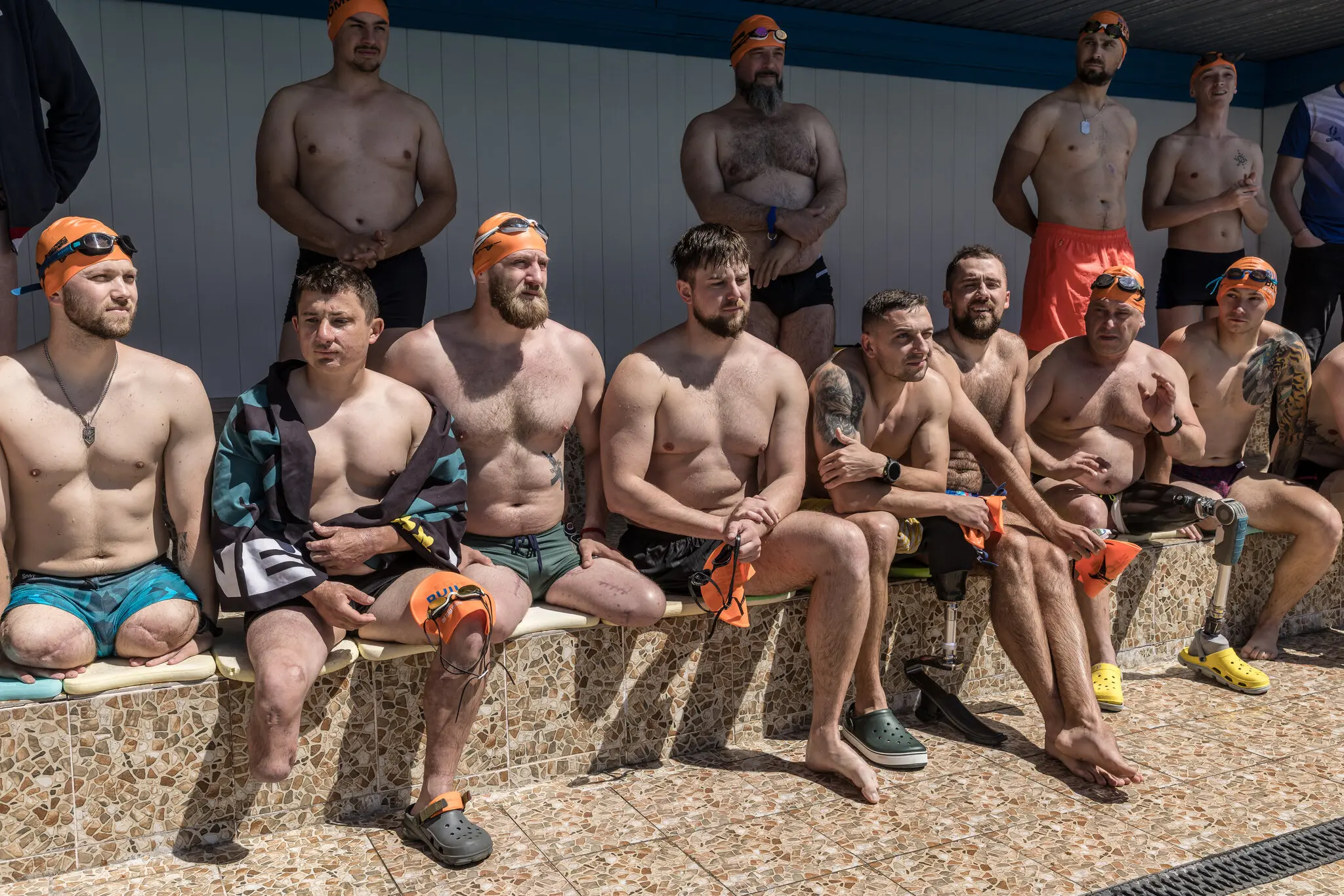 Підготовка до перегонів на змаганнях, організованих One Team Forces, групою, яка підтримує ветеранів, зосереджуючись на реабілітації та поверненні до активного життя — Оксана Парафенюк
Then comes another kind of pain — social pain. A soldier returns from the front to a world where most people do not know how to speak to him about loss, death, guilt and survival. Family members are grateful he is alive, but do not always understand who has come back. Friends offer support, but cannot share the experience of combat.
That is why sport has become more than rehabilitation for many Ukrainian veterans. It restores not only muscle and coordination, but the feeling of being present inside one’s own body. After war, that body can feel foreign. Sport forces it to become home again.
Soccer on crutches, swimming, CrossFit, golf, paddleboarding, salsa, motorcycles, running, hiking, Brazilian jiu-jitsu — all of this is creating a new language of Ukrainian veteran culture. Pity is not at its center. Attempt, failure, falling, laughter, repetition and the shared feeling of not being alone are.
In just a few weeks, Kuzmenko tried an adapted wakeboard, competed in a swim and trained in jiu-jitsu. Other amputee veterans were beside him. For them, this is not a contest with the person they once were. It is a test of new limits: what is possible now, with this body, in this life.
Most of these programs have emerged from below — through private donations, charities, veterans, trainers and volunteers. The state cannot keep pace with the scale of the trauma. Many initiatives are born where someone has already walked the road and does not want the next person to walk it alone.
One of those people is Artem Grot. Born in Belarus, he moved to Ukraine after 2014 and joined the military. In 2019, in the Luhansk region, he stepped on a mine and lost his left foot. Back then, many still saw the war as a limited conflict in the east, and a military amputation was a rarity rather than a mass phenomenon.
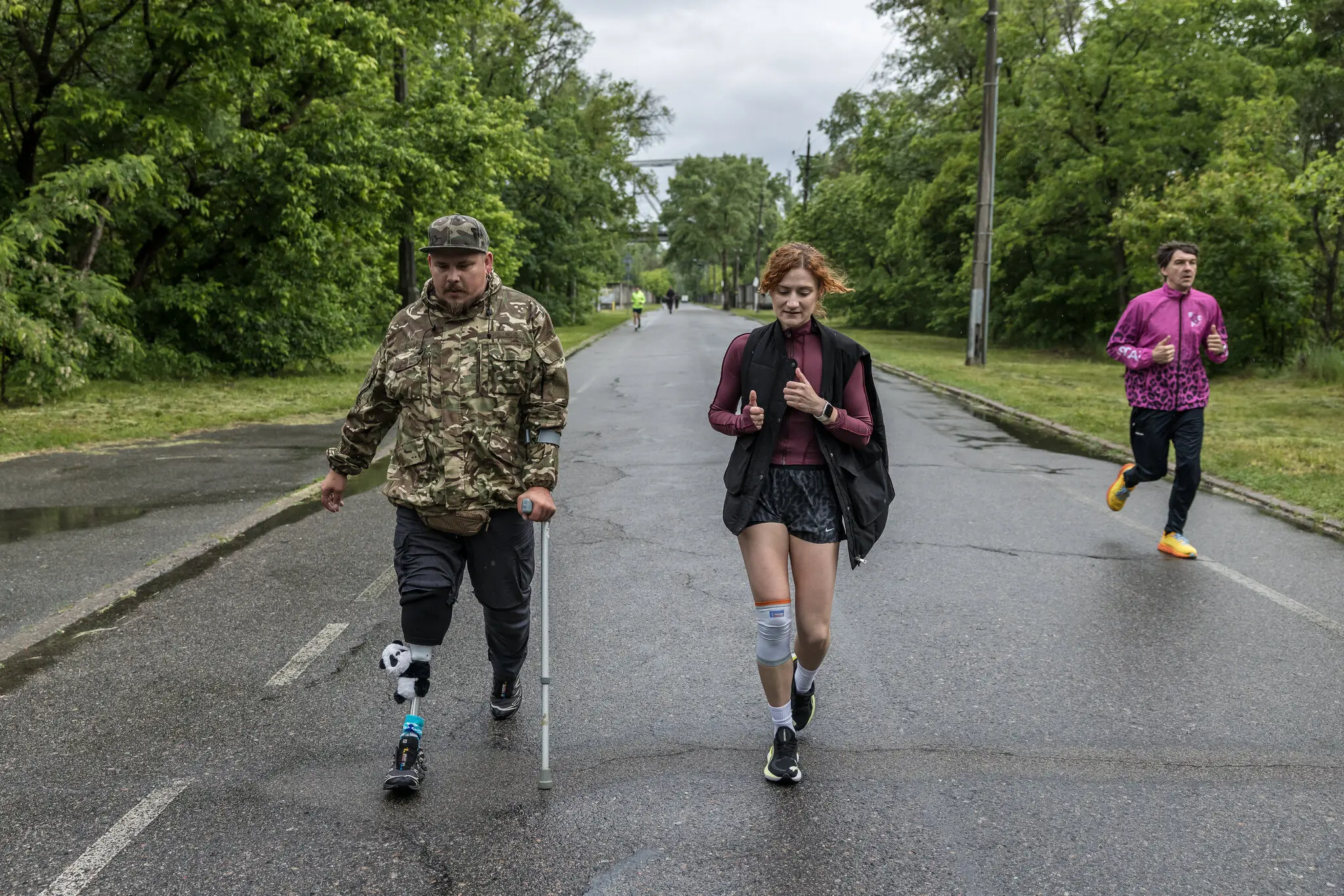 Олександр Яременко бере участь у благодійному забігу після втрати ноги в Сумській області минулого року — Оксана Парафенюк
Grot had to search for his own path to recovery. That was how he found Brazilian jiu-jitsu, a martial art that does not require long periods of standing. For an amputee, it opened not a space of weakness, but one of advantage. He learned to fight and eventually earned a black belt.
After the full-scale invasion, he wanted to pass that experience on. A space opened in Kyiv where veterans could train together. There is no need there to explain what the front means, what a prosthesis means, what fear of falling means, or what aggression remains in the body after combat. It is already understood.
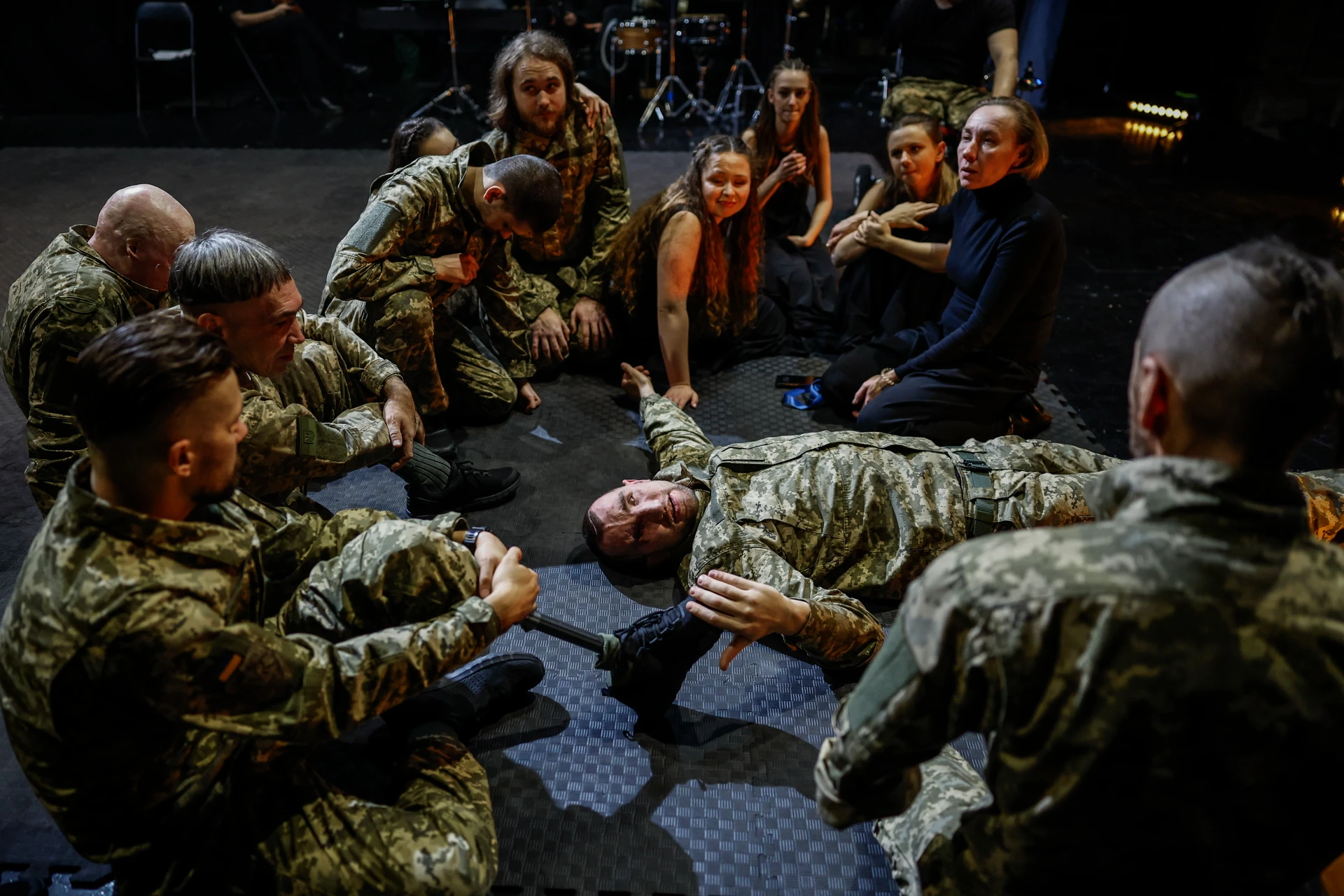
In such gyms, a particular kind of community forms. It is not like a classic support group where trauma is spoken through in a circle. Here, trauma is lived through movement. A man falls onto the mat, tries a technique, loses, gets angry, laughs, removes his prosthesis and suddenly realizes that the loss of a limb is not the loss of strength.
Trainers must work not only with the body, but with combat memory. Veterans often turn even practice into a fight. They are used to surviving, not losing a round. They must be taught that defeat on the mat is not danger, that control can be gentle, and that strength is not only a strike.
This is the delicate boundary of rehabilitation. It is not true to tell a person that he can do everything. But it is even more dangerous to convince him that he can no longer do almost anything. The work of the coach, doctor and community is to separate temporary inability from a real limit. Often, that limit is not in the body, but in the idea of the body.
Bohdan Ivasyshyn lost his left arm and an eye in a mine explosion. At the moment he was wounded, he thought he would die and accepted it. The hardest part turned out not to be survival itself, but the question of why he had survived. Jiu-jitsu and the people around him slowly brought color back to his days.
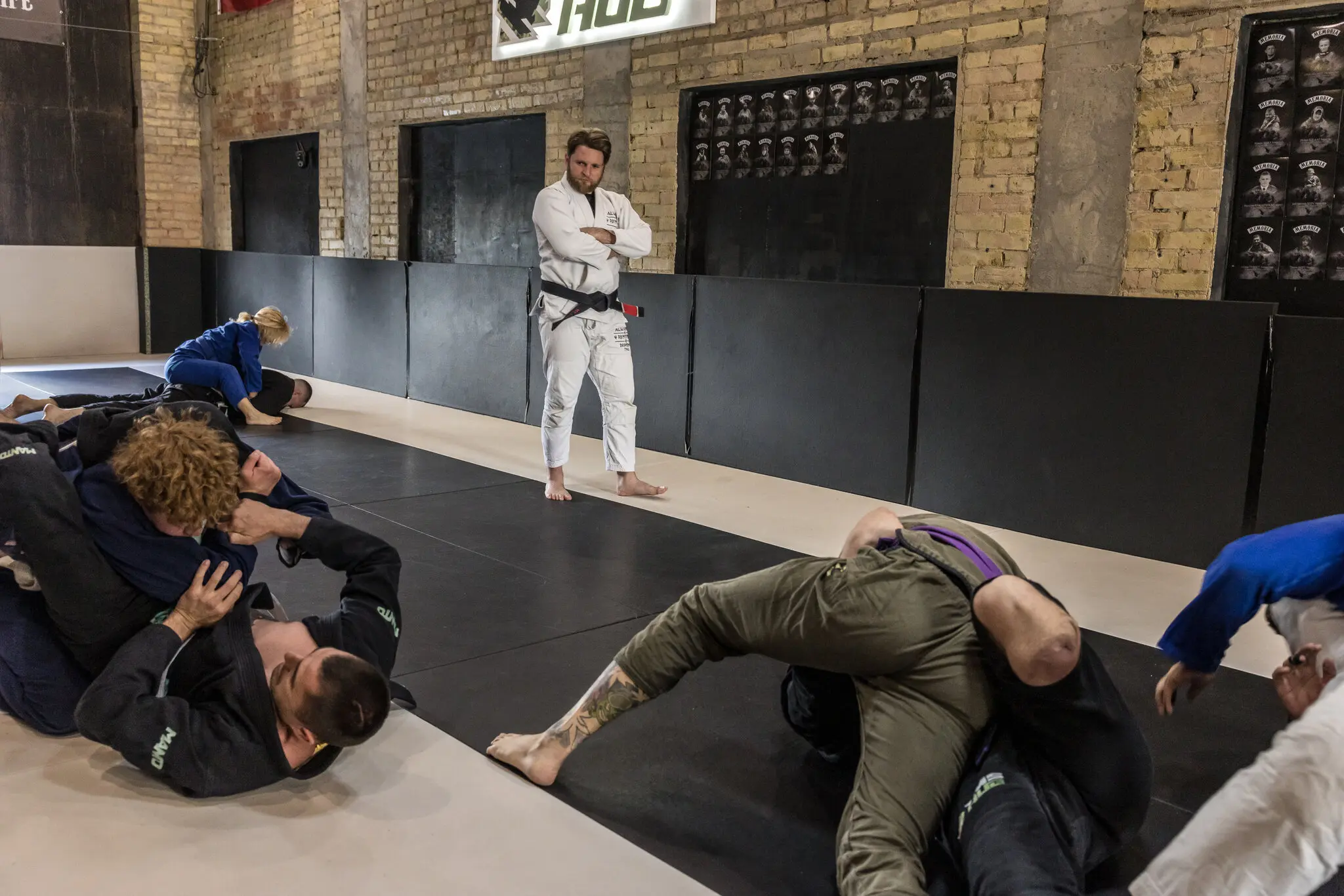 Олег Іскра, тренер з джиу-джитсу, тренує ветеранів у спортзалі TMS Hub у Києві — Оксана Парафенюк
When he first tried to stand on a wakeboard with one arm, he fell again and again. Then, once, he stayed upright. On the dock, other veterans cheered, many of them missing legs. It is difficult to describe that moment in the language of sport. It was not a victory over water. It was a victory over an inner sentence.
Oleksandr Yaremenko lost his leg last year. For a long time, he was frustrated by a heavy prosthesis that made it hard to move, run or train. When he received a lighter, more advanced one, he almost immediately joined a morning run, then went to jiu-jitsu training.
His words about the day he was wounded sound almost severe: the main thing was to get out alive; losing a limb was not the problem. There is no dismissal of pain in that. There is a different scale, one the front brings with it. After an encounter with death, a body without a leg can feel not like an ending, but like a form of survival.
Many veterans still want to return to service. Some hope to take on roles where a prosthesis will allow them to work, including in air defense. Others know that their former combat role is no longer possible. That is a separate loss: not only of a limb, but of a professional identity.
For Kuzmenko, special forces are most likely in the past. He lost his leg in Toretsk in 2024. For 13 hours he waited for evacuation, remembering every second: the bullet that pierced his pelvis, the crawl into an abandoned house, the tourniquets tightened around a leg that no longer obeyed, the message for help written in his own blood.
But the hardest part was something else. Roman, one of the men who saved him, was killed the next day after returning to the same area to collect ammunition. Losses like that are not closed by a prosthesis. They live beside every new step, every jump into water, every attempt at joy.
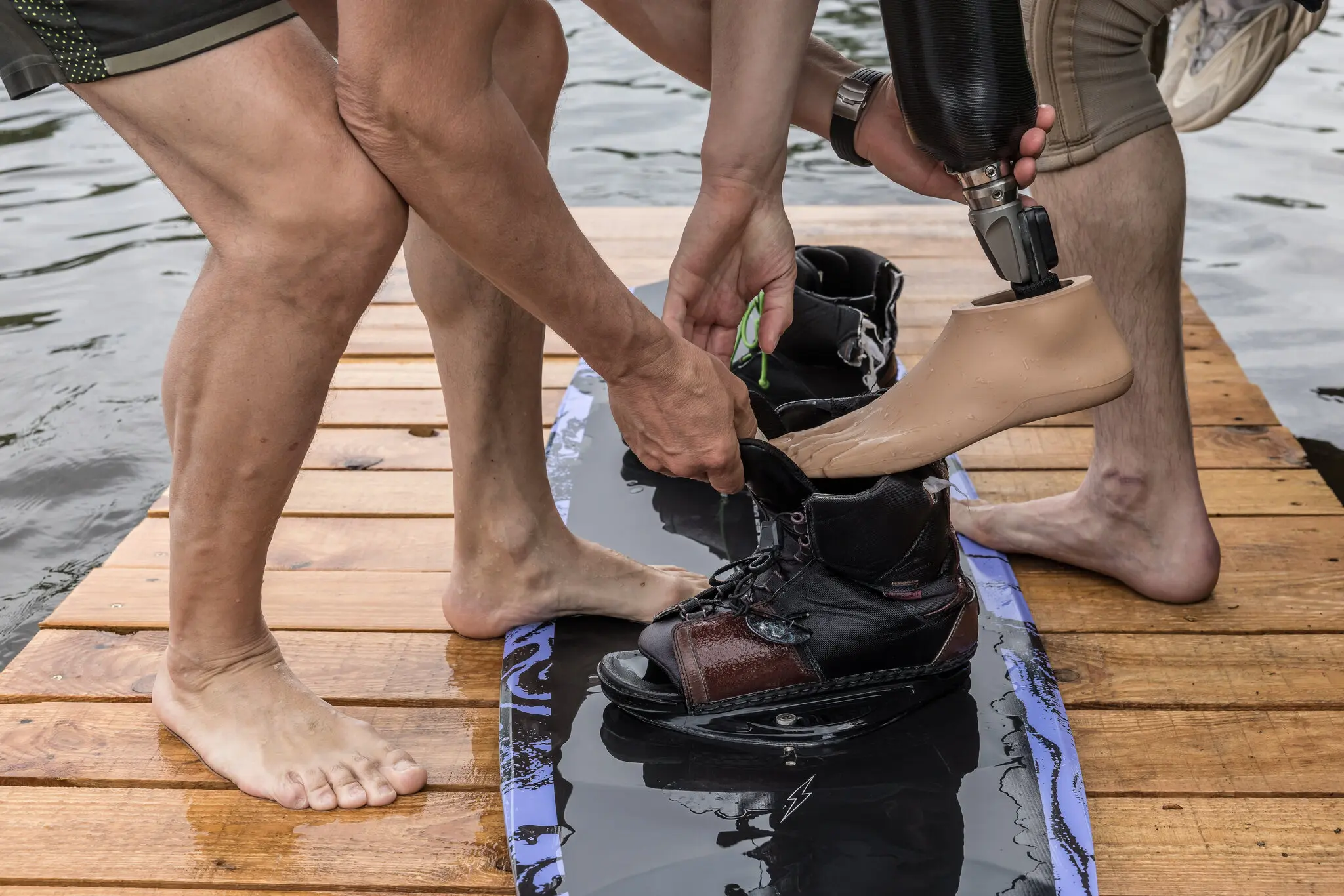 Нові ініціативи, більшість з яких фінансуються з приватних джерел за рахунок пожертвувань та грантів, об’єднують українських ветеранів через спорт — Оксана Парафенюк
When Kuzmenko stood on the wakeboard, he was not thinking about the amputation. He was thinking about Roman, who loved adventure. In that detail lies the complexity of Ukrainian rehabilitation. It does not erase the war. It allows a person to keep moving with the memory of those who did not return.
Ukraine now has to build not only a prosthetics system, but a society in which amputees are not treated as heroic exceptions or objects of sympathy. They need accessible streets, transport, work, sport, psychotherapy, proper medicine, long-term support programs and the right to be different: strong, angry, cheerful, exhausted, ambitious.
Veteran sport shows what this new normal can look like. It does not deny trauma or beautify war. It says: the body has changed, but life does not have to shrink to a hospital corridor. One can swim, fight, run, fall, dance, ride a motorcycle, balance on a board in the middle of the Dnipro.
These are not stories of miraculous healing. Amputation does not disappear, phantom pain does not become a metaphor, and war does not turn into a backdrop for an inspirational video. But in these trainings and shared outings there is something more important than optimism: a firm refusal to let trauma define the entire horizon of the future.
Ukraine will live for a long time among people who came back from war changed. The question is not whether society will learn to thank them. Gratitude is easy. The question is whether it will learn to create a space in which they can not only survive, but live.
On the water, when the boat pulls the board forward, the body has no time to explain to itself what it lacks. It searches for balance. And in that moment, a veteran with a knot tied into the empty part of his wetsuit becomes not an image of loss, but a person in motion. That is where something new begins.
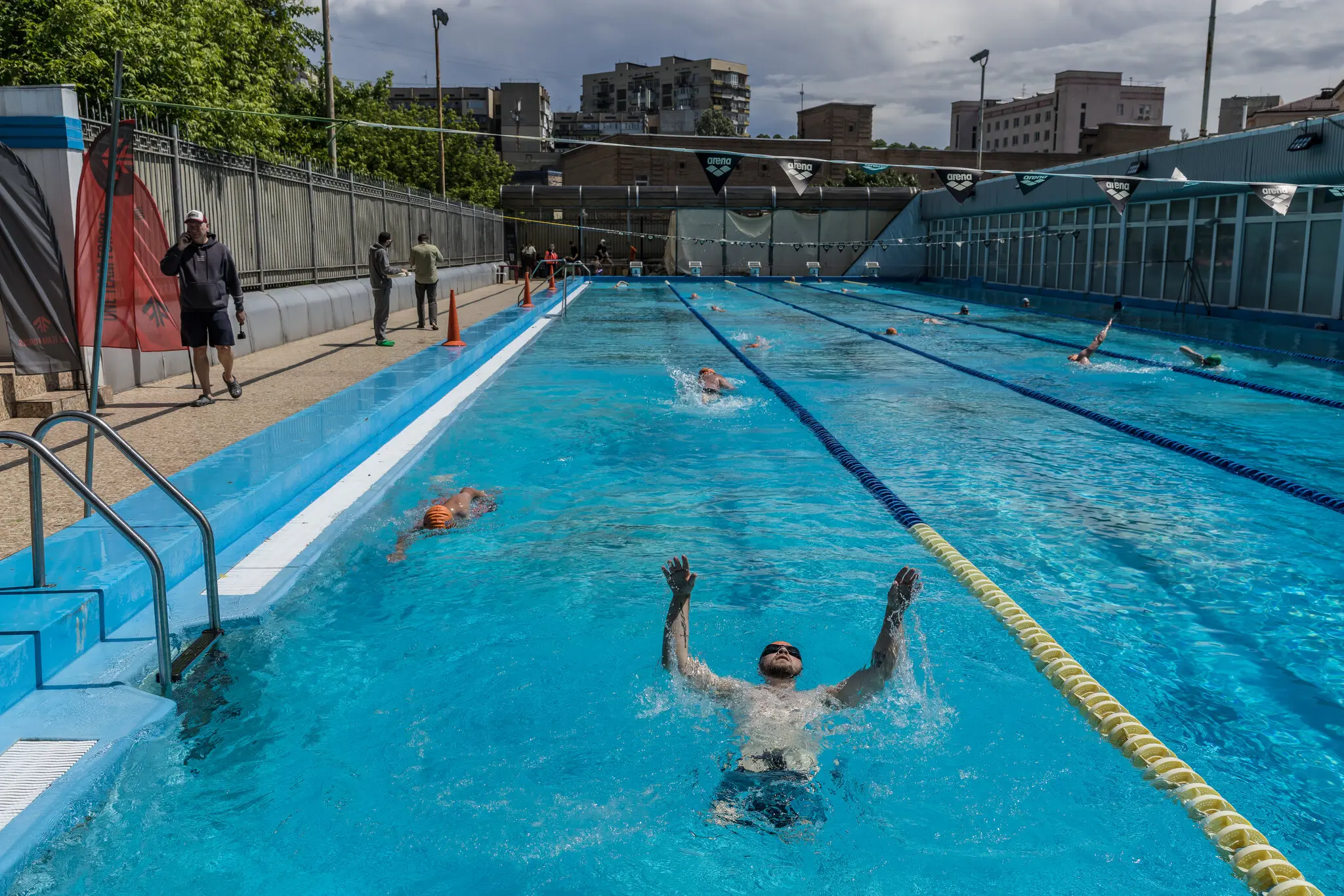 Ветерани в перегонах, організованих One Team Forces — Оксана Парафенюк