






















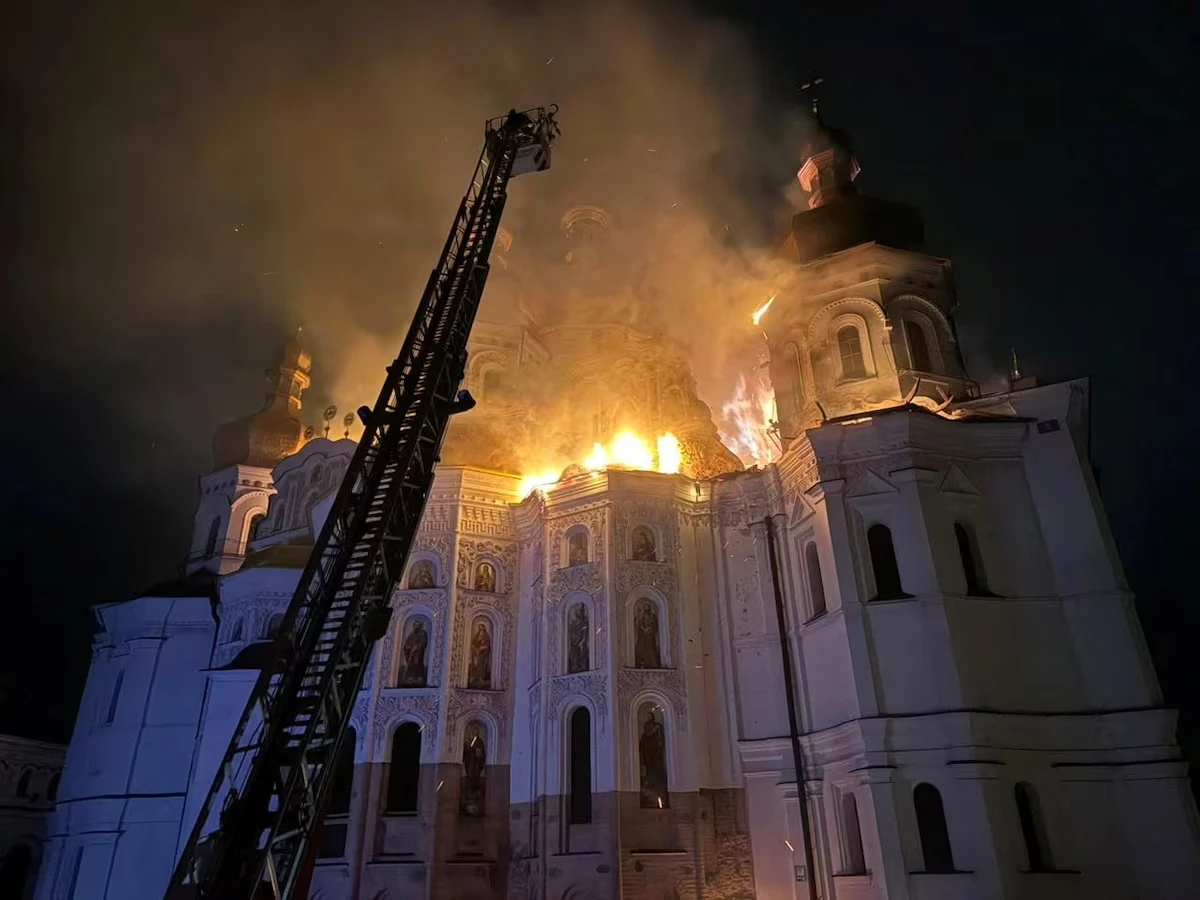
On the night of June 15, Kyiv again heard the war through explosions, air-defense fire and the anxious silence between strikes. But the defining image of the morning was not only a damaged residential building or black smoke above industrial sites. Above the Kyiv Pechersk Lavra, the roof of the Dormition Cathedral was burning.
This is one of the oldest and most sacred spaces of Eastern Christianity. Founded in the 11th century, the monastery complex has lived through empires, wars, destruction and reconstruction. Its caves hold the relics of saints, while its architecture preserves the memory of Kyiv as a spiritual center that cannot be reduced to a Russian historical myth.
The Russian attack on Kyiv killed at least five people in the capital and wounded dozens more. Across Ukraine that night, Russia launched 70 missiles of various types and 611 drones; Kyiv was the main target of the strike, with dozens of missiles aimed at the city. Nationwide, at least 11 people were killed and many more were injured.
For Daycom, this strike matters not only as another episode of Russian terror against the capital. It shows how the war is increasingly turning cultural heritage into a hostage of mass bombardment: even when Moscow speaks of “military targets,” the consequences fall on churches, museums, archives, film studios and residential neighborhoods.
The Dormition Cathedral did not collapse. The fire on the roof was extinguished, sacred and historical items were carried out of the church, and the main structures endured. But the word “endured” should not be comforting. After hundreds of drones and dozens of missiles, every surviving site in Kyiv is not evidence of Russian restraint, but the result of Ukrainian air defense, emergency workers and chance.
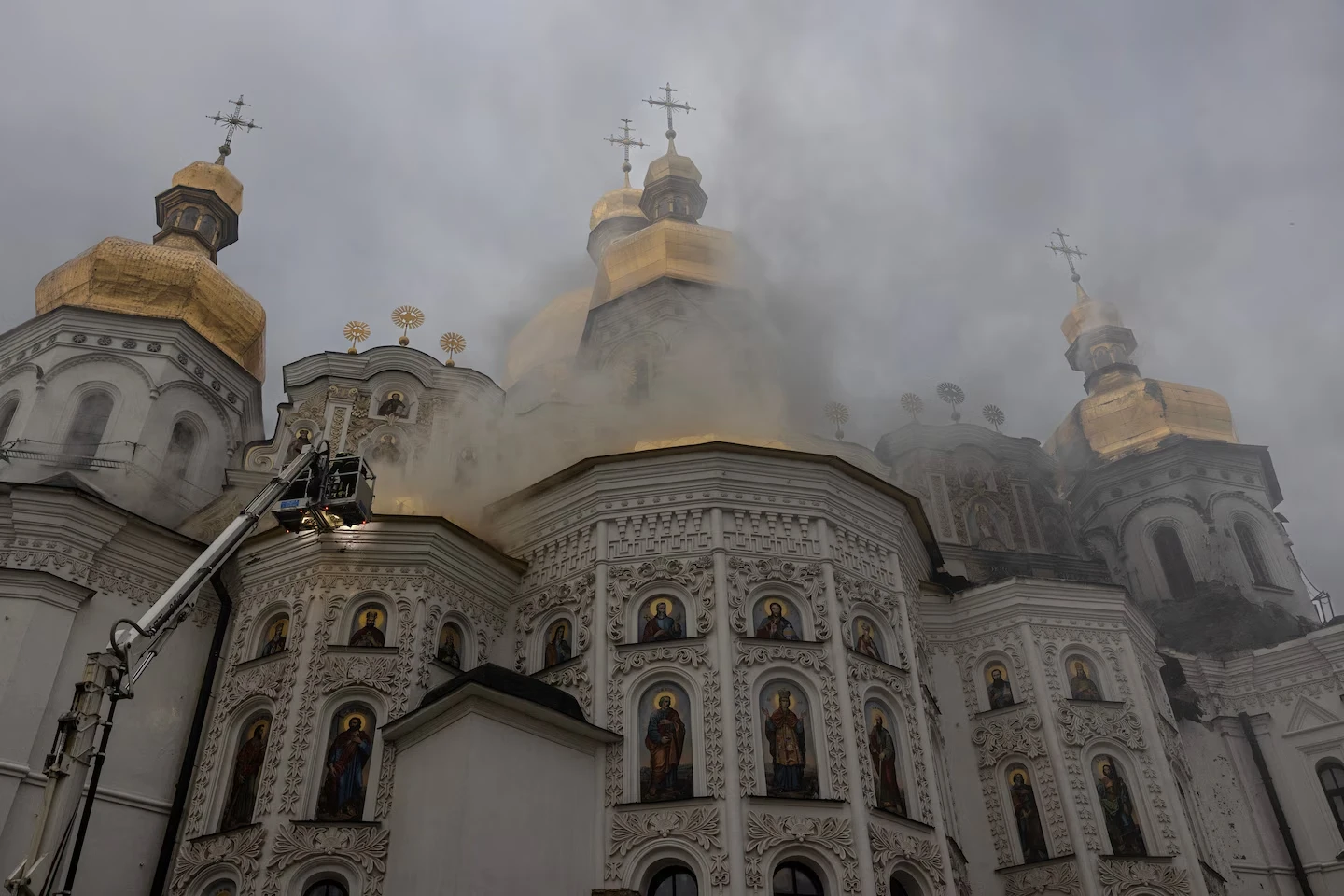
The damage to the Lavra reaches far beyond architecture. This is a strike against a world heritage site, one of the region’s central spiritual landmarks and a place where Ukrainian state memory is inseparable from religious tradition. When such a cathedral burns, it is not only the roof that burns. The symbolic line between war against territory and war against history burns with it.
Moscow claimed it had targeted facilities connected to Ukraine’s military industry and tried to explain the damage to the Lavra as the result of a Ukrainian Patriot missile. Kyiv reported fragments of a Russian Geran-2 drone, Moscow’s version of the Iranian Shahed, found at the site. In this dispute, the type of debris matters, but so does the logic of the attack itself: when a state launches hundreds of weapons at a capital, it cannot separate its responsibility from the consequences in the city.
The mass strike did not hit the Lavra alone. Mystetskyi Arsenal in Kyiv, the Oleksandr Dovzhenko National Film Studio, the Kharkiv Art Museum and the House of Organ and Chamber Music in Dnipro were also damaged. A significant part of the Dovzhenko studio’s costume collection was lost — the kind of heritage that is not always visible on tourist postcards, but without which culture loses part of its material memory.
This is where the scale of the attack moves beyond military statistics. A missile or drone may not be aimed at a specific painting, icon or theatrical costume. But Russia’s tactic of massive waves creates a space in which cultural losses become regular, predictable and politically meaningful. They are no longer incidental background to the war, but one of its recurring results.
By mid-June, international cultural institutions had already recorded hundreds of damaged cultural sites in Ukraine: religious buildings, historic structures, museums, monuments, libraries, archaeological sites and archives. The June 15 attack fell onto that long map of destruction, making it denser still.
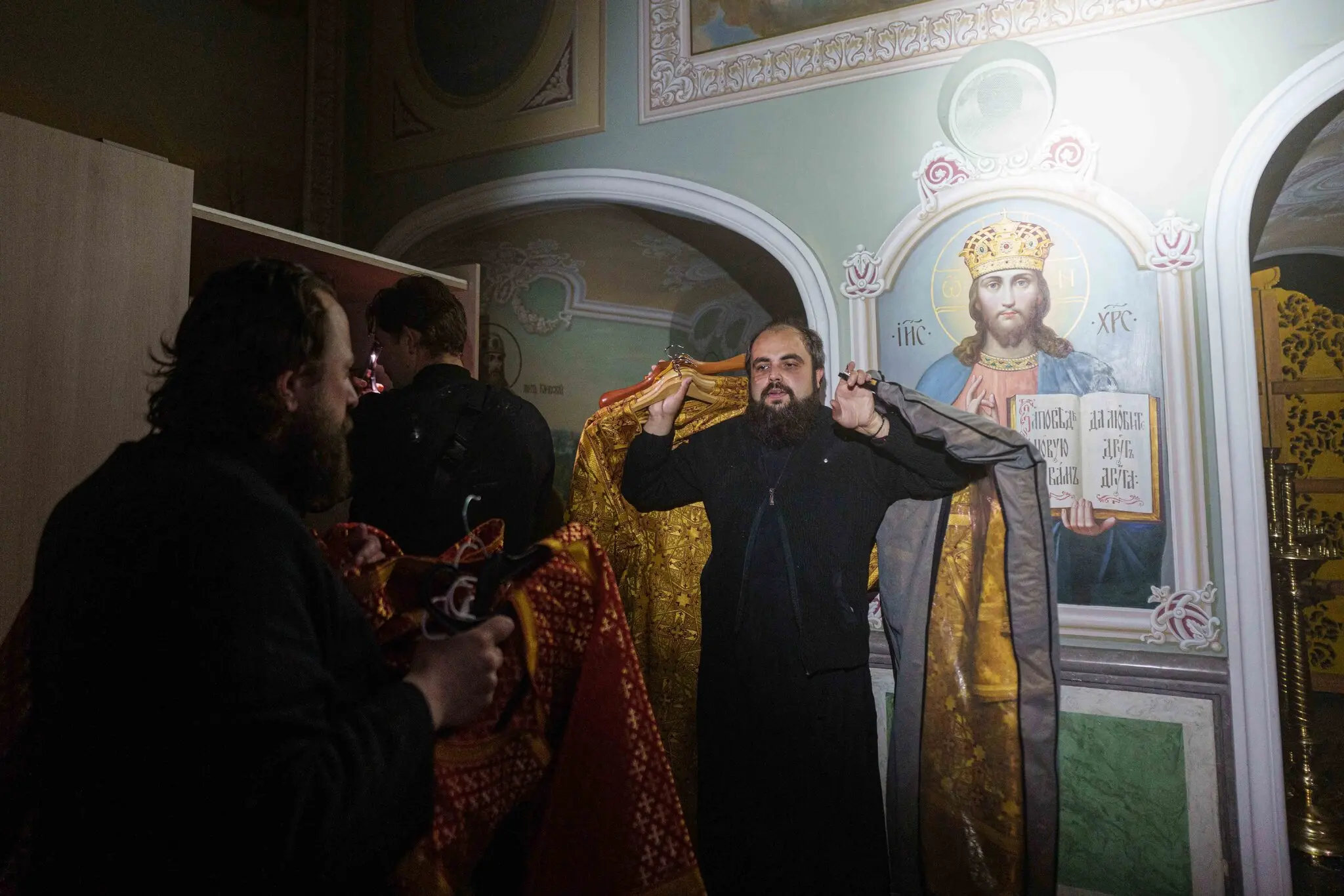 Вивезення речей із собору в понеділок. «Я почув гучний вибух, а потім почали падати уламки», – сказав один священик про пошкодження будівлі — Євген Малолєтка
The strike on the Lavra came on the day Ukraine opened the first cluster of negotiations on joining the European Union — the “Fundamentals” block, covering the rule of law, fundamental rights, democratic institutions, public administration and economic criteria. The coincidence is almost too eloquent: while Ukraine was legally moving toward Europe, Russia was trying to strike at its historical center.
Ukraine’s European choice after 2014 has never been only about markets, standards and institutions. It has also been about leaving a space in which Moscow claims the right to explain Ukraine’s past and determine Ukraine’s future. That is why the attack on the Lavra, on the day of a new stage of European integration, reads as a strike along two axes at once: memory and political direction.
In this sense, the Dormition Cathedral became more than a damaged sacred site. It became a place where two histories collided. One is Ukrainian: restoring its own agency, church independence, European course and right to heritage. The other is Russian: treating that heritage as its own while it can control it, and as foreign once control is lost.
The particular cynicism of the strike lies in Russia’s rhetoric about “protecting Orthodoxy.” A state that claims to guard tradition is waging a war in which one of the region’s most important Orthodox cathedrals burns. After that, words about spiritual unity sound not like an argument, but like a smoke screen over damaged roofs.
For Ukraine, the issue now is not only restoration. The roof will be repaired, specialists will assess the condition of the paintings, old objects will be returned, and damaged cultural sites will be entered into new inspection records. But restoration without stronger air defense will remain only a pause between attacks. Cultural heritage cannot survive through museum workers and rescuers alone if there is no sufficient missile shield above it.
That is why Ukraine’s appeal to its allies after the attack has a very concrete meaning: more Patriot systems, more interceptor missiles, more tools against ballistic threats and tougher pressure on Russia’s military-industrial complex. In this war, air defense has become not only a military issue. It is a condition for preserving churches, museums, schools, hospitals and residential districts.
Russia may continue to speak of “precision strikes” and “military facilities.” But the night of June 15 left another reality behind: people were killed in Kyiv, a cathedral burned in the Lavra, cultural institutions were damaged in several cities, and Ukraine’s European trajectory received another bloody counterpoint.
The Dormition Cathedral has already lived through destruction and reconstruction. Its damaged roof is not the end of the story. But it is a warning. Ukrainian culture has endured not because no one tried to destroy it, but because each time there were people who rescued, rebuilt and defended it. Now that task belongs not only to restorers. It belongs to the army, diplomacy, allies and all of Europe, if Europe truly regards Ukrainian heritage as part of its own.