






















An unidentified drone entered Latvian airspace on the morning of August 14, prompting NATO to scramble four fighter jets — two Italian Eurofighters from Lithuania and two Turkish F-16s from Estonia. One of the Eurofighters identified the aircraft and shot it down.
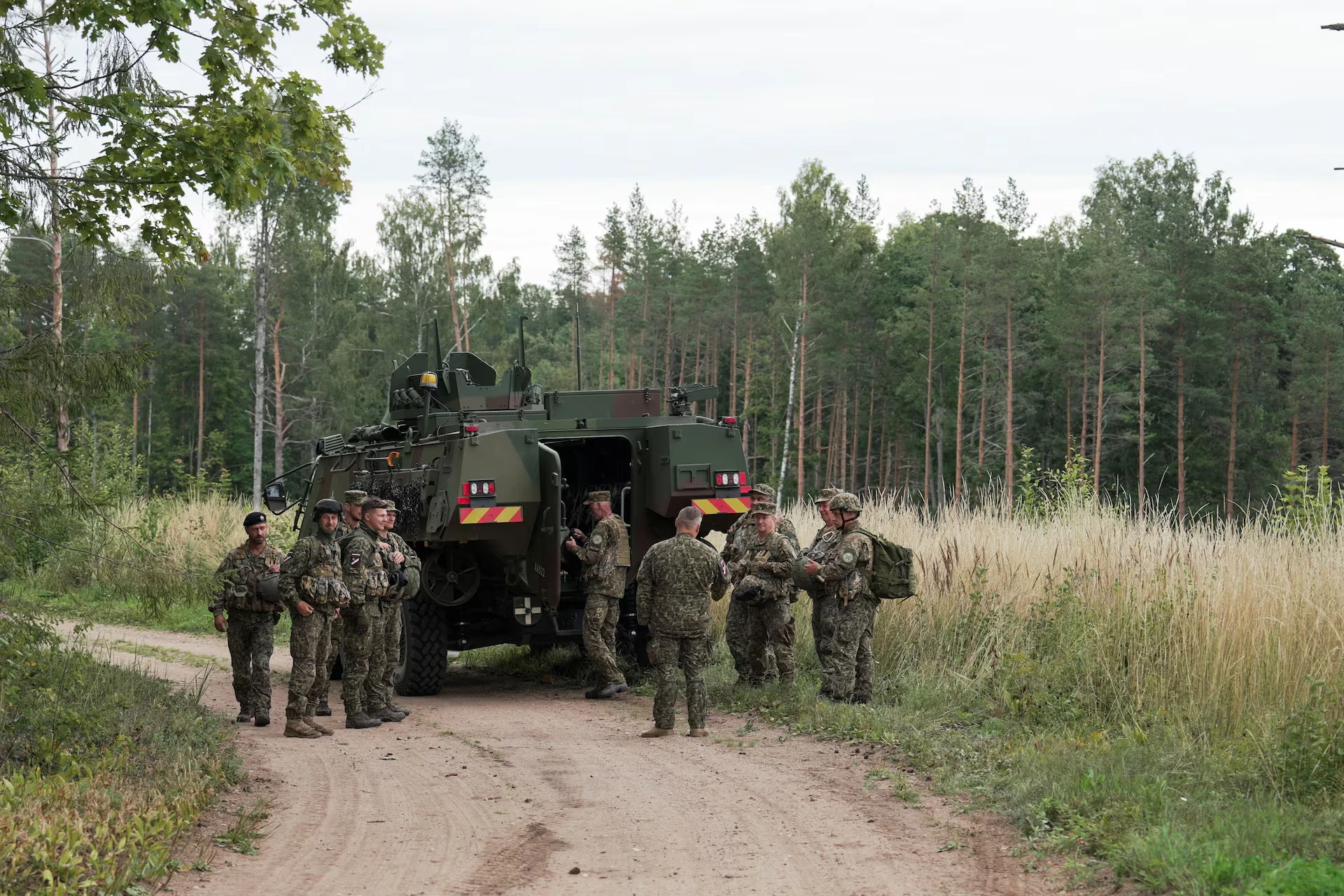
Latvian forces then began searching for wreckage in heavily wooded terrain near Rugaji, roughly 35 kilometers from the Russian border. The drone’s origin remained unknown as the search began, with forests, bogs and sparse settlements complicating efforts to locate the debris.
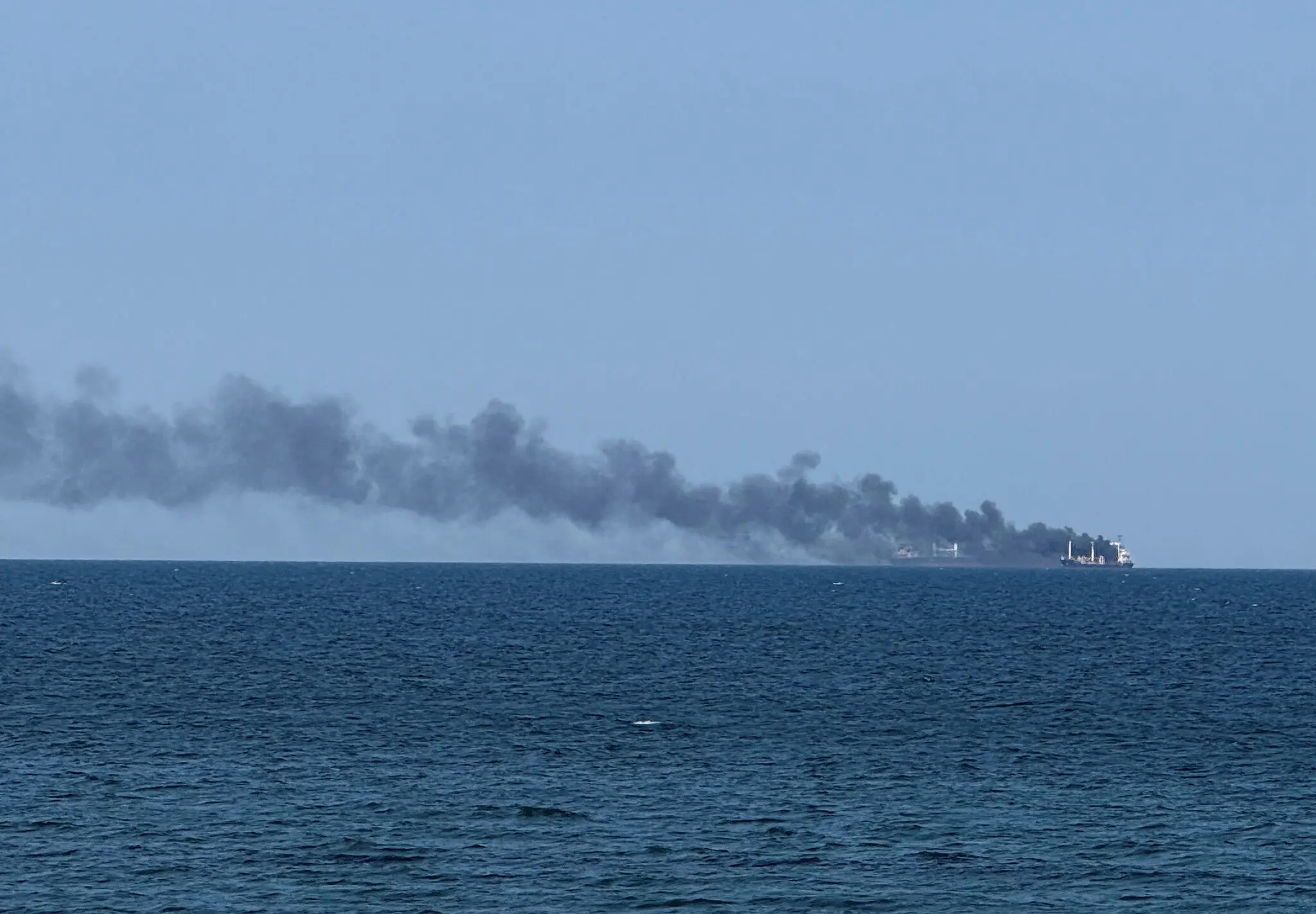
The incident followed a night of Ukrainian drone attacks on Russian ports near St. Petersburg. Russian authorities said 15 Ukrainian drones had been intercepted during those strikes. That provides an obvious context, but not enough evidence to conclude that the aircraft destroyed over Latvia was Ukrainian.
As Daycom has previously assessed, this uncertainty is becoming the central security problem for NATO. The alliance increasingly has to respond not to a conventional incursion with a clearly identified attacker and intent, but to individual drones whose routes may have changed because of navigation failure, electronic warfare or loss of control.
For NATO’s military system, that creates a new kind of burden. An air border must be defended whether an aircraft is deliberately attacking, accidentally drifting off course or becoming collateral damage from the electronic warfare surrounding a neighboring conflict.
Those decisions often have to be made within minutes.
If an unidentified drone is moving through the airspace of a NATO member, commanders cannot wait for investigators to determine its origin several hours later. The immediate task is to remove the possible threat. Attribution comes afterward, from the wreckage.
That is essentially what happened in Latvia.
The significance of the episode lies less in one drone than in the pattern surrounding it. Baltic states have already experienced several cases this year in which unmanned aircraft crossed out of the Russian-Ukrainian battlespace and entered NATO airspace.
In May, a Romanian F-16 shot down a Ukrainian drone over Estonia. In June, a French Rafale intercepted another over Latvia. The August incident extends a sequence that is beginning to look less exceptional.
Latvian military officials have linked some of these deviations to intense Russian electronic warfare. Jamming or spoofing satellite-navigation signals can alter the trajectory of a drone even when its original mission never involved NATO territory.
That creates one of the most uncomfortable paradoxes of the drone war.
Russian electronic warfare is intended to defend Russian targets against Ukrainian drones. But if interference causes those drones to lose navigation and drift toward Estonia, Latvia or Finland, part of the consequence of Russia’s defensive activity is effectively exported into NATO territory.
A defensive action inside the Russian military system can therefore generate a separate security risk for neighboring alliance members.
Geography makes the Baltic region particularly exposed. Latvia and Estonia share borders with Russia, while St. Petersburg and northwestern Russia are relatively close to NATO territory. The mass use of long-range drones increasingly turns this space into a single interconnected air environment.
Finland temporarily restricted parts of aviation and maritime traffic in the eastern Gulf of Finland on the same day as the Latvian incident. That precaution illustrates how spillover risk now extends beyond one interception.
Every major drone attack near St. Petersburg, the Leningrad region or northwestern Russia can potentially create secondary consequences for several NATO countries.
For the alliance, this means keeping fighters on alert even when there is no evidence of an intentional attack on NATO territory.
The Baltic Air Policing mission was originally designed primarily to protect member states that do not maintain sufficient fighter forces of their own. Its role is now evolving from monitoring Russian military aircraft toward responding to relatively small unmanned systems.
That creates an immediate economic asymmetry.
A small drone may cost tens or hundreds of thousands of dollars. Launching a Eurofighter or F-16, sustaining the sortie, firing an air-to-air missile and then organizing a ground search for debris can cost far more.
If these incidents become routine, NATO will need a layered counter-drone network rather than relying predominantly on fighter aircraft.
That means more sensors, mobile air-defense units, electronic-warfare systems, cheaper interceptors and short-range defenses. Otherwise, the eastern flank risks using extremely expensive assets against comparatively inexpensive targets.
Cost, however, is only one part of the problem.
The other is the risk of misjudgment.
An unidentified drone heading toward a power station, port or military facility may simply have drifted off course. But a military commander cannot safely assume that.
That is one reason Russia’s NATO neighbors are strengthening protection around dams, power plants, gas infrastructure and other critical facilities.
At the same time, concern is growing over possible false-flag scenarios.
Baltic governments have to consider the possibility that a drone resembling a Ukrainian system could be used in an attack on NATO territory while leaving enough ambiguity for the attacker to deny responsibility.
That possibility changes the requirements of any investigation.
Identifying the model of the drone is not enough. Investigators need to reconstruct its route, examine navigation equipment and components, determine whether it carried explosives and study software modifications before reaching conclusions about where it came from and who controlled it.
The wreckage near Rugaji therefore matters far beyond the monetary value of the aircraft itself.
It may reveal where the drone originated, what systems it used, whether it carried a warhead and whether its flight into Latvian airspace was consistent with an accidental deviation.
Until that analysis is complete, categorical claims about its origin would be premature.
Caution matters because a NATO member has shot down an unidentified aerial target inside its own airspace. A mistaken attribution could transform a technical security incident into a diplomatic confrontation.
Each such episode also carries political consequences for both Kyiv and Moscow.
Ukraine has a strong interest in ensuring that its long-range campaign does not create persistent security risks for allied states. Russia, meanwhile, faces increasing scrutiny over the scale of electronic warfare activity conducted close to NATO borders.
The spillover of the war into the Baltic region is therefore emerging as a distinct dimension of the conflict.
It does not mean Russia and NATO are at war. But the number of moments in which weapons systems from the Russian-Ukrainian conflict physically approach or enter alliance territory is increasing.
The more drones that are airborne at the same time, the greater the probability of navigation failure, lost control, mistaken identification or an unintended border crossing.
And every such crossing activates military procedures inside NATO.
This is a fundamentally different reality for the alliance’s eastern flank.
For years, the familiar scenario involved Russian military aircraft approaching NATO airspace or operating aggressively over the Baltic Sea. Those aircraft had recognizable radar signatures, crews, transponders or identifiable military profiles.
Now the recurring threat may be a small unmanned aircraft whose nationality and intent are unclear at the moment it appears on a radar screen.
That ambiguity makes the new environment harder to manage politically.
A crewed fighter belongs to an identifiable chain of command. A drone can be autonomous, inexpensive, damaged, jammed or already incapable of responding to whoever launched it.
But if it crashes into an apartment building, power plant or gas facility, the consequences are no less real.
The Italian Eurofighter over Latvia was therefore more than a routine air-policing episode.
It demonstrated how rapidly the drone war is forcing NATO to rethink what border defense actually means.
The task is no longer simply to deter a deliberate attack.
It is also to defend against navigation failures, electronic-warfare spillover, uncontrolled aircraft, accidental incursions and possible provocations — often with only minutes available to decide which category an approaching target belongs to.
The Baltic states are increasingly becoming a laboratory for that new security architecture.
The longer the war continues, and the more numerous long-range drones become, the thinner the practical boundary will be between the Ukrainian battlefield and NATO airspace.
That is why the most consequential detail of the incident near Rugaji may ultimately be not whose drone ended up in a Latvian forest.
It is that NATO is already being forced to shoot such aircraft down inside its own skies — and to prepare for the possibility that incidents like this will stop being exceptional.