

















Brussels is moving before the handover is complete: Peter Magyar’s victory could unlock money for Ukraine, save part of Hungary’s frozen EU funds, and test whether post-Orban change can move faster than old inertia.
Brussels is heading to Budapest not for a ceremonial greeting of an election winner, but for an emergency review of the wreckage Viktor Orban leaves behind. Hungary’s transition has abruptly become about far more than domestic politics. It now touches money for Kyiv, frozen billions for Budapest, and the European Union’s ability to pull one of its most difficult member states back into the common line.
Peter Magyar’s victory did not simply end sixteen years of Orban’s rule. It opened a narrow and awkward window in which the political mandate has already changed, while formal power has not yet fully passed. That is why the European Commission is moving early. In a normal transfer of power, a few weeks would be routine. In today’s Hungary, every day has strategic weight.
The outgoing government still holds the instruments of obstruction, but it no longer owns the future. The incoming leadership has won a powerful mandate for rupture, yet does not fully control the machinery of state. That leaves Hungary in a suspended moment: the old order is politically defeated, but not institutionally gone.
According to Daycom’s earlier analysis, the real price of the post-Orban transition will not be measured by the drama of election night, but by whether the new leadership can turn electoral momentum into administrative change quickly enough. In Hungary’s case, that means two things at once: ending the politics of systematic blackmail inside the EU and proving to Brussels that Budapest is prepared to dismantle the state model that led to the freezing of funds in the first place.
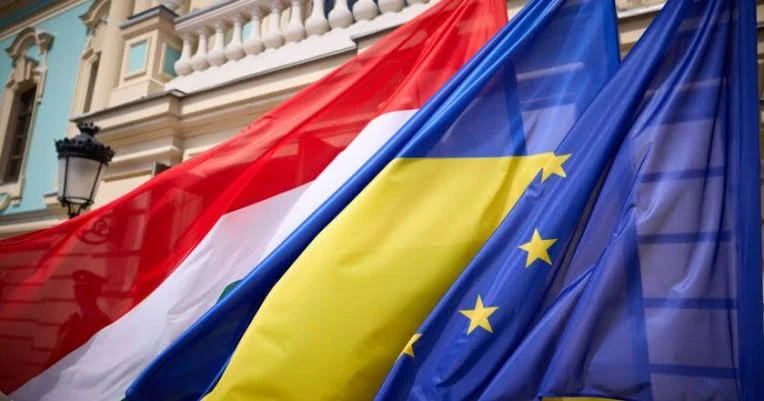
The most urgent fault line is Ukraine. For months, Orban turned Hungary’s veto power into a strategic weapon against European decisions, including critical financing for Kyiv. That made Budapest one of the most exhausting internal fronts inside the Union. For Ukraine, Magyar’s victory matters not as a symbolic defeat for a pro-Russian camp, but as a practical chance to remove one of the most expensive bottlenecks in Europe’s wartime decision-making.
The issue is not abstract diplomacy. It is wartime liquidity. If Hungary’s veto is lifted, Brussels can move quickly on financing that Kyiv needs as it enters yet another year of full-scale war. So long as Orban’s government remains formally in place, however, that decision still hangs in the air. The transition, in other words, is not just a Hungarian matter. It is already a test of how fast Europe can convert political change into usable policy.
But the second great issue is money for Hungary itself. Magyar is not arriving only with promises of a new tone toward Brussels. He is inheriting a country whose access to major EU funds has been frozen over rule-of-law concerns, corruption, conflicts of interest and the degradation of institutional checks during the Orban era. Brussels is not signaling that those funds will simply be released as a reward for defeating the old government. The message is colder and simpler: reforms first, money after.
That makes Magyar’s position harder than the scale of his victory might suggest. He comes in with a strong mandate and high public expectations, but he also inherits a stagnating economy and an extremely tight deadline to salvage at least part of the suspended European money before portions of it effectively expire. The European Union is offering an opening, not relief. Trust can be restored only if the new government moves fast enough to make its break with the past look real.
This is where the deeper political burden begins. Hungary does not merely need a new cabinet. It needs a new operating logic. Over the past decade and a half, the state adapted itself to personalized power, patronage networks, selective loyalty and institutional dependence. That is much harder to undo than it is to denounce on the campaign trail. A government can defeat Orban electorally and still fail to dismantle Orbanism as a governing method.
That is why corruption and state capture matter so much in what comes next. Brussels will not be watching only the names of ministers. It will be watching whether the new government is prepared to confront the entrenched web of favoritism and political clientelism that helped sustain the old order. Anti-corruption rhetoric is no longer a moral flourish. It is the entry price for any serious financial and political reset with the EU.
Magyar has already indicated that Hungary should no longer stand in the way of support for Ukraine. But that does not mean his government will become unconditionally Kyiv-first or effortlessly aligned with Brussels on every strategic file. The more likely model is different: not Orban’s systematic sabotage, but a pragmatic effort to return Hungary to the European mainstream while preserving room for its own political autonomy. For Brussels, that alone would be a major relief. But it would still fall short of a full resolution.
The difficulty is that the outgoing prime minister, even in defeat, can still shape the atmosphere of the transition. A leader who built his power through confrontation is unlikely to spend his final days softening the path for those replacing him. Delay, obstruction and last-minute rigidity are not incidental here. They are the last political uses of a vanishing authority. That is why this period between election and handover matters so much.
For the European Union, Hungary now becomes a test case in institutional speed. Can the bloc do more than wait for an inconvenient leader to fall? Can it move quickly enough to help turn a national political rupture into a workable European reset? That is why the visit to Budapest is not a gesture of welcome. It is an audit of readiness. Brussels wants to know whether Magyar can translate a political earthquake into a governing program before the opportunity starts to narrow.
In that sense, the end of the Orban era is not the final act of a long drama. It is the beginning of a much harder one. Hungary must now learn how to function without permanent conflict with its own союз, while the EU must decide how much trust it is willing to extend before proof is complete. Ukraine needs movement. Budapest needs money. Brussels needs credibility. All three clocks are running at once.
That is the real meaning of this moment. Hungary is not simply changing governments. It is entering a compressed struggle over whether the fall of Orban becomes a real turn toward European normalcy or merely a loud pause between two versions of the same crisis. The answer will shape not only Hungary’s recovery, but also Ukraine’s financing and the EU’s ability to close one of its most draining internal battles of the past decade.